

 by Jordan Rein/photos by the author
Change was in the air on a crystal-clear September day in 2020 as I set out on what I knew would be my “final” Wisconsin & Southern chase while living in Madison, Wis. The moment felt bittersweet. After eight years at the University of Wisconsin–Madison earning both a B.S. and a Ph.D. in engineering, I was ready for the next chapter — yet reluctant to leave behind the place, and the railroad, that had framed so much of that journey. When I first arrived in Madison in August 2012, I was equal parts excited and anxious about what lay ahead. The years that followed brought opportunity, stress, challenge, and ultimately, growth. Through it all, WSOR was there, threading its way past campus and into my daily routine.
As I reflected that September afternoon, it struck me that the railroad had been evolving, too. Shortly after I arrived, Watco Companies assumed full control of WSOR, ushering in its own period of uncertainty and transition. Over the next eight years, the railroad adapted, overcame obstacles, and gradually found its footing. What I did not yet realize, as I chased trains that day, was that even more significant changes were just ahead — changes that would reshape the look and feel of Wisconsin & Southern for the decade to come.

ABOVE: The 14-story Engineering Research Building overlooks the University of Wisconsin campus as Madison–Boscobel Train T007 heads west on May 5, 2016. Madison sits on an isthmus between Lake Mendota (left) and Lake Monona (right), with the state capitol centered on the skyline.
A Hard Road to Success
Change is nothing new for WSOR. The railroad itself emerged from the sweeping upheaval that reshaped the industry in the decades leading up to the 1970s. Years of heavy regulation and declining traffic left many carriers in a fragile financial situation. When a stagnant economy, high inflation, and rising energy and labor costs compounded those pressures, several were pushed past the breaking point. For The Milwaukee Road, that moment arrived on December 19, 1977, when it entered its third and final bankruptcy.
In an attempt to return to solvency, the trustees planned to trim the railroad down to a core system, shedding hundreds of miles of low-volume branch lines; almost 600 of those miles were in the state of Wisconsin alone. This plan alarmed business groups and local and state governments, as large areas would lose their only rail connection, possibly crippling local industry.
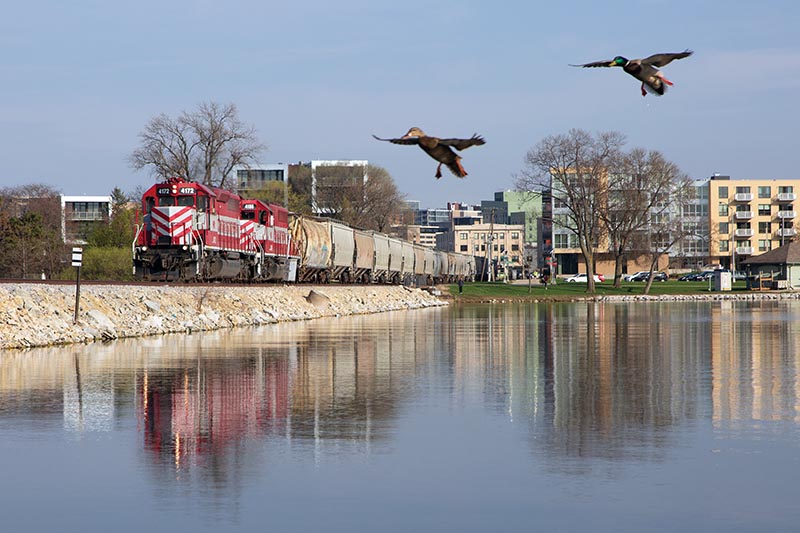
ABOVE: A pair of mallards splash down on Lake Monona as a Chicago-bound grain train enters Madison from the Prairie Subdivision on April 25, 2019. The WSOR goose logo nods to nearby Horicon Marsh, where the railroad began operations on July 1, 1980.
In response to this crisis, the state legislature passed the Rail Preservation Act and several additional statutes in 1977. These new laws allowed the Wisconsin Department of Transportation (WisDOT) to acquire rail property, the state to issue grants for rail improvements, and for the formation of Rail Transit Commissions (RTC). These commissions could be created by local governments to maintain and operate the railways, providing communities agency to preserve rail lines they deemed important.
In early 1980, the East Wisconsin Counties Rail Consortium (EWCRC) was created to administer a cluster of branch lines fanning out of Horicon toward Milwaukee, Oshkosh, and Cambria. By April 1980, EWCRC contracted with an outside company to operate the railroad. And on July 1, 1980, the newly formed Wisconsin & Southern began operations based in Horicon.

ABOVE: Train T003 rolls east at track speed on newly installed welded rail, passing St. Theresa Catholic Church in Eagle on May 21, 2023. GP-type locomotives from the Northern Division often handle weekend T003/T004 assignments when they are not needed at Horicon.
During its first decade, WSOR showed growth opportunities with improved service and infrastructure. However, economic challenges of the early 1980s and a financially constrained parent company prevented the railroad from fully realizing this growth. That changed in 1988 when Milwaukee area entrepreneur Bill Gardner purchased WSOR outright.
Gardner, who already owned a railcar repair business, recognized that more capital was needed to achieve growth. He began heavily investing in the railroad with increased marketing, motive power, and freight cars. By 1992, WSOR had quadrupled carloads. Within a little more than a decade, the branch lines out of Horicon went from the brink of abandonment to blossoming into a young, yet successful operation.
The same success could not be said for all RTCs in the state. Many state-owned or subsidized lines went defunct. On the brink of extinction was a cluster of lines fanning out of Janesville and Madison administered by several independent RTCs. For the first half of the 1980s, these lines saw a revolving door of operators that failed to stay solvent.
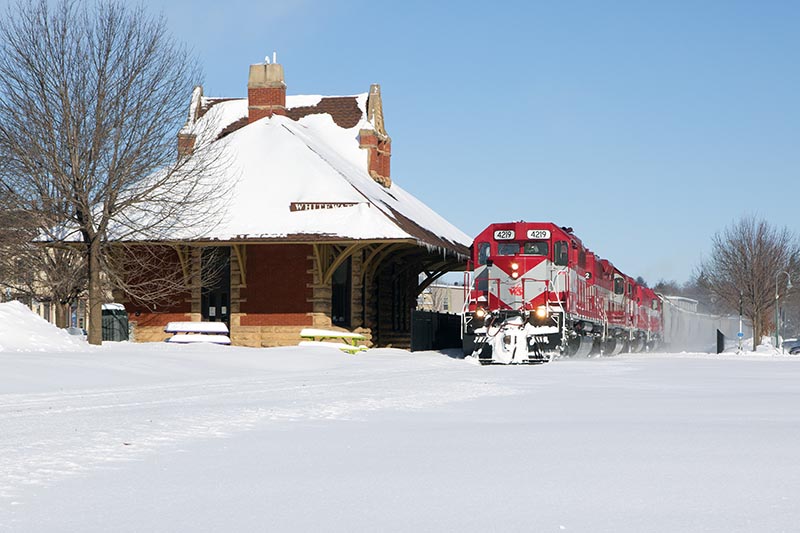
ABOVE: Train T004 passes Whitewater depot on January 29, 2019. WAMX 4219, an ex-CP SD40 delivered in Watco’s black and yellow scheme, was later repainted into the railroad’s newer “V” paint design.
The next operator stepped through the door on January 31, 1985, when Wisconsin & Calumet (WICT, nicknamed “the Wicket” by railfans) began operations over a core segment of the southern Wisconsin RTC lines. WICT took a slower approach to growth, reopening lines when customers could guarantee enough carloads to support operations. Over time, WICT carefully expanded, and by 1989, most of the southern Wisconsin RTC routes were reopened.
Gardner saw another opportunity for growth in August 1992 and purchased WICT. The original WSOR became the “Northern Division” while WICT became the “Southern Division.” Now, several independent RTCs were coordinated by a single operator with a strong footing. While there were growing pains with the WICT purchase, the new addition provided an incredibly valuable link to Chicago that would be a major catalyst for WSOR’s growth.
Throughout the 1990s and into the 2000s, WSOR continued to grow, increasing carloads and acquiring new lines around Madison and Milwaukee. By 2010, WSOR was 30 years old and had grown into a successful regional railroad. Through the action and support of Wisconsin’s local and state governments, along with private investment having a long-term vision of growth, meager carload-generating branch lines on the brink of abandonment were revitalized to become important links in the local economy…
