

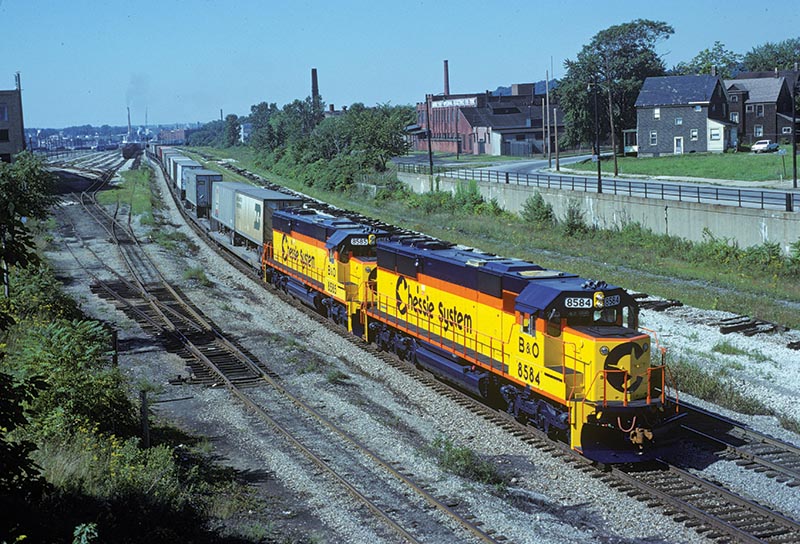
 by David P. Ori/photos as noted
Being an ardent Baltimore & Ohio fan growing up during the 1970s, I had always dreamed of riding one of Chessie System’s hottest trains. I became a fan of the railroad in 1971 when I first visited B&O’s Cleveland Subdivision in my hometown of Parma, Ohio. There, I would witness the passage of the daily road freight, Cleveland 294, from Willard; the CL (Cleveland–Lester) Local; and occasional empty and loaded coal trains operating between Cleveland and Holloway, Ohio. At night, I would hear Cleveland 297 as it made its way out of the Cuyahoga River Valley en route to Willard. Before long, I got to know the crews operating those trains and got occasional cab rides, along with my good friend Terry Chicwak.
When I began driving in the mid-1970s, with my 1970 Oldsmobile Cutlass S, I was able to broaden my railfan horizons and visited hotspots like Sterling, Ohio, and B&O’s hub at Willard, Ohio. At Sterling, my friends and I would spend several hours with the tower operator and gain knowledge about main line operations. Sterling is where the former B&O Baltimore–Chicago main line crossed the former Erie Lackawanna Jersey City, N.J.–Chicago main at grade.

ABOVE: Road Foreman of Engines Ray Shields prepares to board the Baltimore–Chicago Trailer Train at New Castle Junction, Pa., on December 2, 1982. —David P. Ori
Train activity was heavy prior to the formation of Conrail in April 1976. By 1978, Conrail diverted through trains off the former EL main line onto other former Penn Central routes. During the daylight hours, such named trains as the Baltimorean, Chicago-Philadelphia Trailer Train (aka “Jet”), Chicagoan, Pittsburgher, and Shore Line 49 would roll by the classic two-story tower. I would listen to the operator “OS” (noting the passage of a train “on-sheet”) the trains past Sterling with the Akron Main Line Dispatcher and listen to the operators along the Akron Division at such places as RX at Willard, GN at Greenwich, HN Tower at Newton Falls, Ohio, and OA Tower at New Castle Junction, Pa., for train mark-ups.
After acquiring a Pentax K-1000 SLR camera upon high school graduation in 1978, I started to hone my photography skills and began recording the Ohio rail scene on slide film. With camera in hand, I began visiting other towers along B&O’s Akron Division including RN Tower at Ravenna, Ohio, HN Tower at Newton Falls, and UN Tower at New Castle Junction. There, I would get line-ups on the various trains operating on the division. If the action was slow, I would hang out in the towers and talk with the operators. In 1982, I got invited to tour the Akron Division dispatcher’s office in downtown Akron. There, I was able to gain extensive knowledge about division operations by sitting with the dispatchers at the various dispatchers’ desks within the facility.

ABOVE: Operator Dan Schaub greets the Allegheny as it accelerates east past Sterling Tower on July 11, 1987. Originally known as RU Tower for Russell, Ohio, the interlocking once governed the crossing of EL’s Chicago–Jersey City, N.J., main line and Baltimore & Ohio’s Baltimore–Chicago route. —David P. Ori
Piggyback Service
In July 1954, B&O established piggyback service to 12 cities on its 13-state system. Referred to as “Tofcee” (making a pronounceable word from TOFC, the abbreviation for trailer-on-flat-car) Service, it was greatly expanded in 1956 to serve 32 cities. Tofcee trailers were originally painted blue with orange lettering and moved on various trains including B&O’s famous Timesavers. During the early 1960s, piggyback business continued to grow at a rapid pace. In 1965, B&O’s Piggyback Department established all-solid piggyback trains called “Trailer Jets.”
The first pair of trains, the Manhattan Trailer Jet and St. Louis Trailer Jet, began operating on the Cumberland–East St. Louis main line via Cincinnati. A few months later, the New York Trailer Jet and Chicago Trailer Jet were established and began operating between Jersey City and Chicago via Pittsburgh. As volume rose from the Chicago Gateway, the Baltimore Jet was established as a scheduled train in late 1965, handling Washington and Baltimore trailer business as well as high-priority traffic such as perishables and meat.
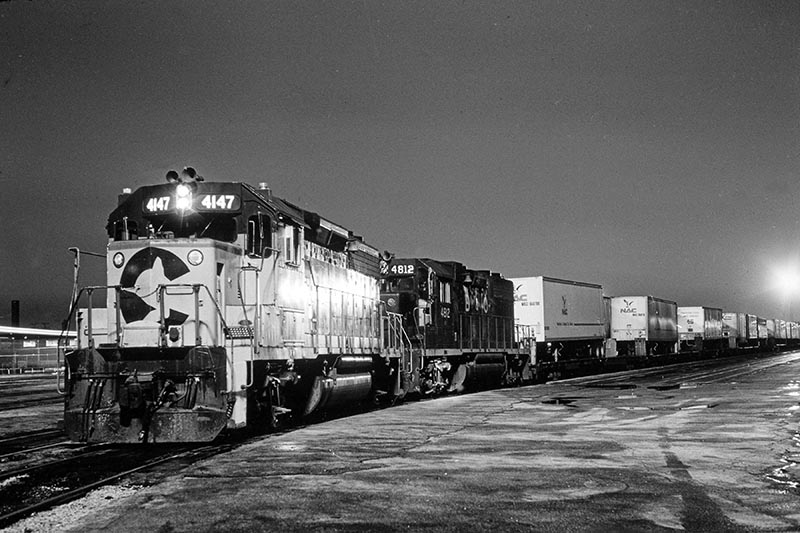
ABOVE: Converted to a rail-to-truck terminal in 1967, Forest Hill Yard served as Chessie System’s Chicago intermodal hub. With dispatcher clearance, the Chicago–Philadelphia Trailer Train departs with 43 cars on December 3, 1982. —David P. Ori
Due to the severe recession of 1974–1975, intermodal operations were suspended on Chessie System. In late 1976, business conditions improved with Chessie’s Intermodal Department re-establishing service between Chicago and Philadelphia. The Chicago–Philadelphia Trailer Train (CPTT) operated on a 31-hour schedule between Forest Hill Yard at Chicago and East Side Yard at Philadelphia. Its counterpart, the Chicago Trailer Train (CHTT), operated between Philadelphia and Forest Hill Yard.
By 1981, trailer business grew substantially between Chicago and the East Coast. As a result, Chessie System inaugurated a pair of new trains, the Baltimore Trailer Train and Baltimore-Chicago Trailer Train. At Fostoria, Ohio, these trains made connections to the Toledo–Lima Trailer Train and Lima–Toledo Trailer Train, respectively.
Ticket to Ride
After reading Mark Perri’s “Follow That Jet” in the May 1982 issue of Railfan & Railroad, I was inspired to propose a similar adventure — riding two of Chessie’s hottest trains, the Baltimore–Chicago Trailer Train (BCTT) and the Baltimore Trailer Train (BLTT). Bob Reid of Rails Northeast approved the idea, and with the help of Lloyd Lewis, Chessie’s manager of news and community affairs, I secured permission from the vice president of operations. The plan was simple — board the BCTT at New Castle, ride west to Chicago, then return east the following evening on the BLTT, with friends Terry Chicwak and Mark Perri photographing our daylight run between Willard and New Castle.
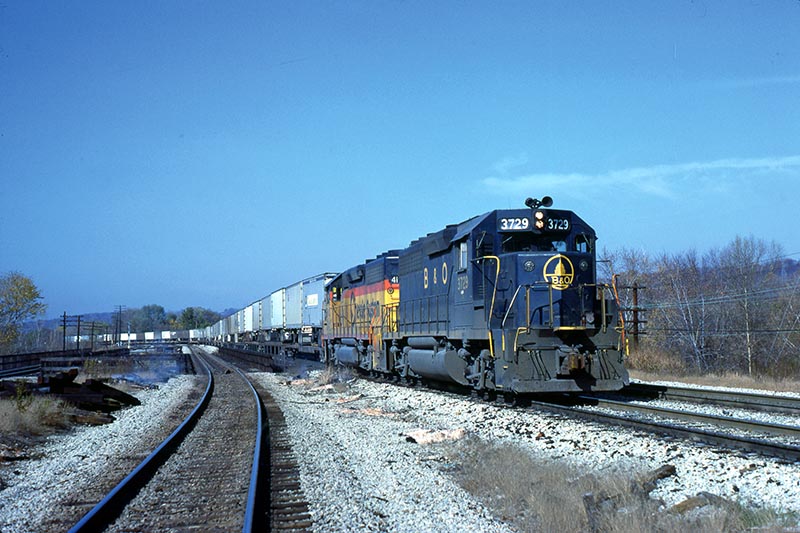
ABOVE: After a 60 mph run across the Akron Mainline Subdivision, the Baltimore Trailer Train rolls into New Castle Junction on September 20, 1981. Here, the train receives a new crew and brake test before continuing east to Cumberland and Baltimore. —David. P. Ori
And Away We Go
On December 2, Assistant Chief Dispatcher Al Ferrise calls to report the BCTT has three Toledo, Ohio, set-outs and 57 through cars for Chicago, with a 1:40pm arrival at New Castle. After gathering my gear and picking up a lineup in Akron — “The Rabbit” manifest and a pair of Grain Pikers are among the expected moves — I head east.
At New Castle, demolition crews are dismantling the old OA Tower, its operator now relocated to the Terminal Service Center. Inside the yard office, I meet Road Foreman Ray Shields, who will ride the cab to Willard. The OA operator confirms the BCTT is on time. Outside, a Western Maryland unit in red and white circus paint switches grain hoppers while the Buffalo–Rochester crew call UN Tower for departure clearance…
