

 Does the past matter? This is an argument I’ve had many times with other people in our hobby. After all, to most of us, the experience of being a railfan is to stand trackside, somewhere, and see something pass by. Our motives vary. Maybe we are there because we want to just experience the thrill of a big, heavy train hammering down the high iron, just a few short yards away, the cacophony of sound and vibration so hard it shakes the ground you’re standing on. Maybe we are there because we want to make photographs, either as a record, or as works that express artistic ideas, or a mixture of both. Or maybe we are just there because it’s a nice summer day and there are worse ways to kill an afternoon.
Central to them all, though, is the actual railway in front of us, the thing we can see moving, working, passing by, alive in some way. The past? It’s gone, long gone, disappeared into the history books, no longer tangible or touchable, and therefore no longer relevant. Why should we care?
Now I am, among other things, a historian. I research and I write and I teach about the past, so obviously, I have a few beefs with this attitude, and obviously I have a few responses. One of those, though, is that the past is rarely as gone as we think it may be. Sure, let’s say you’re standing beside the old Baltimore & Ohio main line somewhere in rural Ohio, with CSX trains thundering by with scores of loaded autoracks destined to market. The locomotives may be less than a decade old, the rail might have been relaid perhaps a dozen years ago, but ask yourself: Why is that line there? Why there, and not some other place? Why are these loads of, say, Ford pickups traveling southward on this route? From what plant, and where?
The things we tend to see as normal, as everyday, are often the result of decisions made decades ago, generations ago. B&O, the nation’s first major common-carrier railroad connecting major cities, was born in the 1820s and died in a series of mergers in the 1980s. Except, no, it didn’t. Look down at your feet — it’s right there, in the ballast, still very much alive and still doing the job it started 200 years ago.
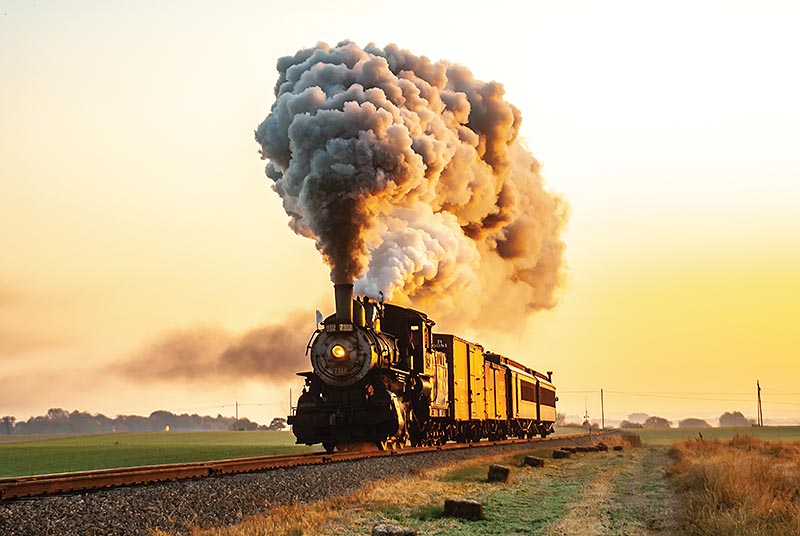
And what of the things we consciously work to preserve? Steam locomotives, for example, are sometimes derided as little more than rolling theme parks, fake trains for kids and old ladies, not real railroading. Their time is long past, vanquished by the diesel. Yet step into the cab of one, a cab of a locomotive as it is fired up and building steam. Stand there, and look into the angry orange eye that is the fireman’s observation hole in the back of the firebox door. Do that, and then say it isn’t real, it isn’t alive, that it’s buried in the past and means nothing now. Stare into the fire, and think of the thousands — the tens of thousands — of people who once stood there, too, and worked in that space, day in, day out, part of the lifeline of communication and commerce that in many places was not only the best means of holding together a community, but the only one that existed.
Sure enough, there are plenty of older folks in our hobby — and I am well on my way to being one of them — and many look backward in time and lament all that we have lost, all that was once routine but now is mostly memory. Some will say it was better then, that everything, now, turns to dust.
But I propose to you this: In the railroad world, the past is never far from reach, and its messages are there if we have the eyes to see them.
—Alexander Benjamin Craghead is a transportation historian, photographer, artist, and author.
