

 As spring settles in and summer approaches, many of us begin planning vacation time. Today, that often means road trips or flights, but many of the foundations of tourism in North America were shaped by the railroads. Consider the sightseeing tour. As early as the 1840s, railways promoted travel not just as a fast and comfortable way to get from place to place, but as an experience in itself — an opportunity to take in the landscape along the way. Even the first transcontinental route, the joint Central Pacific-Union Pacific line between the Midwest and California, was marketed in these terms. One advertisement suggested that a journey over the Rocky Mountains by rail was ideal for “travelers for pleasure, health, or business.”
By the end of the 19th century, many railways relied heavily on tourism and pleasure travel as a means to sell tickets. Perhaps nobody did it better than Atchison, Topeka & Santa Fe, whose marketing materials leaned into selling the landscape itself, from Monument Valley; to the Grand Canyon; to the orange groves, palm trees, and surf of Southern California. Even Santa Fe’s architecture was styled to be picturesque and romantic, recalling both pueblo settlements and the Spanish colonial past. Santa Fe was also known for its hospitality, thanks in large part to its partnership with Fred Harvey Company. Across the railroad’s major stops, Harvey-operated lunchrooms, dining rooms, and even full-service hotels catered specifically to Santa Fe passengers.
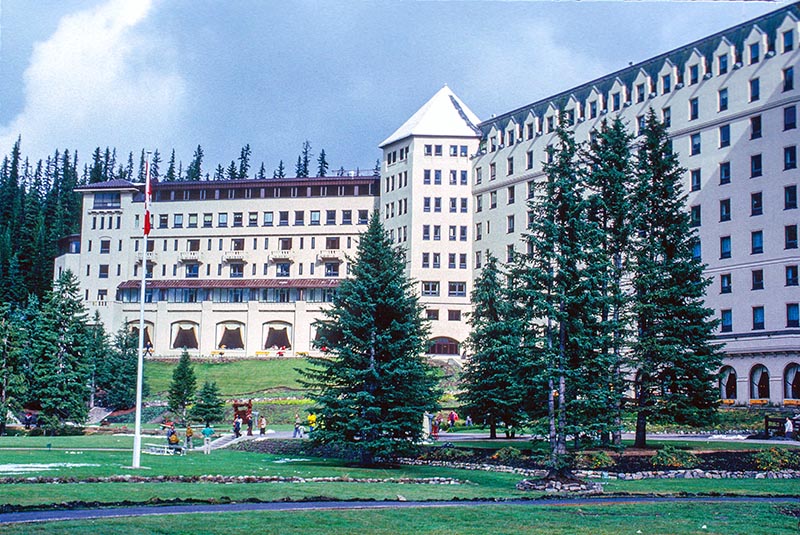
Santa Fe was hardly alone in promoting tourism or investing in hospitality. In the East, perhaps the best-known example is the Greenbrier, a sprawling resort in the mountains of West Virginia opened by Chesapeake & Ohio in 1913. North of the border, Canadian Pacific stands as an unmatched example. Its grand hotels — including the Château Frontenac in Quebec City, Château Lake Louise in Banff, and the Empress in Victoria — remain world famous.
Today, many of these hotels still stand, but most are no longer owned or operated by the railroads. There are several reasons for this. In some ways, the success of the railways themselves reduced the need for company-owned hotels. When Northern Pacific reached its western terminus at Portland, Ore., in 1883, the railroad found it necessary to build a grand hotel. By the early 20th century, however, Portland — thanks in large part to the railroads — had grown into a major city with an abundance of lodging options.
Even in smaller communities, advances in rail technology diminished the need for such facilities. Faster schedules and more comfortable, affordable sleeping car service meant fewer overnight stops, while the rise of automobile travel and aviation in the early 20th century only accelerated the trend. By the 1950s, companies like Fred Harvey were closing or selling off their properties. While it is still possible to stay at the flagship La Fonda in Santa Fe, it is no longer a Harvey House, nor part of the railroad world. Even so, a stay in a former railway hotel remains a treat because many were built with a grand sense of style and a strong connection to place.
But what if you wanted more? What if, this summer, you wanted not just to stay in one of these hotels, but to own one? Recently, the Izaak Walton Inn — opened by Great Northern in 1939 on the southern edge of Glacier National Park — was offered for sale. For just under $18 million, you could reserve accommodations in a 70-room inn and, perhaps, enjoy a permanent vacation.
—Alexander Benjamin Craghead is a transportation historian, photographer, artist, and author.
