

 I was saddened to learn of the passing of David Plowden on May 4 at age 93, arguably the most celebrated photographer of North American railroading. Born in 1932, Plowden built a distinguished career documenting the continent’s industrial and transportation landscape through more than 20 books, numerous awards, and decades of teaching. His photographs reside in the collections of major museums across the country.
Railroads, however, were what first drew him to photography. His earliest photograph was of a Boston & Maine steam locomotive in 1943; his first published image appeared in Trains in 1954; and in 1959, he worked as an assistant to O. Winston Link. A year later, while studying under the influential photographer Minor White, Plowden remained fixated on trains. Frustrated by his student’s single-minded focus, White famously told him, “Go do your damned engines. Get them out of your system or you’ll never do anything else.”
And in some ways, Plowden did. His first book, A Farewell to Steam, focused on steamboats and steam locomotives, but afterward he widened his lens to encompass the broader American landscape — bridges, barns, highways, heavy industry, and countless other built environments. His work appeared in magazines and journals, on gallery walls, and in museums and libraries, and in 1969, he received the rare distinction of a Guggenheim Fellowship.
Yet in other ways, he ignored Minor White’s advice entirely.
The subjects may have broadened, but railroads were never far away. Many of the bridges he photographed for his Guggenheim work carried rail lines; many of his industrial subjects — steel mills, grain elevators — depended on rail service; and many of the Great Plains towns he loved were founded by the railroads themselves.
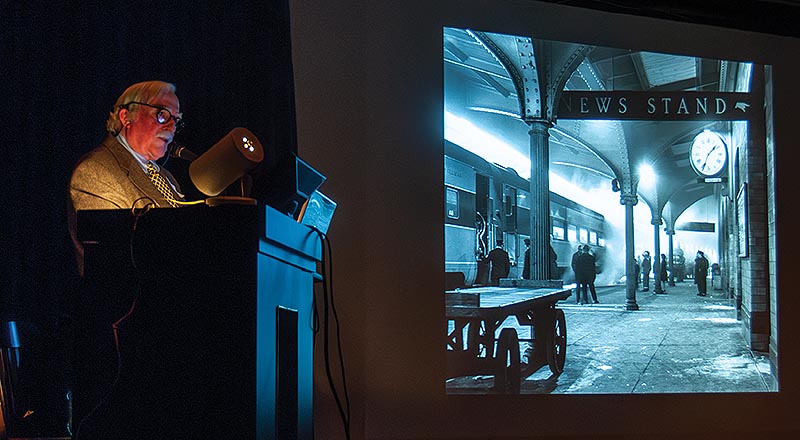
Plowden was also a frequent attendee at conferences hosted by the Center for Railroad Photography & Art, where I had the pleasure of hearing him speak on several occasions. I especially remember one conference when, feeling a bit tired, he lingered in the auditorium for a quiet lunch with only myself and (now Managing Editor) Otto Vondrak for company. Over sandwiches, he shared stories from his career in a calm but confident Mid-Atlantic voice that kept us enthralled.
I still remember his account of discovering the Great Plains during a brief stint with Great Northern in 1955. Posted far out on the western prairie, he was overwhelmed by the endless sky and lack of trees — as though he could feel the Earth itself turning beneath him.
The deliberate, thoughtful cadence of Plowden’s voice comes back to me whenever I look at his photographs, and it is remarkable how fully those same qualities are reflected in his work. That may also speak to his method — he would sometimes spend an entire day behind a tripod, waiting for a cloud to shift or for the sun to cast just the right balance of shadow and light. His friend and photojournalist mentor Walker Evans once argued that documentary photography could be more than merely clinical, that it could also be “lyric,” and Plowden’s photographs stand as lasting proof.
I do not know whether Plowden would have called himself a “railfan,” but he clearly took pride in his enthusiasm for trains. Our hobby can sometimes feel difficult to explain to outsiders, yet Plowden never seemed burdened by that awkwardness. To him, a train was always a thing of beauty, and he leaves behind, at least for me, a simple but profound lesson — spend your life creating things you love.
—Alexander Benjamin Craghead is a transportation historian, photographer, artist, and author.
