

 by Justin Franz/photos by the author
The Center for Railroad Photography & Art recently launched a new blog on its website called “Collection Tracking.” In it, staff members look at scenes from the Center’s archive and compare them with how they look today. Executive Director Scott Lothes kicked off the series with an interesting look at changes in Madison, Wis., since the late 1950s and early 1960s, when CRP&A founder John E. Gruber was regularly photographing Milwaukee Road passenger trains. Future installments will look at some of the changes witnessed by Wallace W. Abbey in Chicago, Karl Zimmermann in Switzerland, and Richard Steinheimer in the Mojave Desert. I suspect it will be an interesting series, and you can see all of them over at the Center’s website. (Full disclosure: I serve on the board.)
I mention this new blog because “then and now” photography is something I think about a lot, especially in railroad photography. Standing in the exact same spot (or close to it) as someone else — or even your past self — to take a photo and then compare it with a past one is a fascinating process to me. It creates an invaluable record of railroad history and even the history of certain places.
The most obvious method of then-and-now photography is one that shows the changes the railroad has gone through. Two years ago, the summer after Montana Rail Link was reacquired by BNSF Railway, I made a concerted effort to go out and repeat photos that I had taken the previous year during the regional railroad’s final months. To do this, I focused my photographic efforts on the twice-daily Gas Local between Missoula and Thompson Falls. The train generally ran at the same time each day under both railroads, and, with the exception of the motive power, the consist itself usually looked the same (a spacer car and black tank cars). As an added bonus, during the first year or so following BNSF’s return, the train usually got some interesting power in the form of older (relatively speaking) EMDs such as SD70Ms. Side by side, the images show just how quickly things can change in less than 12 months.
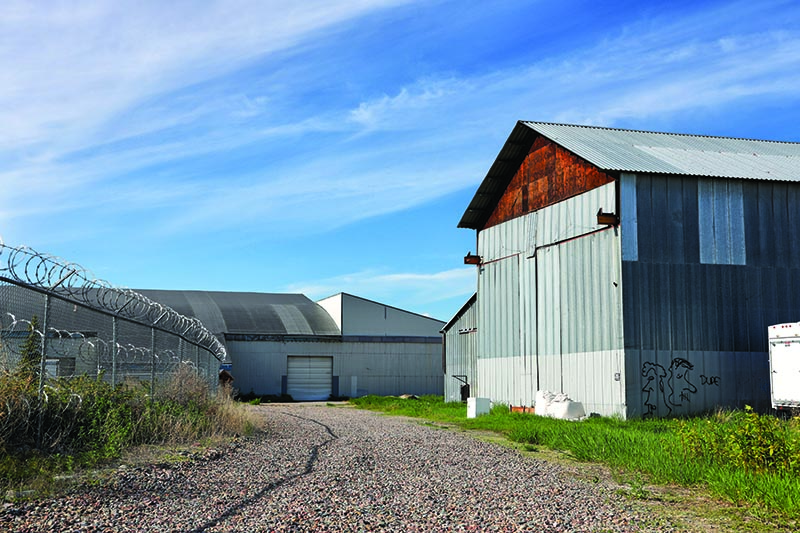
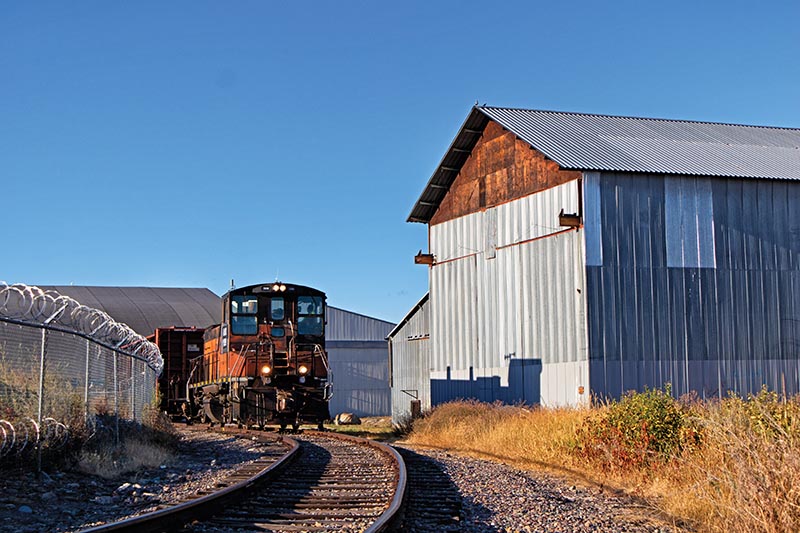
ABOVE: Less than three years later, in this May 2021 view, the rails are gone, but the buildings remain. Before and after photography is an effective way to convey changes that happen along the railroad — perhaps the most dramatic being when the railroad leaves a space.
Perhaps the most dramatic form of before-and-after photography is a spot where the railroad is no longer there. Who among us hasn’t snapped a photo of an empty right-of-way to use as a reference to search for an image of what it looked like when trains ran there? Over the years, I’ve taken a number of photos of the old Milwaukee Road “Lines West” in Montana, Idaho, and Washington to try to track down images of the railroad in its glory days.
Perhaps my most serious attempt at a before-and-after series of images came close to home here in Montana. For almost 10 years, I worked in downtown Kalispell, and once or twice a week, Mission Mountain Railroad would rumble by to serve the two remaining customers there, a grain elevator and a drywall distributor. About a decade ago, the town began making noise about moving those last two rail-served customers out of town into a new industrial park and then replacing the tracks downtown with a trail. The railroad didn’t mind because it would result in fewer crossings to maintain. Knowing the mile or so of track through town wasn’t long for this world, I spent countless hours photographing the train there (I got pretty good at finding excuses to leave the office, although my co-workers quickly figured out what I was doing). By 2019, the new industrial park was complete and Mission Mountain suspended service. A year later, the tracks were ripped up. Today, some parts of downtown haven’t changed much; the old drywall warehouse where I once shot WAMX MP15AC 1598 picking up an empty is still there, but the grain elevator has been replaced with apartment buildings. Every few years, I try to go back to stand exactly where I was when I shot Mission Mountain a decade ago, to record the continued change.
Perhaps no place I’ve been to in recent years better exemplified the need for good “before-and-after” photography than California’s Cajon Pass. I had seen photos of the place before my first visit in February 2025 (see “One Morning on Cajon” in the June 2025 edition), but I was still learning the lay of the land when I got there. Joining me on that trip was local David Busse, who was pointing out the old alignment at Summit, which was significantly higher than the current one. It was hard to picture in my mind, but once I got my hands on Chard Walker’s book Cajon: Rail Passage to the West (a must-read for anyone visiting the area), it all made sense.
While visiting Cajon, one shot I knew I wanted to get was something with Interstate 15 twisting over the mountains. If everything goes according to plan, Brightline West will eventually be running high-speed trains through the highway median, and that scene will look dramatically different from today. When high-speed trains are rushing along the highway, I hope to come back and take a new photo of the same landscape, showing the changes that have occurred. Railroading is an endlessly fascinating subject, and one reason is that it never stands still; images taken “then and now” can help convey its dynamism. Sometimes, finding those photos is simply a matter of digging into your own archive. But other times, it’s a matter of planning; going back to a spot you’ve been to in the past and taking a new image. Either way, I think you’ll find it to be a worthy endeavor, recording the many changes of the industry.
