

 by Justin Franz
All railroad photographers worth their salt know that adding a piece of railroad infrastructure — whether it’s a signal bridge, a station, or an old interlocking tower — can greatly enhance an image. These unique, railroading-specific structures often evoke a sense of place and time, giving viewers hints about who built or operated the railroad even before they read the caption.
Usually, when I include a tower, station, or signal in a photo, I later try to dig up some information about it, hoping to learn more to include it in a caption. There’s almost always a wealth of information about these structures, either on the internet or in books. But one piece of railroad infrastructure that has been overlooked, despite its imposing size, is the coaling tower.
Not long after the start of the 20th century, North American railroads began a major modernization effort, constructing more than 2,000 concrete coal towers. Sometimes these structures were built at locomotive servicing facilities, but other times they were along the main line at remote locations. Growing up in Maine, I remember several towers along the former Bangor & Aroostook at Northern Maine Junction, Derby, Millinocket, and Oakfield. The fact that these towers remained standing decades after the railroad had dieselized always amazed me. But despite being a dyed-in-the-wool B&A fan, I couldn’t tell you much about them. Who built them? Who built any of these massive structures?
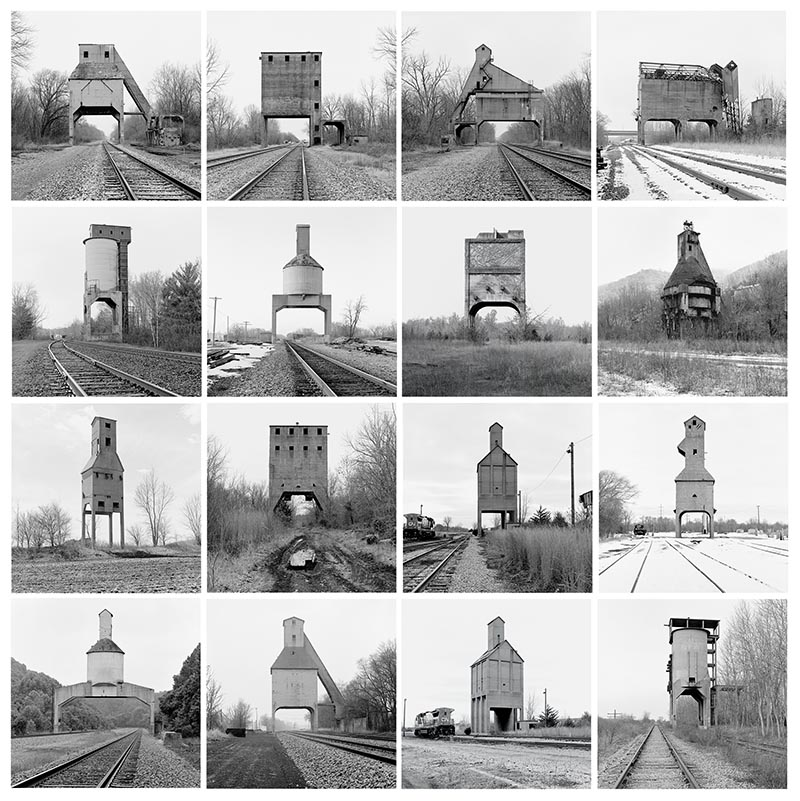
Luckily for us, photographer Jeff Brouws was also curious and intrigued that these mysterious structures remained standing long after the last one had been used. The result is a powerful new book from MIT Press called Silent Monoliths: The Coaling Tower Project. Brouws is an accomplished documentary photographer who has authored several books on other well-known photographers, including The Call of Trains: The Railroad Photography of Jim Shaughnessy and A Passion for Trains: The Railroad Photography of Richard Steinheimer. His own work, which extends beyond just railroad photography, has been showcased in numerous art museums and galleries. Brouws has long been fascinated by how industrial landscapes evolve, and he spent years photographing abandoned factories in the Midwest and Northeast. In many ways, Silent Monoliths continues that effort, a project that took five years and more than 20,000 miles of driving. The result is arguably the most comprehensive study of these structures ever created.
Following the release of the book, Brouws and I corresponded about his photographic process and his reasons for being drawn to this project. An edited version of that conversation follows.
Justin Franz: You mention in the book that it was a photo taken by a friend in Council Bluffs, Iowa, that inspired this project, as well as finding the Wikipedia page that listed the surviving towers. What made it such an obvious project for you, and what spoke to you about it?
Jeff Brouws: For the past 40 years, my work has focused on the architecture of urban and rural landscapes across America. While my roots are in railroad photography, I’ve found myself drawn, within and beyond the world of trains, to abandoned sites and places over that time. In addition, I’ve always been inspired by Walker Evans’ concept of the “historical contemporary,” the idea that the past and present meet in the surviving, older structures around us. The coaling towers were the perfect way for me to explore that connection.
When I document these structures, I work in typologies — groups of similar subjects all photographed the same way. These pictures are mainly informational and documentary in nature, but I think they also have a quiet beauty. They move away from the idea of one single “masterpiece” because the photos are stronger and have more impact as a collection than alone, especially when seen as a grid. By shooting them the same way, mostly in consistent light, I create a set that lets the viewer compare the subtle similarities and differences within that single type of structure. This was the perfect style for photographing the coaling towers.
Having been an avid collector all my life — beginning with baseball cards and stamps as a kid — the drive to create an archive feels natural. It is this same impulse that led me to the coaling towers. Because there is a finite number remaining in the U.S. — roughly 109, as of early 2026 — it felt like a reachable goal. As far as I know, such a survey had never been done, and I wanted to contribute to the historical record. Ultimately, the coaling towers filled that collector urge in me, too.
JF: The book mentions that you spent a lot of time “scouting” these towers via Google Earth. Were there instances where, by the time you got to the tower, it was already gone?
JB: Of all the towers on my list, Bethlehem, Pa., was the only one that got away. I arrived expecting a silent monolith, but found only rubble. David Plowden often said he was “one step ahead of the wrecking ball,” but in this instance, I was exactly two weeks behind it. To console myself, I actually took photos of its concrete remains.
I have been more fortunate elsewhere, having captured coaling towers in Flomaton, Ala.; Social Circle, Ga.; Toledo, Ohio; and Marceline, Mo., before they were lost. My archive also includes the two structures that fell in 2025 and the three others slated for demolition in 2027.
When scouting for all the towers, the challenge often lies with the limits of Google’s satellite imagery. While city data updates almost annually, rural imagery can be five years old and significantly lower in resolution. Overgrowth adds another layer of difficulty. Because most satellite passes occur in summer, dense foliage often hides these concrete giants, making them nearly impossible to see from above.
JF: When you approached a tower, what was your method in capturing it? How much time would you spend on the site, and how many images would you take? I notice in some instances, you photographed the tower from multiple angles. Did you do that in every instance, or every possible instance?
JB: I start with a straight-ahead portrait of the coaling tower, putting the tripod at a set distance and angle to keep it consistent. This forms the Typology section of the book. Once the main shot is done, I loosen up and move around the site to experiment with different lenses and wider views. By including the surrounding landscape, the photos in the Topographies section capture different perspectives that a strict typological approach might miss, putting the tower in its broader context. While physical obstacles sometimes limited what I could try, I took extra photos whenever possible, which, as you know, is invaluable during editing. This practice provided a much fuller record of each spot. Richard Steinheimer often called this method “layering.” These more “freehand” images capture a “sense of the place” in a way a single documentary shot of a coaling tower can’t.
I generally shot 12 to 24 frames at each spot for the medium format work and was more generous with digital, though the chance for this “walk-around” scenario (like for the coaling towers at Montgomery, Ala., and Monfort Junction, Wis.) wasn’t available at many sites. On average, I spent about an hour or so at each location.
JF: Sometimes you went back to reshoot a tower; what sparked the desire to revisit some of these places? Seeking better lighting conditions? Or seeing what changes may have taken place?
JB: Many of these towers became old friends; I found myself building a sort of relationship with them, with repeat visits like seeing a favorite relative once a year. I purposely chose to photograph them after the fall leaves had dropped — typically between early November and late March. I favored the flat, overcast winter light to render the towers as clear and unadorned as possible — pure documents, free from shadows that hid their surfaces (this wasn’t always the case; a few were photographed in direct or soft sunlight and in darkness, too).
During these revisits, I also recorded changes in their physical appearances, such as the tower at Girard, Ohio, or changes in the surrounding landscape, like at Cushing, Okla. This highlights one of photography’s great strengths — its ability to document these subtle transformations over time. Some towers needed a revisit simply because the situation or the weather wasn’t right the first time. On one trip en route to the annual Center for Railroad Photography & Art conference, I battled rain the entire way, making the journey pretty much a wash. Concrete towers do not photograph well when parts of their cement surfaces are darkened by rain, and unfortunately, the Toledo tower was demolished before I could return for a reshoot.
JF: Was it obvious to you from the onset that you would photograph this project in black & white, or did you ever consider doing it in color?
JB: On the first trip out, I did shoot both color and b&w. But reviewing the results after all the film was processed, I determined b&w was the way to go.
Also, as a nod to Bernd and Hilla Becher — the well-known German husband-and-wife team who photographed industrial structures for 50 years in the U.S. and Europe —I saw the coaling tower project as an homage to their legacy. As we often say, all photographers get inspiration from those who came before us. They did typologies and worked exclusively in b&w; that was good enough for me. I also wanted the photographs to have an “evidentiary,” stripped-down feel that color film doesn’t quite give you — color creates its own aura, if that’s the right word, which I wasn’t looking for.
JF: Often, old railroad structures are preserved and celebrated, but that’s not the case with these. In so many instances, they’re overlooked even by those who are interested in railroads. Why do you think that is?
JB: That’s a tough question. I’d say we railfans are mostly geared toward photographing locomotives, trains, and rolling stock — and, to a lesser degree, infrastructure, unless there’s a train included in the frame. It’s a bit of a gray area, though. Some members of our fraternity do focus specifically on depots or other elements of the railroad landscape, regardless of motive power. There is even highly creative, impressionistic work being done that transcends these categories altogether; however, generally speaking, trains and the landscapes they travel through have traditionally been the focus of our community.
While infrastructure like roundhouses or stations has always drawn more attention because they were central to the action, many surviving coaling towers are now in isolated, out-of-the-way locations, often seeing little, if any, rail activity (like the ones you previously mentioned in Maine). Furthermore, their bare-bones, utilitarian look may not appeal to every photographer.
Finally, historian John Hankey and I realized early in the project that coaling towers have been significantly under-researched. There simply hasn’t been much scholarly or historical attention paid to them, making them a “lost” chapter of railroad history. Perhaps many railfans, as I once did, simply don’t realize the extent to which they still exist.
That said, I’ve seen a recent uptick in interest regarding these structures, driven largely by the demolition activity mentioned above. With several more slated for removal in 2026–27, the sense of urgency is growing. On a more positive note, preservation efforts are gaining ground. For a look at what’s possible, I encourage everyone to explore the C&O coaling tower in Charlottesville, Va., via an internet “street-view” search. It’s a marvelous example of a former tower seamlessly integrated into a condominium complex — an elegant solution that pays tribute to the city’s railroad roots through successful urban planning.
JF: What advice would you offer someone who’s embarking on a project of this scale?
JB: Take the first step without worrying about how big the commitment is. Getting deeply involved with a subject — researching as you go along and “layering” your archive over multiple trips — is what makes the process fun and rewarding. Remember — speed is optional, but perseverance is key. You don’t need to abandon your usual photography either; a long-term project can run alongside your other railfanning activities.
