

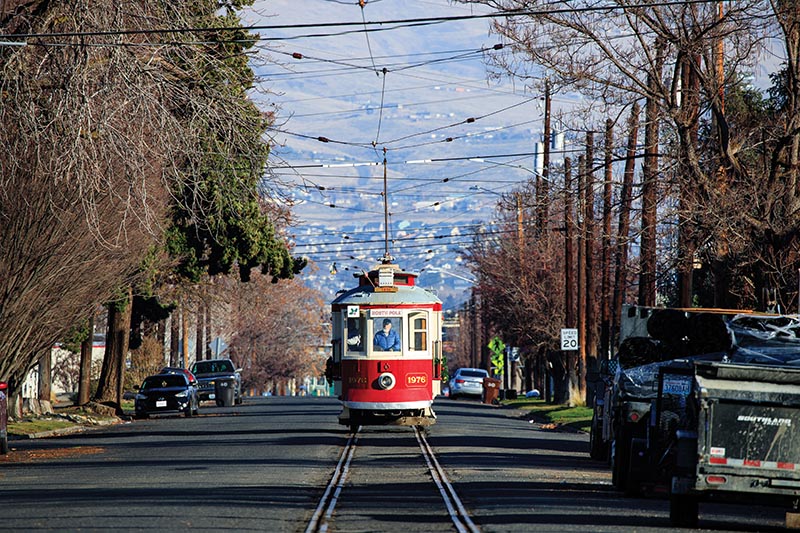
 by David Honan/photos by the author
Maintenance Supervisor Russ Wentworth faced a daunting challenge — with little advance notice, the sole mechanic at Washington’s Yakima Valley Trolleys was tasked with preparing an ancient fleet of interurban vehicles for what could be their final main line runs. His expertise meant putting in long hours in an unheated carbarn with vehicles that hadn’t been on the street in years, but “Uncle Russ” unhesitatingly poured all his energy into the assignment.
Why the urgency for unanticipated wintertime operations? The trolley museum unexpectedly found coal in its stocking during the 2025 holiday season, when the Yakima City Council declined to approve a negotiated operating agreement for 2026 and ordered the volunteer-run organization to cease operation of the city-owned equipment and facilities on December 31. Acknowledging a stark possibility that this might be the last opportunity to operate its historic vehicles and street trackage, museum leadership swiftly organized an event to celebrate more than a century of electric railway operation in the city.
Yakima Valley Trolleys (YVT) is the preserved remnant of Yakima Valley Transportation Company (YVTC), which was founded in 1907. Starting as a streetcar line serving downtown Yakima, the company was acquired by Union Pacific predecessor Oregon-Washington Railroad & Navigation Company in 1909 with a goal of tapping the fertile agricultural resources of the region. Eventually, the system comprised more than 40 route-miles radiating into surrounding communities, providing interurban passenger service and feeding freight traffic to the national rail network. Regular passenger service ended in 1947, and the remaining streetcars were scrapped or sold. Freight service continued until Union Pacific filed for abandonment in 1985 due to declining traffic.
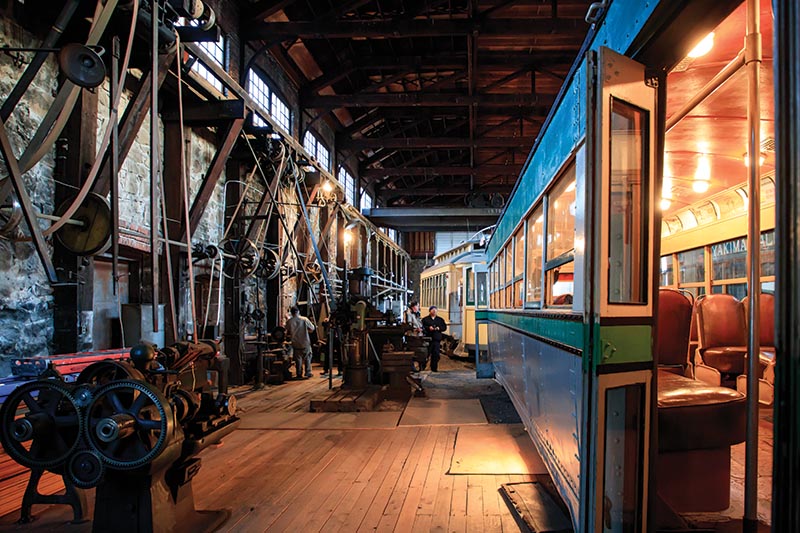
ABOVE: The carbarn’s machine shop tools are still driven by belts connected through a clutch system to the wall-mounted line shaft. Open doors on car 21 invite guests to tour the rare Brill model.
Aside from streetcars, YVTC acquired relatively few pieces of operating equipment over the years. Notable in the fleet were locomotive A, built in 1911 as a freight motor and subsequently converted to a line car for overhead wire maintenance; steeple cab 298, ordered from General Electric in 1922, and the line’s primary locomotive for more than 60 years; and three Brill Master Unit trolleys acquired in 1930. All five of these historic vehicles remain on the property today, though two of the trolleys have been relegated to parts donors.
In 1974, recognizing the opportunity to establish a tourist attraction, the city of Yakima restarted passenger service using two streetcars purchased from
Oporto, Portugal. Running jointly with Union Pacific’s freight trains, train orders were posted in the carbarn, and trolley motormen had to obey them. The success of this operation led to Union Pacific donating the remaining YVTC trackage and equipment to the city upon cessation of freight service. The trolley barn and powerhouse were initially leased to the city, with outright purchase completed in 2008. The trackage remaining comprises approximately a half-mile along Pine Street, and three-and-a-half miles along 6th Avenue and across the Naches River into the city of Selah.
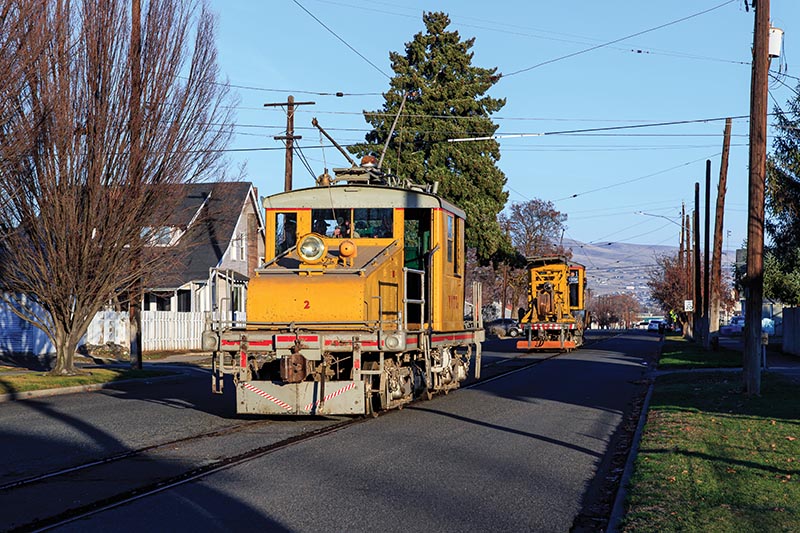
ABOVE: The crest of the hill is behind them as locomotive 298 and line car A rumble along Pine Street with cabs full of excited riders.
Since 2001, the interurban lines have been run by the nonprofit organization Yakima Valley Trolleys under an agreement to use the Yakima-owned facilities and equipment in exchange for providing both infrastructure and vehicle maintenance. The museum’s operations are primarily funded by ticket sales, private donations, and grants.
Challenges
Scott Neel has been volunteering on the trolleys for more than 40 years. He grew up a block from the YVTC main line in Selah and joined the museum to earn a Boy Scout merit badge. He explains the importance of the railroad in shaping the path of his life: “As a kid, I was inspired by a big yellow locomotive running down the middle of the street. Today, I’m not only the motorman on that same locomotive, but I’m also a licensed mechanical engineer, in part because of how my imagination was inspired by the YVT and the people who operated it.”
During his tenure at the museum, Neel has served in nearly every role that exists, from flagman to director, and has held a motorman qualification since 1990. There is no shortage of pride when he relates that the organization’s preservation efforts allow visitors to experience how interurban transportation functioned a century ago. He notes that despite being something of a shoestring organization, the museum consistently delivered results from funding opportunities. These long-term successes positioned it to secure a $499,000 grant for crucial work to stabilize and repair the carbarn…