


On December 19, Union Pacific and Norfolk Southern submitted an application for what they called “the most thoroughly planned merger in railroad history,” which, if approved, would create the nation’s first single transcontinental railroad and significantly reshape the American rail network.
If authorized by the U.S. Surface Transportation Board, UP’s acquisition of NS would create a 50,000-mile railroad spanning 43 states and reaching every corner of the continental United States. During a press conference shortly after UP submitted its 7,000-page application to the STB, UP CEO Jim Vena said his proposal would complete a project that began in 1862, when President Abraham Lincoln signed the Pacific Railroad Act to construct the First Transcontinental Railroad.
“This merger is about completing Abraham Lincoln’s vision,” Vena said.
But while Vena spoke in aspirational terms, declaring the merger a win for the nation, getting the deal approved won’t be easy — especially as UP’s competitors line up to oppose it.
‘Transform How Freight is Delivered’
In July, when UP announced its plan to purchase NS for $85 billion, the railroad stated it believed the merger would benefit rail shippers, employees, and the public. With the 7,000-page application, UP began to clarify some of the details of what that might look like. According to UP, the combined system will remove more than 2 million trucks from America’s highways each year. The most notable benefit will be seen in the Midwest, where the eastern and western Class I railroads meet but where complex interchanges make trucking a more attractive short-haul option for shippers.
“As time and technology continue to transform how freight is delivered, our industry must keep pace and move forward, reaching underserved markets with new rail solutions and strengthening the U.S. supply chain,” Vena said. “Customers deserve stronger, more connected freight rail, and our merger will make that happen.”
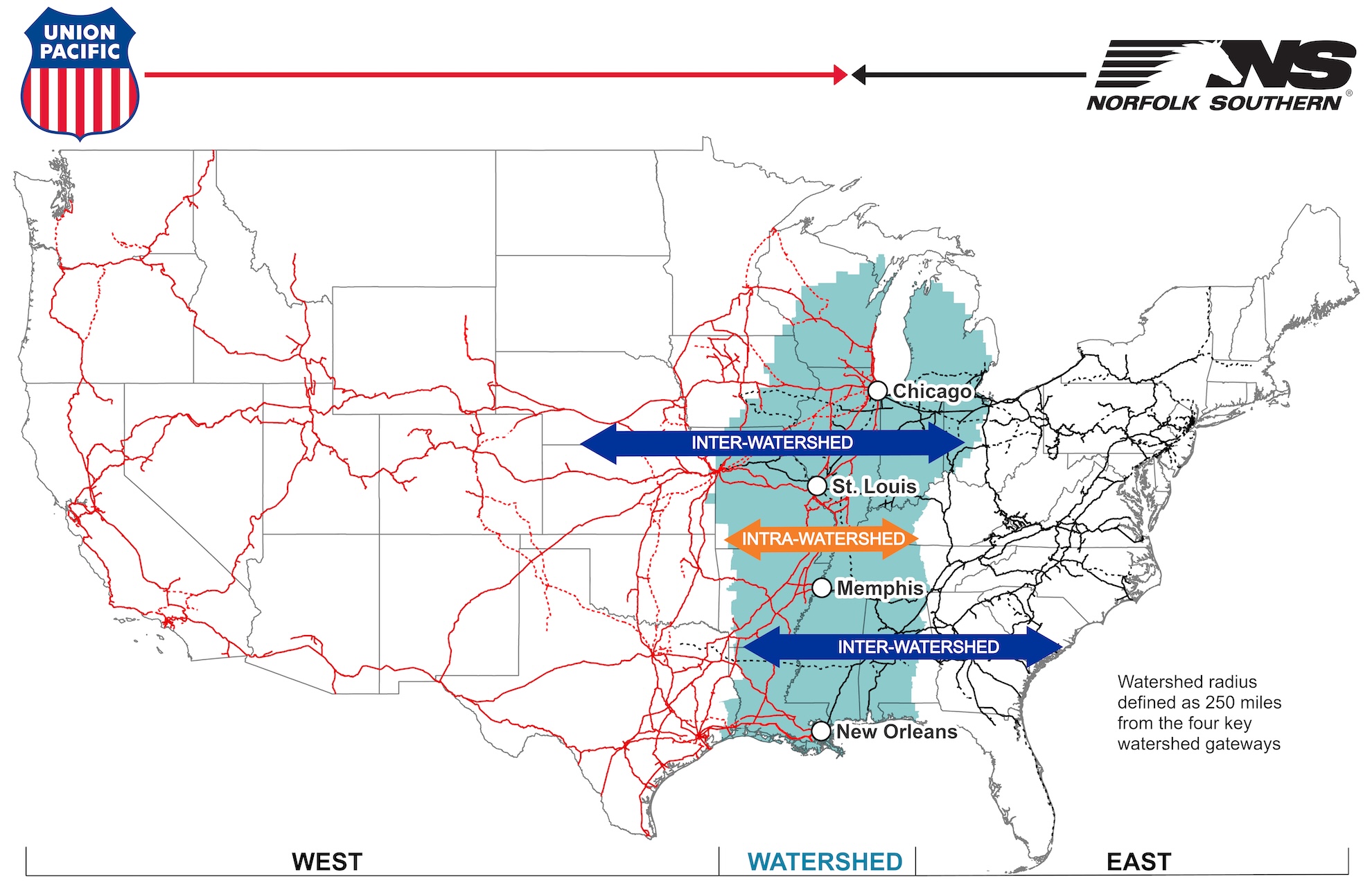
In its application to acquire NS, UP said that the most significant benefits will occur in the Midwest “watershed,” where complicated interchanges between east and west make trucking a more appealing option.
UP officials said that the merger would allow the combined railroads to eliminate time-consuming interchanges and reduce freight transit times. Specifically, the railroad planned to introduce two new intermodal train pairs between Southern California and the Northeast and Southeast; six new manifest trains through the Midwest; and six new premium intermodal lanes operating seven days a week. Among those new intermodal lanes are runs between Lathrop, Calif., and Croxton, N.J., via Chicago (83 hours); City of Industry, Calif., and Croxton, N.J., via Kansas City (95 hours); Los Angeles and Detroit/Livernois via Kansas City (80 hours); Inland Empire Intermodal Terminal and Jacksonville, Fla., via Shreveport, La. (83 hours); Mexico and Croxton, N.J., via New Orleans (85 hours); Houston and Atlanta via New Orleans (39 hours).
In response to UP’s proposed takeover, competitors such as BNSF, CSX, and CPKC have all announced similar new traffic routing partnerships connecting the east and west. In his application statement, however, Vena argued that while partnerships are helpful, they are “narrow and cannot be scaled” like a true merger.
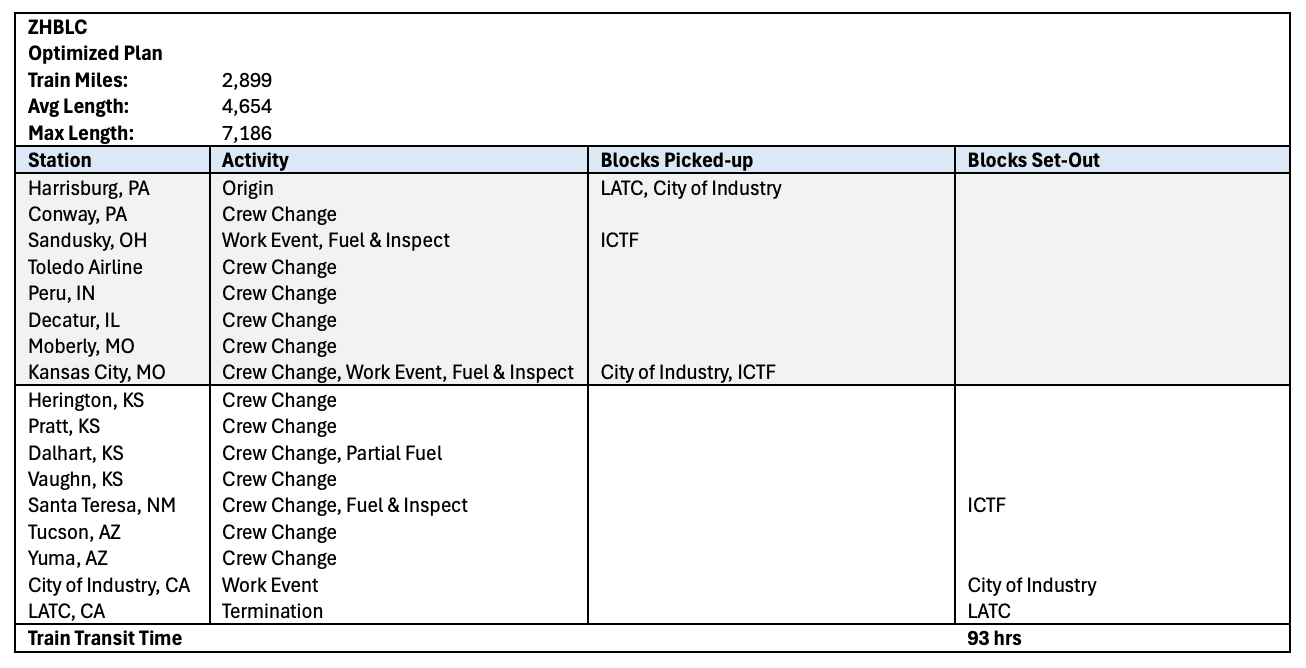
The proposed operating plan for a new Los Angeles to Harrisburg, Pa., intermodal train, ZHBLC.
Preserving and Enhancing Competition
The biggest question facing a combined UP-NS will be how it enhances competition, a key requirement for the STB to approve any merger. To do that, the railroads have said they would voluntarily establish “Committed Gateway Pricing,” streamlining the pricing of interline moves, meaning customers on other railroads would see benefits from the merger. UP has also said it would keep all existing gateways open on “commercially reasonable terms.”
UP and NS have also stated that they plan to decrease their ownership shares of two connecting short lines: the Peoria & Pekin Union Railway in and around Peoria, Ill., and the Terminal Railroad Association of St. Louis. In the case of PPU, UP and NS jointly own the short line with Canadian National. UP and NS have proposed reducing NS’s stake so that the combined railroad no longer holds the majority of interest. The same applies to TRRA in St. Louis, which is currently co-owned by UP, NS, BNSF, CSX, and CN.
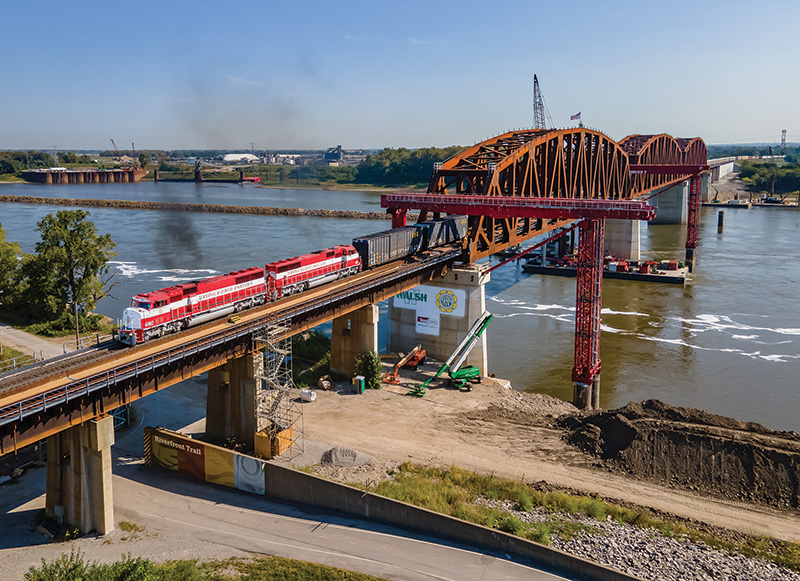
UP and NS have said they plan to reduce their ownership share in two shortlines, including the Terminal Railroad Association of St. Louis. Photo by Terry Redecker.
Competitors React
In the application, Vena said he not only supported a combined UP-NS, but also a combined BNSF-CSX. “Such a merger would provide the same type of benefits as UP-NS,” Vena wrote. “It would give customers more and stronger options.”
But from the start, BNSF, UP’s main competitor in the west, has stated it’s not interested in more consolidation. In a statement shortly after UP submitted its application, BNSF CEO Katie Farmer reaffirmed that stance.
“The transaction poses a significant threat to the U.S. economy and the American consumer through its long-term competitive harms,” Farmer said. “It would leave shippers with fewer options — driving higher rates and ultimately higher prices for consumers. This didn’t begin with customers asking for this merger, and the claimed public benefits appear to accrue primarily to shareholders. Past mergers demonstrate the risk of serious service failures with destructive impacts to customers, the U.S. rail network and the American economy.”
Even before UP submitted the application, BNSF was already questioning the “past mergers,” especially the 1996 merger of UP and Southern Pacific. On November 28, BNSF asked the STB to review the “harm” of that merger, which they claimed decreased competition and shipping options for customers across the West.
CPKC also responded, stating that the proposed merger would present “extraordinary and far-reaching risks to customers, rail employees and the broader supply chains.” As of press time, neither CN or CSX had reacted.
That said, the merger had its supporters: the application included over 2,000 letters of support for UP and NS.
This story will be updated as more information is received.
—Justin Franz
