

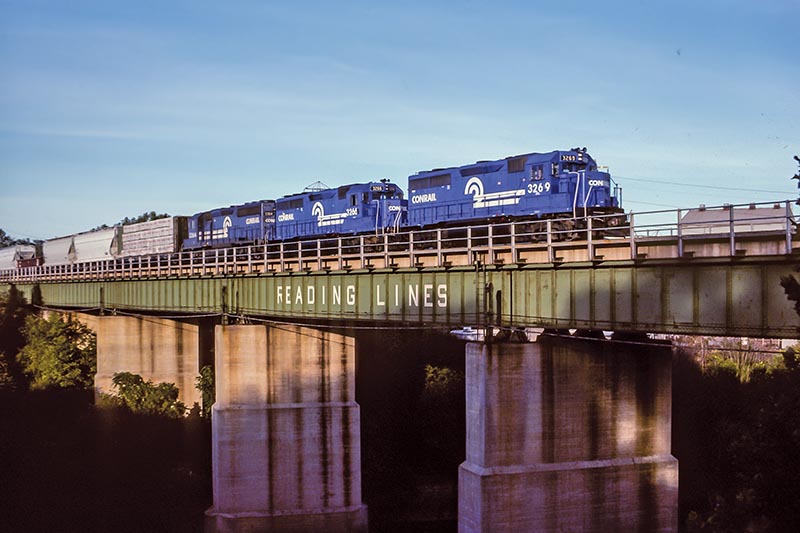
 When the federal government created Consolidated Rail Corporation in the mid-1970s, it set out to weld several bankrupt Northeastern railroads into one viable system. To railfans, “Conrail” became synonymous with the disappearance of storied and colorful names. To many communities that depended on those lines for employment and tax revenue, it meant the shutdown of local yards and car shops and the ripping up of underperforming branch lines. In different ways, both rail enthusiasts and the communities those railroads served experienced a sense of loss that went beyond balance sheets and timetables.
Little of this lends itself to the kind of endearing romance with which many of us regard earlier railroads. It may therefore seem odd to commemorate the 50th anniversary of Conrail’s creation. Yet the reality is this — without Conrail, there might not be a viable railway industry today.
The history of North American railroading is a lesson in overexpansion. For most of the 19th century, railways were seen by investors as a transformative enterprise that would make them rich. To small-town dreamers and big city boosters, this was a technology that would funnel trade and influence to their communities. To company executives, rapid growth was the key to dominance — claiming lucrative territory before the other guy did, or diverting traffic from whoever got there first. In the Northeast, the result was “irrational exuberance,” good money after bad, and too many places served by too many lines.
Such duplication could foster competition and lower rates for shippers, but it also rendered profit margins perilously thin. The rise of publicly funded highways beginning in the 1910s, followed by the growth of subsidized airports in the 1930s, further eroded railroads’ competitive position. By the mid-20th century, lines that had long been marginal were firmly in the red, and routes once justified as “loss leaders” were draining their parent companies dry. When Conrail took over on April 1, 1976, its broader mandate was to preserve rail service in the Northeast and Midwest — and, by extension, to stabilize the North American rail network itself.
Achieving that goal required what battlefield medics call “triage.” Conrail concentrated its limited resources on maintaining, repairing, and upgrading the strongest segments of the network, while allowing less economically viable facilities to close. While most jobs were protected under Conrail, drastic and often brutal cuts elsewhere were needed to make the new railroad competitive. Decisions made in the decades prior were influenced by investors looking for quick returns and a public that quickly turned to the auto and the airplane for their shipping and travel needs. Rationalization, alongside various forms of regulatory relief and government aid, allowed Conrail to reach profitability and return to the private sector in 1987.
What might the railway industry have looked like had Conrail never been created? One can imagine the eastern main lines parceled out to state governments or simply left to wither, industries relocating farther south and west, and a deindustrialized landscape more severe than even the bleakest Bruce Springsteen ballad.
Conrail was unsentimental, rationalizing the excesses of a romantic, yet often imprudent, past. But it was also a hopeful creation — one that halted a systemic collapse and preserved rail service in the most densely populated and industrialized region of the U.S. Conrail saved what it could. In doing so, it saved railroading in the East — and we are all better off for it.
—Alexander Benjamin Craghead is a transportation historian, photographer, artist, and author.
