

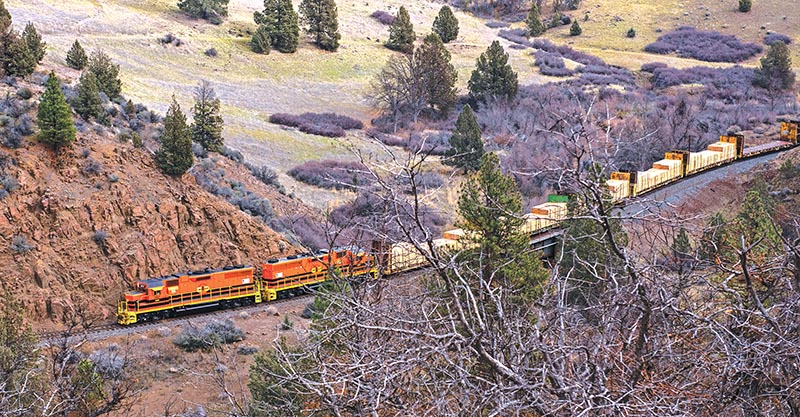
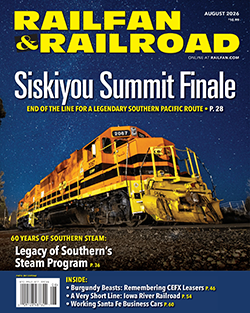
 In this issue, we follow the journey of two photographers as they document what may be the last train ever to cross Oregon’s Siskiyou Summit. This branch line is, to most, an obscure piece of geography, but in the West, it is one of the more storied railways. For nearly 40 years, this was (in effect) Southern Pacific’s main line, and the only direct rail connection between the Pacific Northwest and California.
Its history was never untroubled. It was supposed to be the first connection between Portland, Ore. — where construction began in 1867 — and the rest of the nation. Thanks to competing proposals, political struggles, and financial mismanagement, by the time that the line was completed over the Siskiyous in the late 1880s, the intended first had slipped to third, and Oregon already had two other transcontinental railways — Northern Pacific and Union Pacific.
The Siskiyou Line was also a challenging piece of engineering, with steep grades, tight curves, and several tunnels. The country, moreover, was rough. Most of the land around the line was mountainous and forested, ill-suited to agriculture or settlement. In desperation, the railway attempted to sell its land grant properties for mining and timber rights — in clear violation of its legal rights, which added a burden of legal troubles that lasted for decades.
The rugged terrain, especially at Siskiyou Summit itself, also proved suitable for even less legitimate activities. Tunnel 13, a 3,108-foot-long bore at the very summit of the line, had long been a site where trains slowed to a crawl. To twin brothers Roy and Hugh DeAutremont, it also seemed like an ideal place to secretly board a train and rob it. In 1923, the two jumped on a southbound SP passenger train as it came out of the tunnel. Their robbery went spectacularly wrong when an overabundance of dynamite blew up the cash they sought, along with half the mail car. Panicking, the pair murdered most of the head-end crew before fleeing as poor as they had arrived.
Three years later, SP opened its so-called “Natron Cutoff” over the Cascade Range, and the Siskiyou Line began its descent in importance. Eventually, it became yet another freight-only, timber-dependent branch. As with many similar lines, the 20th century was not kind, as subsidized highways, corporate consolidation among shippers, and larger economic and environmental challenges ate away at the remaining traffic. In the 1990s, SP “spun off” the Siskiyou to short line Central Oregon & Pacific, but this did not alter the basic facts of rough terrain, wildfires, and frequent bad weather. All of this made the line characterful for railfans, but it also made the financial rationale of repairs and maintenance hard to justify.
Will we ever see another train over Siskiyou Summit? There’s timber still being harvested, but it is being handled in fewer and larger mills. The population growth of southern Oregon, meanwhile, would seem to make the line a good fit for a renewed passenger service — 360,000 people live in the Rogue River Valley, and another 112,000 live in the Roseburg region just to the north — yet it’s hard to imagine Amtrak (or anyone else) justifying this rugged line for passengers alone.
In some ways, this story is surprising. After all, we may be at the dawn of the first transcontinental railway system in the U.S. through the proposed merger of Norfolk Southern and Union Pacific. How can we afford to close routes? In other ways, this is yet another example of the conundrum facing North American railways over the last century: overall tonnage has increased, while the system’s mileage has steadily shrunk since about 1916. The Siskiyou Line is part of that larger story.
—Alexander Benjamin Craghead is a transportation historian, photographer, artist, and author.
