

 by Gordon Lloyd, Jr./photos as noted
The 1970s were a dark time for the passenger train. Following years of decline and divestment, passenger railroading on the continent — both short- and long-haul — was at a low point. Freight railroads wanted out of the obligation to run passenger trains, and national, state, and local governments often had to step in to pick up the pieces to maintain service. Unfortunately for them, the equipment supporting those services was often outdated and in poor condition. Aging steam-era passenger cars hauled by worn-out first-generation diesels were the rule rather than the exception.
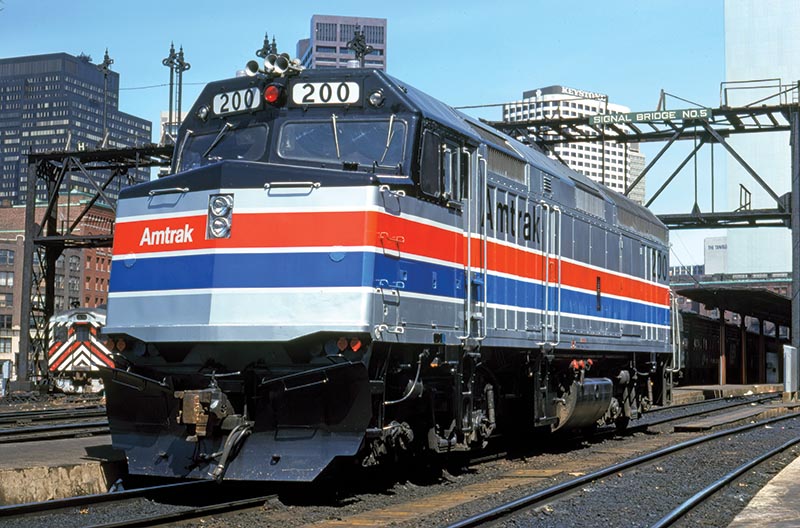
It was against that backdrop that a new locomotive hit the rails, one which would ultimately become the face of passenger railroading during the late 20th century and into the 21st — the F40PH. Between 1975 and 2007, EMD and its licensees built more than 500 F40PHs for long-haul operators like Amtrak and VIA Rail, as well as commuter rail agencies coast to coast. Simply put, the F40PH would become one of the most successful locomotive designs of all time, helping propel passenger railroading into a new, optimistic era.
The F40PH was not the first locomotive to carry an “F40” designation. In 1974, EMD built 15 F40C locomotives for Chicago-area commuter service on Milwaukee Road lines later operated by Metra. Unlike the four-axle F40PH, the F40C was a six-axle, cowl-bodied locomotive derived from the SDP40F/SD40-2 family, rated at 3,200 hp, and equipped for head-end power. Built for heavy commuter trains, the F40C remained unique to Chicago with the last examples retired from regular service in 2004 (though briefly revived in 2009 and 2012 before permanent retirement).
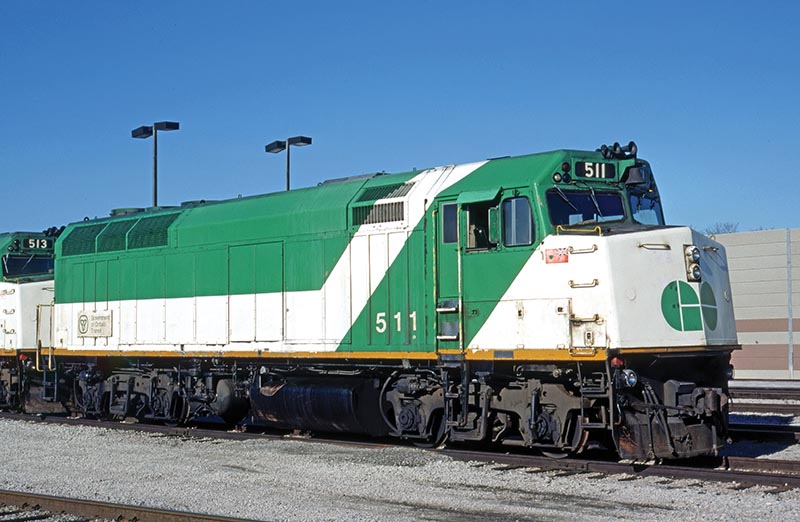
ABOVE: GO Transit 511 is at Mimico, Ont., on February 10, 1990. GO Transit acquired six General Motors Diesel Division-built F40PH locomotives in 1978. Numbered 510–515, they were the first F40PHs built in Canada and remained in service until 1990, when they were sold to Amtrak. —Peter Jobe, LTL
GP40s in Passenger Service
As soon as the first passenger car was coupled to a locomotive, there was both a desire and a need to provide power to the train itself for heating, cooling, lighting, and other onboard amenities. An early solution for heat was to use steam directly from the locomotive. Later, steam-powered generators or axle generators were installed on passenger cars to charge batteries for lighting and other needs. When diesel locomotives replaced steam locomotives in the 20th century, some had boilers to allow for the continued use of steam heat. In the mid-20th century, railroads like Chicago & North Western began to experiment with “head-end power,” or HEP, using generators on locomotives driven by a shaft extending from the air compressor (itself shaft-driven by the prime mover). Generators, housed in a boxy enclosure on the long hood, provided low-voltage 32-volt d.c. power for lighting and 240 volts for air conditioning.
In the late 1960s, Toronto’s commuter carrier, GO Transit, opted for an HEP-equipped version of the GP40, distinguished by its SD40-sized frame. The increased length was used to accommodate a GM 12V-149 engine, which drove a 500-kW alternator. The apparatus was housed in a boxy extension of the long hood. These GP40TC units were the first new-build HEP-equipped locomotives.
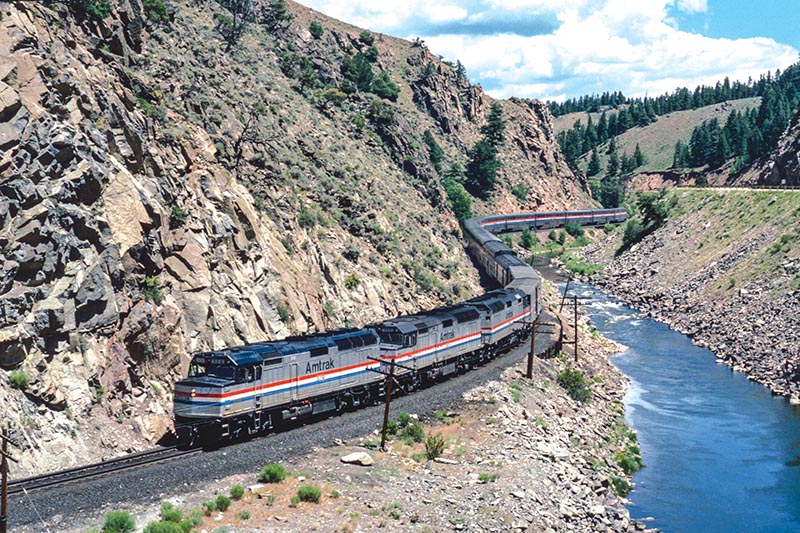
ABOVE: A trio of Amtrak F40PHR locomotives leads Train 5, the westbound California Zephyr, through Byers Canyon, Colo., on Denver & Rio Grande Western in July 1989. The “R” designation means these units were built from parts traded in to EMD from Amtrak’s short-lived SDP40 fleet which was plagued with problems in the 1970s. —James House
Other railroads also opted to purchase GP40s for passenger service, including Central Railroad of New Jersey (which purchased 13 GP40Ps in 1968) and Southern Pacific (which purchased three GP40P-2s in 1974). Interestingly, because of the old equipment they were being matched with, CNJ and SP’s versions were delivered with steam generators.
While all the units had unique visual differences due to the service they were in (extended long hoods), the front end looked like any other low-nose GP40 running in freight service. It wouldn’t be the last time the GP40 was adapted for passenger service. In the decades to come, commuter operators like Metro-North, New Jersey Transit, MARC, Connecticut Department of Transportation, and Massachusetts Bay Transportation Authority would all use variations of the GP40 for passenger service. That model would also be the basis for the locomotive that would come to define passenger railroading during the last quarter of the 20th century.
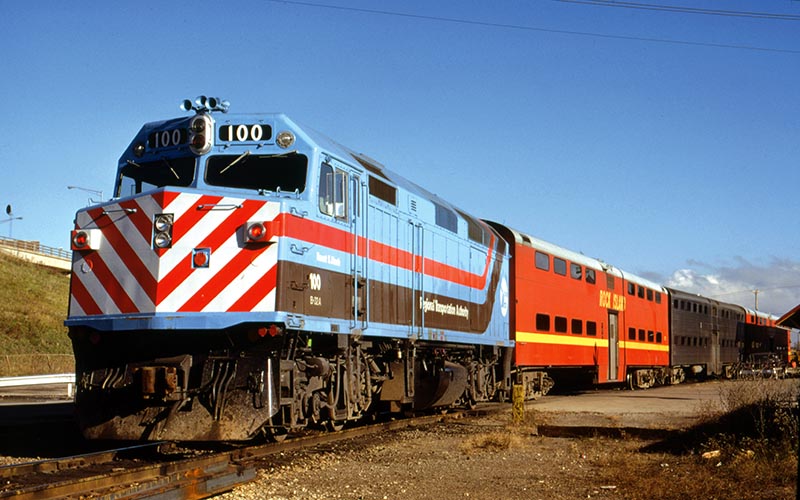
ABOVE: ABOVE: Regional Transportation Authority 100 is seen at Blue Island, Ill., on November 12, 1977. This would be the first of 115 F40 locomotives owned by RTA/Metra, making up the second-largest fleet. —Arthur H. Peterson, LTL
Amtrak Looks for New Power
When Amtrak cobbled together a national network on May 1, 1971, it predominantly received equipment the freight railroads no longer wanted. While some railroads, such as Great Northern, had invested in passenger equipment in the 1960s (like new EMD SDP40s), they weren’t about to give up a still-new locomotive to Amtrak, especially when it could easily be placed in the regular freight pool. Instead, Amtrak was left with what the Class Is didn’t want, mostly tired old F- and E-units.
Looking to modernize its fleet, Amtrak contracted with General Motors’ Electro-Motive Division for a new locomotive model. The SDP40F, created from established SD40-2 engineering and performance data, formed the basis for Amtrak’s first new locomotive purchase, and deliveries began in June 1973. The SDP40F utilized a 16-645E3 engine for 3,000-tractive hp, Dash-2 control system, HTC trucks, six D77 traction motors, and a 57:20 gear ratio; the engine, main alternator, auxiliaries, and steam generator were housed under an attractive FP45-like cowl hood.
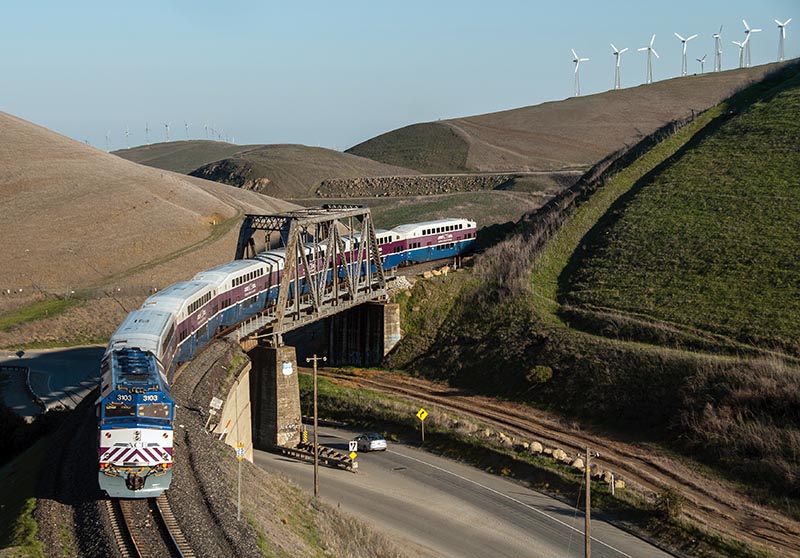
ABOVE: Altamont Commuter Express F40PH-3C 3103 pushes a commuter train on Altamont Pass in California on March 8, 2012. The train originated in San Jose and is heading for Stockton. —Steve Barry
Problems began to emerge with the locomotives, however, most notably a series of derailments. The incidents often occurred when traveling between 40 and 60 mph through 2-degree curves. Typically, it was the first car (the baggage car) that ended up off the rails. After nearly a dozen incidents, speed restrictions were established for the locomotives on certain curves, and Burlington Northern even attempted to ban them from its routes. Exactly why the derailments occurred was never determined, but the issue was enough to make Amtrak reconsider how it wanted to build its roster. Its next locomotive order was a fleet of HEP-equipped P30CH locomotives from General Electric. It continued to work with EMD on a new locomotive design, though, specifically for routes that used its newly acquired Amfleet cars.
The result was the 3,000-hp F40PH, essentially a GP40 with a cowl carbody and with plenty of room for HEP. Following the path of the F40C, the F40PH employed a main-engine-driven alternator connected via a gearbox. The alternator was a Delco product, with 500kw, 480v a.c. nominal output. The geartrain increased the alternator RPM to 1800. Two takeaways from this type of application are a loss of traction horsepower when the head-end power alternator was producing power for the trailing train, and the need for the prime mover to operate at its highest throttle setting to produce electricity, even when stationary…