

 by Eric Cortinas and Parker Gibson/photos as noted
How do you say goodbye to a historic route that has shaped its region for more than 150 years? The former Southern Pacific Siskiyou Line, connecting southern Oregon with northern California, has drawn railfans for generations with its rugged scenery and fascinating operations. With a major freight customer closing its doors, operator Central Oregon & Pacific had no choice but to shut down the south end of this storied line. There are more than 150 years of history to unpack, which are essential to understanding the significance and resilience of the Siskiyou Line.
Beginning in the mid-1800s, Oregon & California Railroad’s desire to connect the upper Sacramento Valley in California to the lower Columbia River Valley in Oregon resulted in a survey effort to establish the optimal route between the two regions. Two potential routes were outlined, one of which became the Siskiyou Line. The other route, built later, became the Natron Cutoff, which took the place of the Siskiyou Line as SP’s preferred north-south route. The latter survives today as Union Pacific’s Black Butte and Cascade subdivisions. At the time of the Siskiyou Line’s initial construction, O&C determined that this route was the preferred choice despite traversing drastically more rugged terrain.
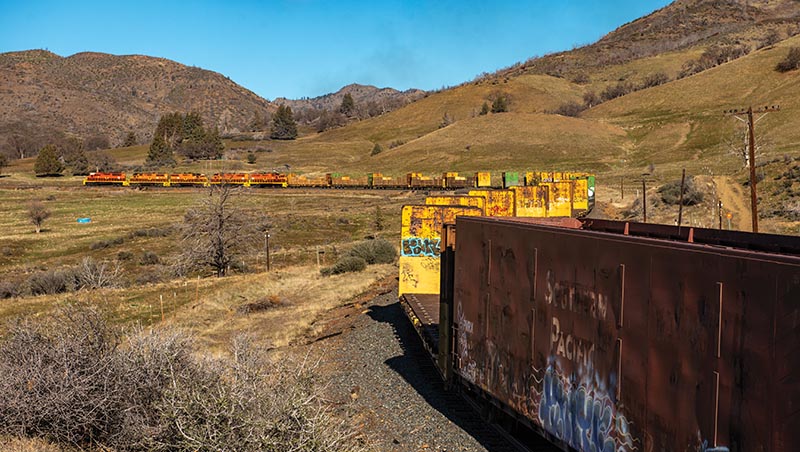
ABOVE: One of the last chores performed by the Weed crew was gathering empty bulkhead flats from the 3,500-foot siding at Hornbrook. Later, two GP38-3s and an SD40-2 from Medford, Ore., would tie onto the head end. —Parker Gibson
Work began in 1868, and over the next four years, the right-of-way was built as far south as Roseburg, Ore. In 1872, efforts halted and wouldn’t restart until the early 1880s. The eventual renewal of construction would be short-lived, though, lasting only from 1881 to 1884, and this proved to be O&C’s final stand. Plagued with issues from the start, O&C declared bankruptcy, with the topography of the region and financial struggles both playing substantial roles in the decision.
Seeing opportunity in the unfinished route, Southern Pacific moved to expand its growing system by assuming control of the faltering O&C and the Siskiyou Line. When construction resumed, SP took a different approach, choosing a steeper route through the Siskiyous that resulted in a rigorous climb and sharp descent over the mountain range. Near the summit, trains faced grades greater than 3 percent, among the steepest on the Southern Pacific system. Construction crews battled the elements until 1887, when the line was finally completed.
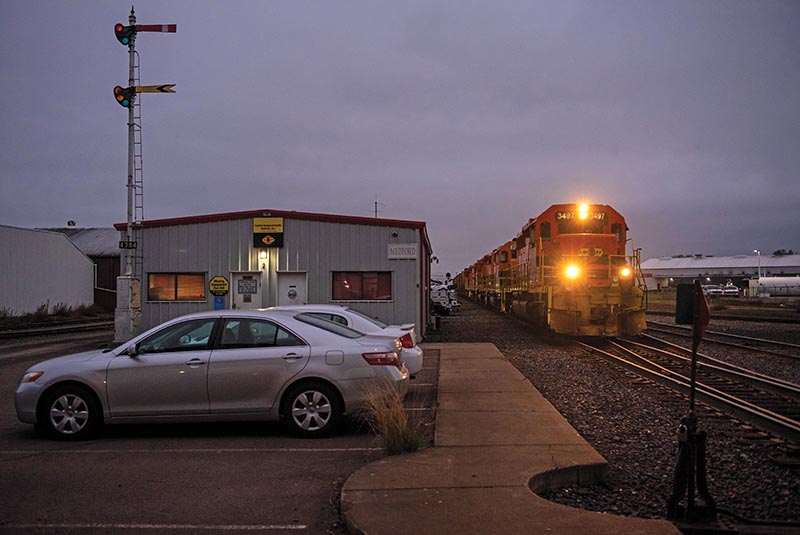
ABOVE: Style B semaphores were synonymous with railfanning along the Siskiyou Line during the 1980s and 1990s. Although none remain in service, one still stands beside the Medford yard office. After receiving clearance on December 11, 2025, the final train rolls into the yard, where the Medford Switcher will break up the consist and sort the cars. —Parker Gibson
According to SP’s timetable, the Siskiyou Line spanned nearly 93 miles between Weed, Calif., at mile 348.4, and Medford, Ore., at mile 441.8. Each mile reflects the distance from the company’s headquarters in downtown San Francisco.
The line became a vital source of freight and passenger revenue throughout the end of the 19th century as the only direct route between California and Oregon. As profitable as the route was, it was difficult and expensive to operate due to the steep grades paired with numerous sharp curves that put a strain on equipment and infrastructure. Despite these challenges, the route remained an asset to the SP into the 20th century, ultimately leading to the company’s outright purchase of the defunct O&C and transferring ownership of the Siskiyou Line fully into the hands of SP in 1926.
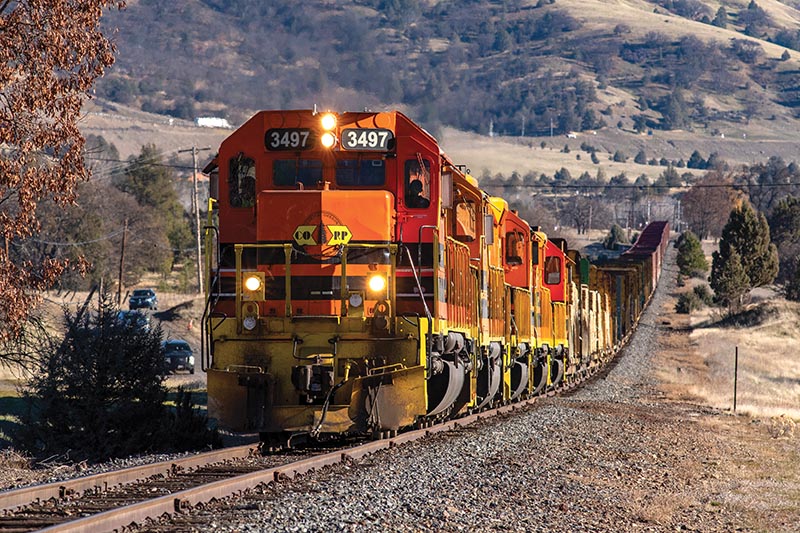
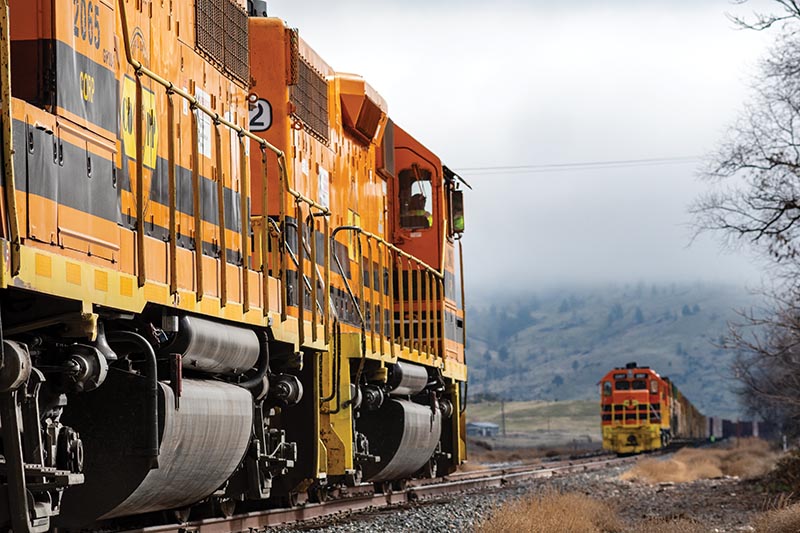
ABOVE: Nearly 50 cars trail behind CORP SD40-2 No. 3497 as the train begins climbing out of the sag on December 11, 2025. In the background stands the new high-wide detector near the former location of one of California’s last Style B semaphores. —Parker Gibson
After 1927, traffic began to decline as most passenger service shifted to the newly constructed Natron Cutoff, leaving the Siskiyou Line primarily to freight. In 1955, SP discontinued passenger service over the route. The lumber industry, however, kept trains moving for nearly 40 years after passenger trains disappeared. As SP neared its own end (purchased by Union Pacific in 1996), the line over the pass was embargoed in 1992. Traffic from Weed continued by way of Black Butte, Calif., handled by a local operating over the southernmost segment of the line.
In December 1994, SP leased the entire route to Central Oregon & Pacific, which lifted the embargo and resumed traffic over the pass in 1995. Over the next two decades, the Siskiyou Line and CORP faced repeated changes and periods of uncertainty. Between 1995 and 2012, CORP moved between parent companies RailTex and RailAmerica before becoming part of Genesee & Wyoming. During this period, traffic on the southern end of the Siskiyou Line came to a halt for nearly seven years beginning in 2008, as deteriorating track conditions required extensive rehabilitation. The future of the line became a subject of debate, though a multimillion-dollar project ultimately replaced rail and ties and repaired numerous bridges. When the work was completed in 2015, Roseburg Forest Products’ shipments out of Weed became the primary source of revenue on the southernmost portion of the route, remaining so until December 11, 2025.
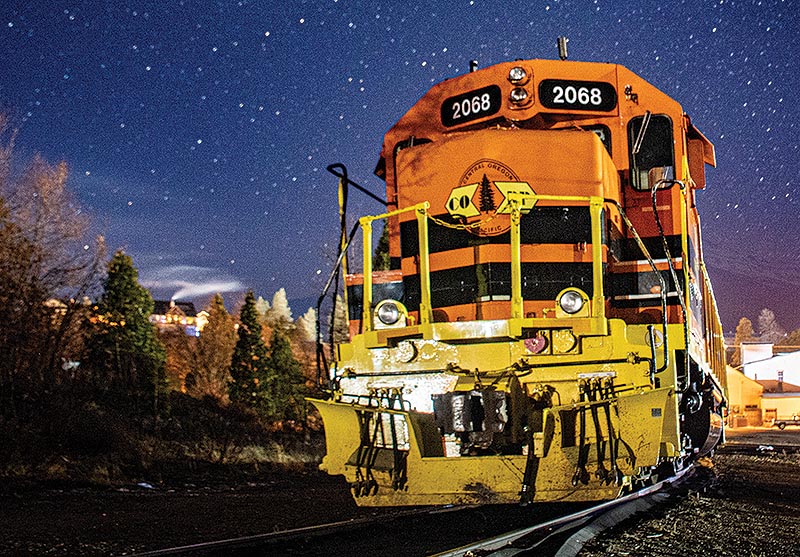
ABOVE: A galaxy of stars watches overhead on December 10, 2025, as CORP 2068 sits silently in the heart of Weed, Calif., awaiting its final trip across the Siskiyou Line the following morning. —Eric Cortinas
Through Eric’s Lens
It was the night of December 10, 2025, and the winds of change were especially fierce in the Northern California town of Weed. A sharp winter chill swept across my face as I photographed a pair of EMD GP38-3 locomotives silently basking in the glow of the streetlights. Owned by Central Oregon & Pacific Railroad, these locomotives had become a familiar part of life in Weed, serving one of the last pieces of heavy industry supporting the town’s economy. As I captured images of the engines resting beneath a blanket of stars, a surreal feeling came over me. This would be the final night the CORP name would grace Weed.
A few short weeks earlier, Roseburg Forest Products, the railroad’s last customer in town, announced the closure of its veneer production facility. The shutdown would mean the loss of roughly 150 jobs at RFP, employment changes at CORP, and collateral economic damage throughout the town. With no other viable freight customers in Weed, the RFP closure would spell the end for the southernmost portion of CORP…
