

 by Tim Doherty/photos by the author
In 1976, everything about Conrail was big — biggest railroad employer, biggest passenger carrier, biggest railroad in terms of revenue, and along with it, big problems. Big Blue inherited the underinvested physical plant of its bankrupt predecessors as well as their service problems and a declining Northeast manufacturing base.
The former New York Central Boston & Albany route over the Berkshire Mountains gave Conrail a near monopoly on southern New England rail traffic, compared to the parallel Boston & Maine to the north. Renamed the Boston Line, it became the primary gateway rail route in and out of New England. By comparison, very little of the former New York, New Haven & Hartford to the south remained in Conrail by the 1990s.
Prior to World War II, rail traffic in New England was centered on the movement of high-value manufactured goods and passengers, both of which were disrupted by new highways being built in the 1950s and the flight of manufacturing to lower-cost locations. The prospects were bleak for the New Haven as the decimated railroad went into receivership for the last time in 1961.
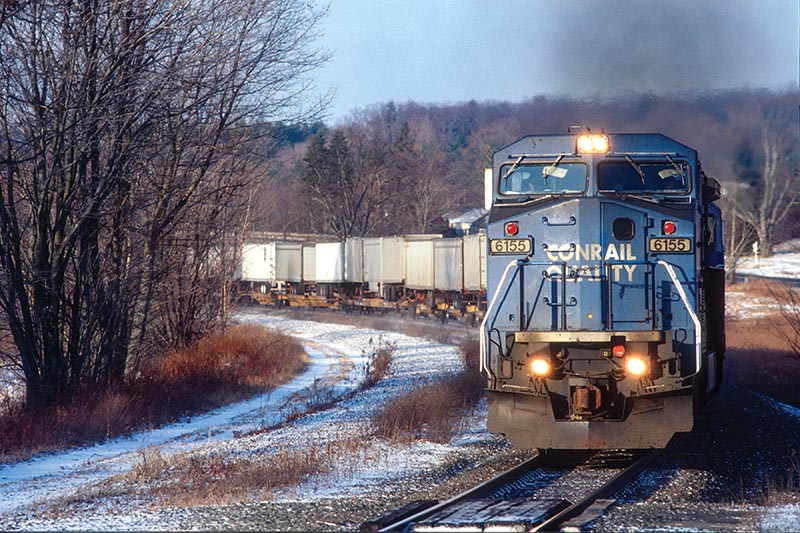
ABOVE: In the early 1960s, New York Central launched “Super Van” service on the former Boston & Albany. Conrail later expanded the service to six intermodal pairs at its peak in the late 1990s. Eastbound TV-6 rounds the famed curve at East Chatham, N.Y., on February 7, 1999.
Facing challenges from declining market share, New York Central and Pennsylvania Railroad agreed to merge in 1962 — a move regulators would approve only if the ailing New Haven was included. Despite its massive scale and apparent resources as the sixth-largest corporation in the U.S., Penn Central was doomed from the outset by hasty merger planning, poor implementation, and questionable investments. Internal conflicts led to operational disruptions that clogged terminals and resulted in lost shipments. Revenues collapsed, and the railroad declared bankruptcy in June 1970, less than two years after the merger was completed.
The collapse of Penn Central also pulled down connecting systems, and by the mid-1970s, the Northeastern rail network was in crisis. Conrail was created to provide “adequate and efficient rail service” at the lowest cost to taxpayers. To do this, thousands of miles of excess track and facilities would be eliminated as a stronger, unified system would emerge from the ashes. Conrail’s success as planned by its creators was “heavily dependent on future projections of uncertain events.” Service would improve and traffic would return as Conrail’s track and facilities were rehabilitated. Further, and likely more problematic, was that the plan for Conrail was developed in the middle of the energy crisis where embargoes by foreign oil producers caused massive shortages and drove up prices. Planners expected new traffic to emerge as oil-fired power plants converted to coal, which at the time was less expensive.
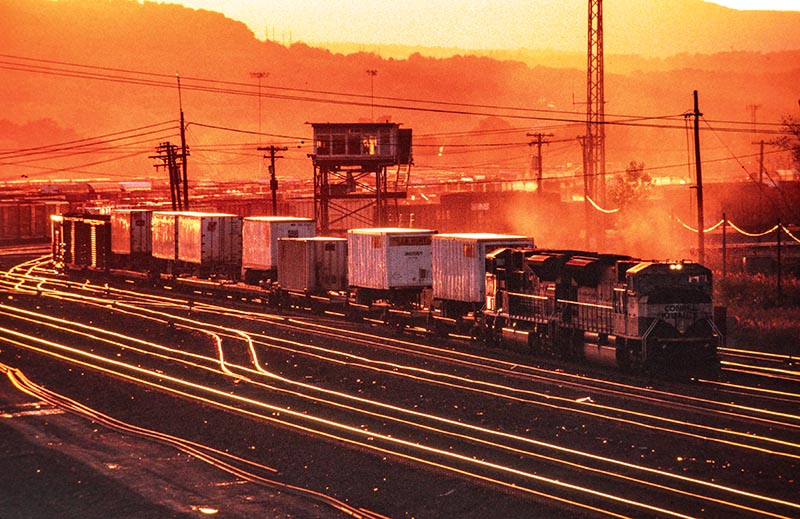
ABOVE: At Selkirk Yard’s east end, the Boston Line to New England diverges from the River Line to New Jersey. On May 28, 1999, SEAL (Selkirk, N.Y.–Allentown, Pa.) departs with Worcester TrailVans lifted from westbound TV-7. At Kearny, N.J., the cars would connect with TV-213 for Norfolk Southern at Lynchburg, Va., and Atlanta.
By 1977, the coal conversion did not materialize as oil prices stabilized, and Conrail had a massive hole in its expected bottom line. Despite the thorough analysis of freight traffic and projections for the future, the resulting system included too much track for the business that Conrail had by the late 1970s. New England already had twice as much track as the national average. Thanks to legislation passed in the early 1980s, Conrail began a further round of rationalization, handed off its passenger operations to the states paying for the trains, and began to use the tools of deregulation to reach profitability relatively quickly.
New England was the birthplace of American heavy manufacturing in the 19th century, and to serve these new industries, some of the earliest railroads in America were chartered between 1832 and 1833. Running southwest from Boston, the New Haven — often in fiscally dubious fashion — acquired nearly every line in southern New England by the beginning of the 20th century, creating a dense web of main lines and branches. North of Boston, Boston & Maine and Maine Central operated routes into New Hampshire and Maine, as well as a western gateway to Albany, N.Y., that included the 4.75-mile-long Hoosac Tunnel. Guilford Transportation Industries consolidated these two lines into a single system in 1983.
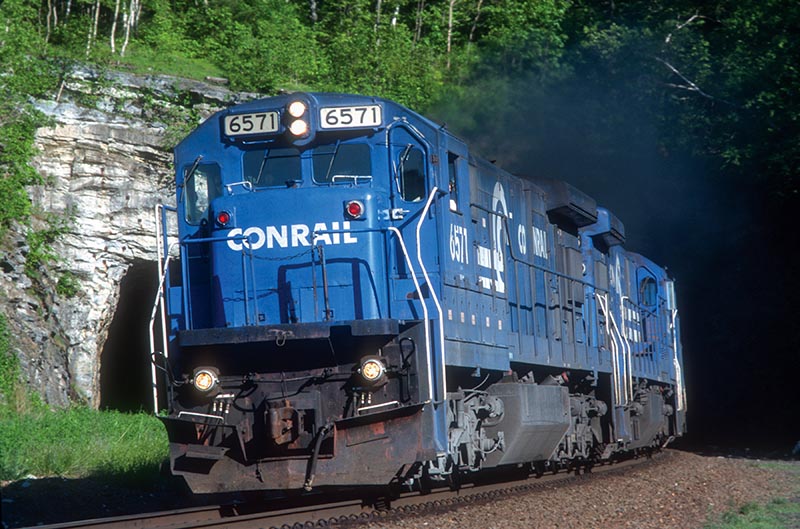
ABOVE: Conrail NESE bursts from State Line Tunnel at Canaan, N.Y., on May 28, 1999, three days before takeover by CSX, led by four 3,000-hp B30-7As. These unique 12-cylinder GE units were prized for fuel efficiency.
Positioned between these two systems, Boston & Albany Railroad was built due west from Boston, linking the three largest cities in Massachusetts with the Hudson River. Its route and construction reflected the combined business and political ambitions of Massachusetts interests seeking a direct western outlet to the interior of the U.S. that bypassed New York City. Built and operated initially as two separate railroads, the Boston–Worcester, Mass., line opened in 1835, followed by Western Railroad from Worcester to the Hudson River opposite Albany in 1841. The two lines did not initially connect at Worcester, nor did they get along well, frequently disputing rate divisions.
Construction of the Western posed a far greater engineering challenge, requiring the railroad to cross two summits at Charlton and Washington, Mass. Fewer than eight miles of the route were level, and deep rock cuts were blasted to climb from 72.5 feet above sea level at Springfield, Mass., to a summit of 1,460 feet at Washington, just 38 miles to the west. The ruling grades lie between mileposts 128 and 138, where the railroad ascends 1,000 feet while crossing the Westfield River 15 times on a succession of sharp curves.
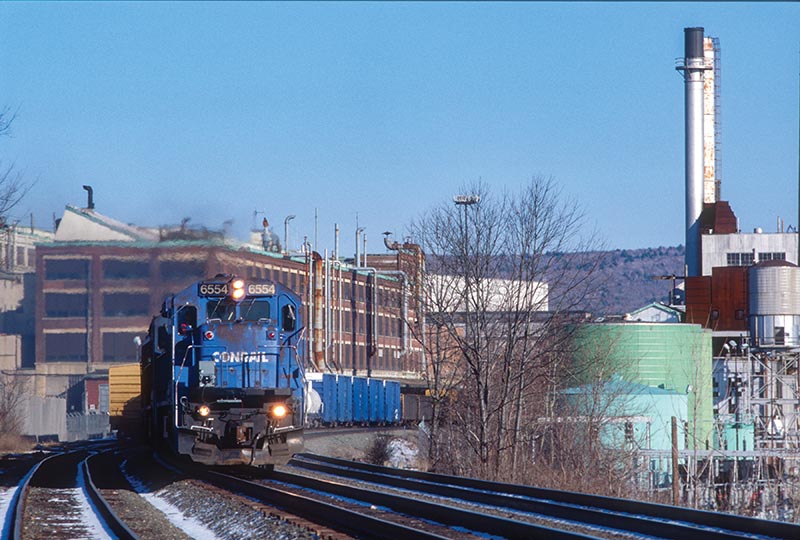
ABOVE: Conrail’s Lawrence to Selkirk freight LASE passes the shuttered GE complex in Pittsfield, Mass., on Feburary 13, 1999. With traffic off of Guilford from Eastern New England this train was one of two originating on Guilford (B&M) and handed off to Conrail at Worcester.
Leased to New York Central in 1900 — which served as its principal connection in Albany — B&A provided the longest single line route to New England. Early entrance into industrialization did not provide a lasting benefit. As early as the 1910s and 1920s, the textile industry shifted production to less expensive locations in the southern and western U.S. The precision manufacturing industry that developed surrounding Springfield in the Connecticut River Valley faced competitive challenges in the 1950s and 1960s, and it also relocated to reduce labor costs. Newer, less rail-dependent technology and scientific industries emerged in New England. The silver lining in this economic transition was that the workers in and around this growing sector would become consumers of automobiles and other goods.
In the 1970s, the freight arriving by rail in New England included perishable and non-perishable food, beer, newsprint, paperboard, tissue, flour, animal feed, fertilizer, plastics, cement, structural steel, plywood, building products, auto parts, and finished automobiles. Conrail inherited widely scattered customers located on different lines that required costly switching for limited carloads. Conrail served multiple grocery distributors, printing plants, and the few heavy manufacturers that continued to hang on. The initial freight schedules reflected the need to serve all these customers with small local yards across southern New England…
