

 by Justin Franz
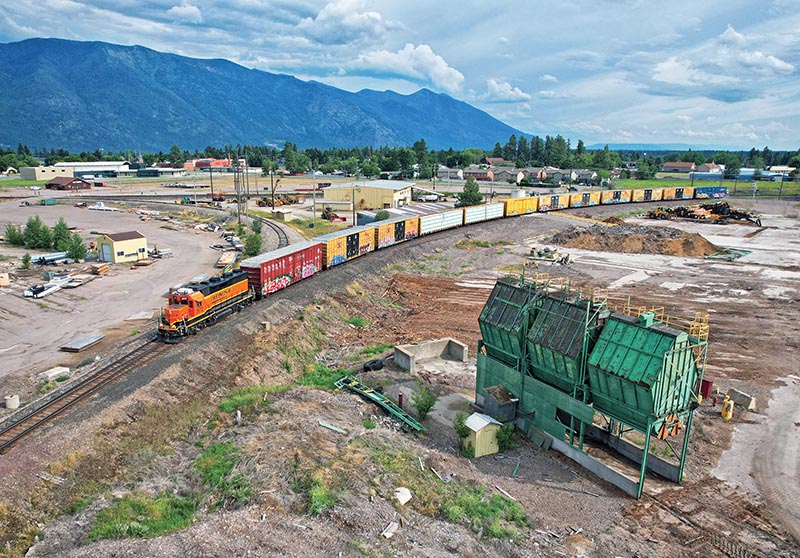
No tool has changed railroad photography more since the advent of the telephoto lens than the drone. Sure, you could argue that digital cameras were a big deal, but they ultimately didn’t change the “look” of railroad photography as much as telephoto lenses did starting in the 1960s or drones in the 2010s. In both instances, entirely new compositions became available to photographers.
But now, the future of drone railroad photography in the U.S. is threatened by a government ban on the sale of new foreign-made drones.
DJI Drone Ban
The last time we talked about drones in Camera Bag was in July 2025. At that time, drone enthusiasts were still processing the impacts of the National Defense Authorization Act, a massive military spending bill that passed a few months earlier. Deep in the text was a provision that called for the federal government to conduct a security audit on drones produced by DJI, the Chinese-based manufacturer that dominates the consumer drone market. If the government didn’t conduct such an audit, DJI would be added to the Federal Communications Commission’s “Covered List,” which includes companies the government believes “pose an unacceptable risk to national security.” In layman’s terms, being added to the list means that DJI would no longer be able to release and sell new drones in the U.S. For its part, DJI said it welcomed the security audit and was confident that its products did not pose a threat to U.S. security or the privacy and security of its users. But unfortunately for DJI and U.S. drone users, that security audit never happened, and the FCC added DJI to the naughty list a few days before Christmas. But that wasn’t all; the FCC went a step further, announcing on December 22 that it was banning all foreign drone companies from selling new products in the U.S. Considering DJI controls 70 to 80 percent of the consumer drone market worldwide, for all intents and purposes, it’s still mostly just a DJI ban.
Previously, opponents of DJI have alleged that the company’s drones pose a threat to Americans due to data collection. But this time around, the argument against it was more about physical threats. In its public notice announcing the ban, the FCC said that foreign-made drones posed a threat to U.S. safety and security for several reasons, including the possibility that they could be used by cartels to smuggle drugs across the border (although there was no mention that a U.S.-made drone could also do that, or by one of the tens of thousands of automobiles that cross the border every day; but I digress). The FCC also argued that foreign-made drones could pose a threat to large gatherings, like sporting events or parades (although, again, so could the aforementioned U.S.-made drone or automobile).
You really didn’t have to read much between the lines of the press releases to find the real reason why the government was doing this — it’s trying to put the thumb on the scale on the side of the U.S.’s still-minuscule drone industry. Citing an executive order from the middle of last year, the FCC noted that “ensuring a strong and resilient drone industrial base is an economic and national security priority.”
As with everything in American life these days, there’s a political angle — although in this rare instance, it appears both parties are aligned in their dislike of DJI. After all, it was President Joe Biden who signed the 2024 defense act into law, and it was President Donald Trump’s FCC that sealed the deal and banned new products from DJI.
What Does It Mean?
So what about the American drone industry? Unfortunately, at this time, it’s predominantly focused on commercial users, meaning the drones that are made in the States can cost tens of thousands of dollars, usually out of the price range of even the most serious railroad photographer. The consumer-grade ones, those priced around $1,000 or less, simply don’t compare in quality to what DJI is putting out. And the few companies that were focusing on building consumer drones in the U.S.? Sadly, some of them have gone out of business. Perhaps the government’s handicapping of DJI in the U.S. will lead to more American-made options in the years ahead, but I don’t think that will happen before your next railfan outing.
So What Does This Mean for Me?
If you’re like me and you use a DJI drone (I’m flying an Air 2S), what does this mean? For now, we’re okay. Government agents aren’t about to kick down your door and take your camera. From what I’ve read, the FCC ban only affects new products, not those already certified to fly in the U.S. That means you should also still be able to do software updates as needed. It also means that you can still buy a new drone — at least for now. A quick look at B&H Photo’s website shows that models like the Air 3S or the Mini 4 Pro were in stock, although some bundles (which include an advanced controller and extra batteries) were backordered. One issue was that U.S. Customs had been holding some shipments of DJI drones, alleging that the company was violating the Uyghur Forced Labor Prevention Act. Passed in 2021, that law prohibits the import of goods from the Xinjiang region of China, where forced labor among ethnic minorities has been reported. For its part, DJI says none of its products are made in that region.
As time goes on, it seems likely that buying new DJI drones will get harder and harder, and most of the newest models will not be available in the U.S. Of course, what drones are out there now are impressive and, in my opinion, pack more than enough technology needed to be useful for years to come (my rule of thumb is if I can take a photo and it’s good enough for a centerspread in print, then it’s good enough for me). But it’s unclear how much effort DJI will put into making new versions of “old” drones that have already gotten the green light from the federal government. In many ways, the advice I gave back in the July 2025 issue remains as relevant as ever — be extra careful and try not to send that drone into the trees.
Union Opposition
There’s one more bit of drone-related news that flying railfans should be made aware of. One of the nation’s largest railroad unions is calling for drones to be grounded at rail yards and along main lines. Last fall, the National Safety and Legislative Department of SMART-TD sent a letter to the Federal Railroad Administration “demanding a full prohibition on the use of drones by railroad managers, or anyone else, in active rail yards and along main lines where trains are moving.” The filing came as an increasing number of railroads are using drones to inspect infrastructure, but to also stealthily keep an eye on crews.
“Our rail yards are not laboratories or surveillance zones. They’re our offices,” said Jared Cassity, SMART-TD National Safety and Legislative Director. “When a drone flies overhead, it’s not just a nuisance; it’s a distraction in one of the most dangerous work environments in America. And make no mistake; if something goes wrong, it won’t be the manager behind the joystick who gets hurt. It’ll be one of our members. There is nothing cute, cool, or futuristic about any of that.”
It’s unclear whether the FAA will act on the union’s request, and it’s also uncertain how feasible it is to ban drones near rail lines. Most commercially available drones require FAA approval to operate in restricted areas near airports, so the system could potentially be expanded to include rail lines. However, given the extensive size of the rail network, expanding such a system would be a monumental task. There’s also the question of how far from the right-of-way these restrictions would apply.
The only sure thing is this: If you do enjoy railfanning with a drone, go out and get those unique views while you can!
