

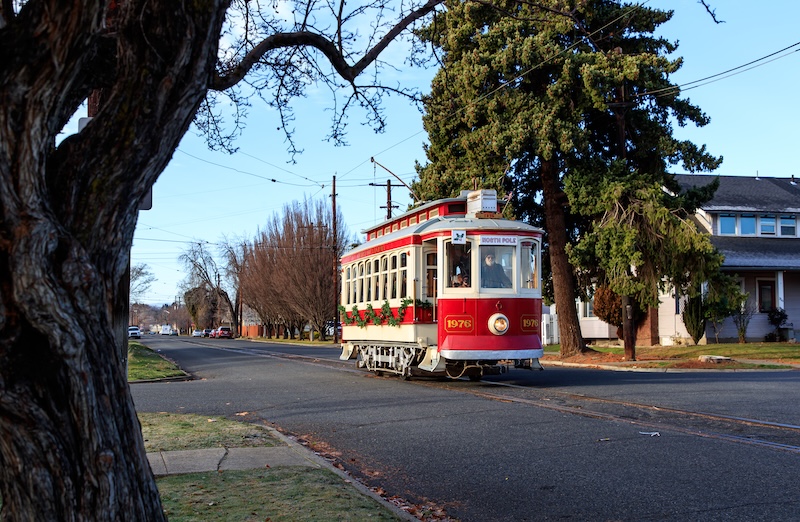
The Yakima City Council voted Tuesday night to extend a five-year operating agreement with Yakima Valley Trolleys, the Washington non-profit that runs the community’s historic interurban railroad. However, what the railroad will look like when that agreement ends in 2030 remains an unanswered question.
Late last year, the city council decided not to automatically renew its operating agreement with the non-profit that manages what remains of the Yakima Valley Transportation Company, an interurban railroad once part of the Union Pacific and now owned by the city. At that time, the council wanted to better assess its financial situation. A week earlier, it approved a 2026 budget that included cutting $9 million from its current budget, including from police and fire services.
The actual operation of the trolley is fairly minimal for the city. The previous agreement specified that the city would cover basic costs, such as heating and maintaining the city-owned trolley barn, and set aside about $10,000 for any maintenance issues with the track or other city-owned property. However, the larger issue—and expense—is a major road construction project along the trolley route connecting the trolley barn with the rest of the line to the town of Selah. That street, Sixth Avenue, needs to be rebuilt, and for a time, the city considered paying the approximately $7 million it would take to reinstall the rails and the catenary above. But with a budget crisis on the horizon, some city council members are questioning whether that’s a wise financial choice. As a result, the city council decided to delay approving or denying an operating agreement until a decision is made on the road project.
Presently, the trolley operation is mostly confined to Pine Street. In 2024, a diamond crossing with the Central Washington Railroad at the north end of Sixth Avenue was removed for maintenance, and a bridge further north was taken out of service. The bridge is currently being repaired, and volunteers are hopeful the diamond will be put back in place, allowing trolleys to reach Selah again.
Tuesday’s meeting started with public comment. Nearly 20 people spoke to the council, either in person or via Zoom, supporting the trolley, including one person who was in England. Only one person opposed extending the operating agreement. After public comment and other city business, the council began discussing the Sixth Avenue project and the costs of rebuilding it with the track. Mayor Matt Brown asked if it was possible to turn Sixth Avenue into a one-way street, allowing the trolley line to stay in its current place but no longer be part of the roadway. Community Development Director Bill Preston said the city’s engineering staff would need to look at what’s possible. Brown and others also inquired if there are other street projects that could be addressed first, giving Yakima Valley Trolleys more time to potentially secure their own funding to help keep the tracks. Preston said it would ultimately be up to the city council to decide which roads to fix first, but stated that Sixth Avenue is “structurally toast” and the longer the city waits to fix it, the more expensive it will be. Ultimately, the city council decided to hold another hearing, scheduled for February 17, to gather public input on what should happen along Sixth Avenue and how to pay for it.
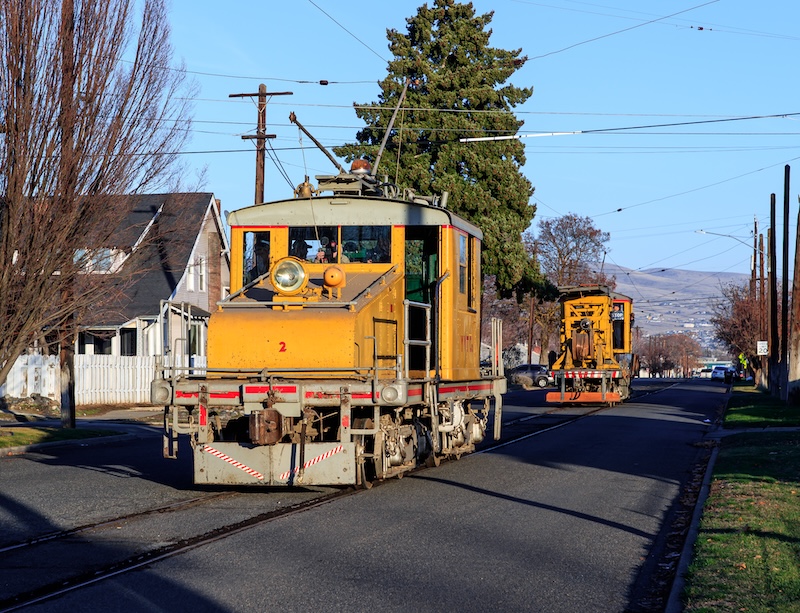
Yakima Valley Transportation Company 298 made a rare appearance during what could have been the railroad’s final day of operation on December 31. It was followed by line car A. Photo by David Honan.
With that item out of the way, the council then moved on to the operating agreement with Yakima Valley Trolleys. The pared-down agreement outlines that the city will spend about $5,000 annually to heat buildings and power the overhead, and keep around $10,000 available for emergency street repairs. The non-profit will help cover the cost of insurance, about $4,800 annually, according to city staff.
One city council member, Rick Glenn, expressed concern about the cost of the trolley to the city; “I’d rather have more cops and firemen and keep the pool open,” he said at one point. However, other city council members pointed out that the city would have to pay for maintaining the buildings whether the trolleys were running or not. The city council then voted six to one to extend the operating agreement. The new agreement will run through 2030.
Late Tuesday evening, Yakima Valley Trolleys thanked their supporters and announced they were getting to work planning various events and excursions, including some on Valentine’s Day weekend.
The main question now — and one that will be debated during the next city council meeting — is what that railroad will look like in 2030. If the city proceeds with the Sixth Avenue project but doesn’t pay to reinstall the rails, Yakima Valley Trolleys will no longer be able to reach the community of Selah to the north. Without that connection, the railroad would no longer qualify as a true interurban, and volunteers have said that could threaten an effort to get it designated as a National Historic Landmark as the country’s last interurban railroad.
Yakima Valley Transportation Company was established in 1907. Starting as a streetcar line serving downtown Yakima, the company was acquired by Union Pacific predecessor Oregon-Washington Railroad & Navigation Company in 1909 with the aim of tapping into the region’s fertile agricultural resources. Eventually, the system grew to include over 40 route-miles radiating into surrounding communities, providing interurban passenger service and feeding freight traffic to the national rail network. Regular passenger service ended in 1947, and the remaining streetcars were scrapped or sold. Freight service continued until Union Pacific filed for abandonment in 1985 due to a decline in traffic. The railroad was later purchased by the city and has operated as a museum ever since.
—Justin Franz, with additional reporting by David Honan.