


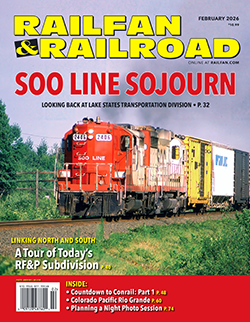
 This month, Andrew Nelson leads us on a fond look back at the Lake States Division of Soo Line. Our story is set in the mid-1980s, when the Soo began preparations to “spin off” a portion of its original main line as a condition of absorbing the remnants of the bankrupt Milwaukee Road.
The names “Milwaukee Road” and “Soo Line,” though, are old ones in railroading, and crucially, both are nicknames. Like many railways founded in the 19th century, both companies went through multiple re-incorporations and mergers, their identities an unstable litany of place-names joined by an ampersand. A shorter “handle” became a favored marketing tool. The origin of the Milwaukee’s is self-evident, as “Chicago, Milwaukee, St. Paul & Pacific” indicated the Upper Midwest cities linked with the Pacific Coast. Focusing on the largest city in Wisconsin as the epicenter, it becomes “The Milwaukee Road.” Soo Line requires a bit more explanation. Originally founded as Minneapolis, Sault Ste. Marie & Atlantic in the 1880s, the railway’s middle place-name referred to a Quebecois-founded town on Michigan’s upper peninsula, with the French word “Sault” pronounced “Soo.” While the “Soo Line” nickname came early, it wasn’t until 1961 that the Minneapolis, St. Paul & Sault Ste. Marie Railroad adopted it as its legal moniker.
Beyond the nicknames, the Milwaukee and the Soo are both railways that grew up with what was called — a century ago — the “Old Northwest,” a region that stretches from the Great Lakes to the plains of the Dakotas. For much of the 19th century, numerous railways criss-crossed this space, fighting to control traffic in the region’s rich grain-growing lands. The Milwaukee traces its founding to the 1840s in an attempt to connect Great Lakes and Mississippi River shipping, cutting out business that might otherwise have gone via Chicago. The Soo, founded more than a generation later, had similar designs; its St. Paul backers planned the new line running due east toward Great Lakes ships at its namesake town on the passage between Lake Superior and Lake Huron. It was so successful that the transcontinental Canadian Pacific picked up a majority stake in the company in the 1890s.
The Old Northwest, then, is a region that is intimately tied up not merely in its grain-rich landscape, but also in its proximity to Great Lakes ships and (through them) to the Atlantic Seaboard. Today, we are apt to see the hills and dales of Wisconsin or the lake-studded woods of Minnesota and think them insulated from the wider world, but in fact the Old Northwest was, thanks to lake steamers and railways, one of the most connected parts of North America. It is little wonder that, for much of the 19th century, immigrants from Germany, Sweden, and Finland saw this region as a place to start over and make good. The fact that they, like the railways they rode, largely succeeded is part of why today the idea of this region as a northwestern edge of anything is difficult to perceive. Every railway line, every new small town, every growing downtown office tower in Chicago and Milwaukee and St. Paul made it all the harder to see this as anything other than a contiguous part of the wider Midwest.
Likewise went the Milwaukee and the Soo. The former suffered bankruptcy after bankruptcy in the latter half of last century. It was not, perhaps, so much a marker of failure as it was a symptom of having grown too far, too fast, connecting too much of the Northwest — both “old” and “new” — at the expense of making a sustainable profit. The Soo acquired it in 1986, but just four years later, Canadian Pacific bought out the remainder and converted it into a subsidiary that exists only on paper. Just as the Old Northwest had grown into the larger Midwest, the region’s flag carriers disappeared into the larger railway network.
—Alexander Benjamin Craghead is a transportation historian, photographer, artist, and author.
