

 by Jim Rowland/photos as noted
On a map, Michigan’s Washtenaw County might appear unremarkable — just another patch of Midwestern farmland and small towns, yet it holds several distinctions. In the world of college sports, it’s home to the University of Michigan and the Wolverines’ football stadium in Ann Arbor, the county seat. In the world of regional railroading, it marks the southernmost point on Great Lakes Central Railroad, where the line ends at Osmer — a quiet junction north of Ann Arbor where GLC interchanges with Watco’s Ann Arbor Railroad.
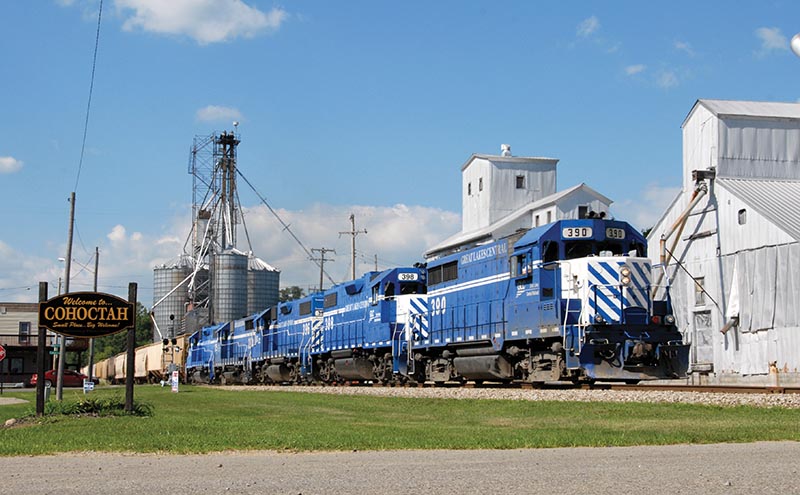
As it happens, Washtenaw County is also home to the author’s extended family, making it a regular stop during summer visits. Those trips often include time trackside at Osmer, camera in hand, to document the routine arrival and departure of Train OW-11 — GLC’s several-days-per-week run from Owosso to Ann Arbor. But this year’s visit carried new urgency. On March 6, GLC announced an agreement for Watco to acquire control of the 379-mile system, made up primarily of former Ann Arbor, Grand Trunk Western, and Pennsylvania Railroad trackage, along with smaller segments of New York Central and Pere Marquette heritage. One of the primary draws is GLC’s fleet of EMD GP35s originally ordered by the Ann Arbor and riding on trade-in trucks from Alco FAs.
During your author’s summer visit, everything appeared business as usual, but the clock was ticking. Summer 2025 turned out to be the last chance to capture Great Lakes Central as we’ve come to know it.
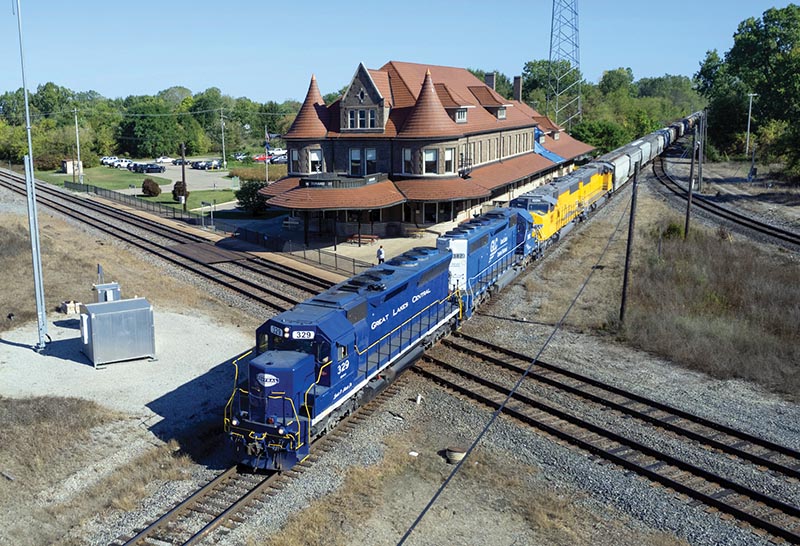
ABOVE: On the eve of the Watco takeover, GLC Train OW-11 brings two ex-Union Pacific SD60Ms north to Owosso on September 30, 2025, crossing the Canadian National main at Durand. The ex-UP units would enter GLC service the next day under Watco ownership. —Jeff Mast aerial photo
From Five Railroads
One must dive into Michigan’s colorful railroad past to fully appreciate the varied history of today’s 379.2 miles of state-owned trackage that is GLC. The railroad operates a route made up of five different legacy carriers that passed through multiple subsequent owners since the era of fallen flags, merger mania, and deregulation. How all these lines came together to form one cohesive system could fill a large book of tall railroad tales, but after weathering multiple political and economic storms came a pared-down, viable railroad system.
Former Ann Arbor trackage constitutes the lion’s share of GLC’s system. Ann Arbor’s main line from Toledo, Ohio, to Frankfurt was built in stages between 1872 and 1889 to function as a through route utilizing Lake Michigan car ferries to access western carriers in Wisconsin. With car ferry transportation long gone, today’s GLC operates former AA lines from Osmer to Pitt Junction, located just south of Durand, along with Owosso to Yuma. Most of this track had been purchased and/or leased by the state of Michigan just prior to the inception of Conrail, with Grand Trunk Western having acquired the segment from Durand to Ashley outright. While Conrail, GTW, Michigan Interstate, and Michigan Northern all operated various segments of the Ann Arbor (affectionately called the “Annie” by local fans), they were all eventually united under Tuscola & Saginaw Bay (TSBY) operation until May 2006.
Pennsylvania Railroad’s former Grand Rapids & Indiana line makes up the second-largest amount of GLC trackage. GLC operates over the former PRR from Cadillac to Petoskey, along with Walton to Traverse City trackage; the majority of this line was constructed between 1870 and 1873. After the Penn Central merger in 1968, the line was operated by Michigan Northern starting in 1976 and subsequently TSBY in 1984.
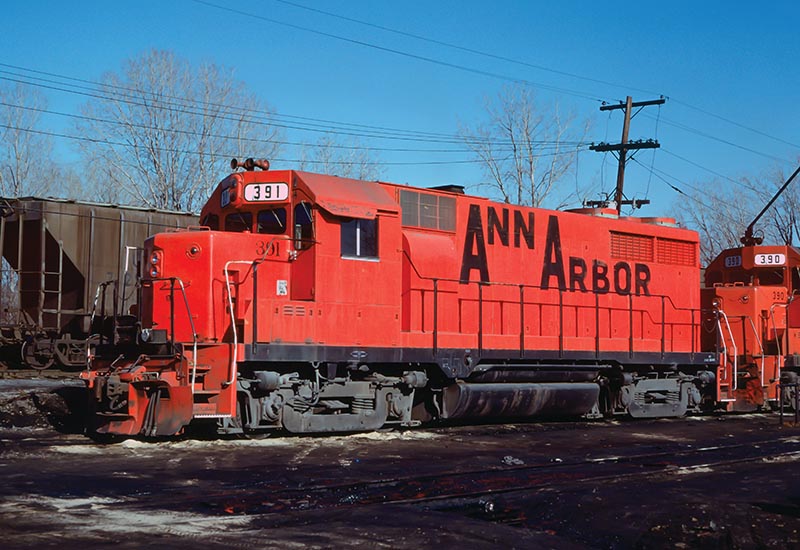
ABOVE: Ann Arbor Railroad was historically under control of Wabash Railroad until 1963, when Detroit, Toledo & Ironton took over. AA was sold to private investors in 1970, but declared bankruptcy in 1973. The state of Michigan purchased the railroad and designated Conrail as operator in 1976. The contract was transferred to Michigan Interstate in 1977, but in 1982 the state split the railroad south of Ann Arbor and transferred operation of that portion to Tuscola & Saginaw Bay. Riding on trade-in trucks from an Alco FA, AA GP35 391 rests at Toledo, Ohio, on March 28, 1982. —Roger Durfee photo
Pere Marquette, Grand Trunk Western, and New York Central lines make up the smaller segments of today’s GLC. Track between Grawn and Williamsburg, via Traverse City, is former Pere Marquette built in 1891. It became part of the Chesapeake & Ohio system in 1947, and was later operated by Michigan Northern and TSBY. GLC’s Ashley to Middleton Branch was originally Grand Trunk Western, built in 1888 and sold to TSBY in 1983. Finally, a small remnant of NYC’s Saginaw Branch, built in 1868 and once linking Lansing with Bay City via Saginaw, constitutes GLC’s Owosso-Oakley Branch. After Penn Central was absorbed into Conrail, the line was operated by Michigan Interstate in 1977 and then TSBY in the 1980s.
Tuscola & Saginaw Bay Railway was incorporated on April 26, 1977, to operate a number of state-owned lines under contract for the Michigan Department of Transportation. With the addition of the lines formerly operated by Michigan Interstate and Michigan Northern in 1982 and 1984, TSBY used its former AA trackage as a funnel for conveying traffic south to its major interchange partners — Grand Trunk Western at Durand, CSX at Howell, and Michigan Interstate at Osmer.
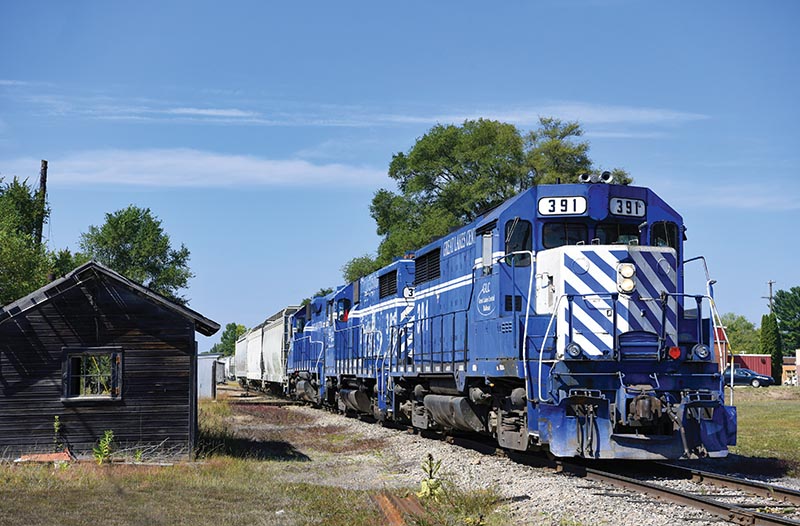
ABOVE: GLC 391 (ex-AA 391 seen at right) and other units are backing off the Transfer Track to the former Ann Arbor yard after working on the former Chesapeake & Ohio at Clare on September 12, 2025. A few weeks later, 391 struck a grain truck and was heavily damaged. —Roger Durfee photos
While all the other interchanges were long-established, Osmer was new. As a location out in the middle of nowhere, it had been of no consequence prior to the division of the original Ann Arbor property. Once ownership was split south of that point and the old AA from there to Toledo became a separate railroad, a new two-track interchange yard was constructed to avoid running large trains into the increasingly cramped Ferry Yard in downtown Ann Arbor. Michigan Interstate retained the Ann Arbor to Toledo segment following its divestiture of all lines north of Ann Arbor. Following a 1983 bankruptcy and 1985 purchase from the state of Michigan, it was again sold in 1988 to Ann Arbor Acquisition Corporation as its Ann Arbor Railroad System. Watco eventually purchased the railroad in 2013.
When the last Lake Michigan car ferry ceased operation in 1982, through rail traffic across the region became a thing of the past. (Although the former C&O S.S. Badger still sails today, it no longer carries railcars.) To stay viable, TSBY focused on cultivating a strong, diversified base of local customers — a strategy that proved successful. Sustained by steady freight traffic, TSBY remained independent for more than two decades. In 2006, however, management elected to sell the railroad, and that May it was acquired by Federated Railways. With the change in ownership came a new name — Great Lakes Central Railroad…
