

 by Andrew S. Nelson/photos by the author
On February 28, 1987, I got a call from my brother, Jeff, who was then a student at the University of Wisconsin at Stevens Point. He had just come back from Soo Line’s Stevens Point engine terminal and had news — the terminal was chock-full of GP9s, GP30s, and GP35s. There wasn’t a single SD40 or SD40-2 to be found. Something was brewing.
And brewing it was. Soo Line was going to make a stronger go of its Lake States Transportation Division (LSTD) that had been created in 1986 after it had acquired The Milwaukee Road. Basically, the “Lake States” as it became known, was the original Soo Line trackage in Wisconsin (with two small tails into eastern Minnesota) and Upper Michigan prior to The Milwaukee Road merger. Also included were the former Milwaukee Road Wisconsin Valley Line between New Lisbon and Tomahawk, Wis., and the former Milwaukee Road line between Green Bay and Milwaukee. In the months prior to the official January 1, 1986, merger, Soo had shifted almost all through traffic between the Twin Cities and the Chicago-area terminal at Bensenville/Schiller Park to the former Milwaukee Road main line. This left the original Soo main through Wisconsin with little traffic. Stevens Point, a busy division point on the original Soo, went from eight to 12 through trains per day to fewer than half as many.
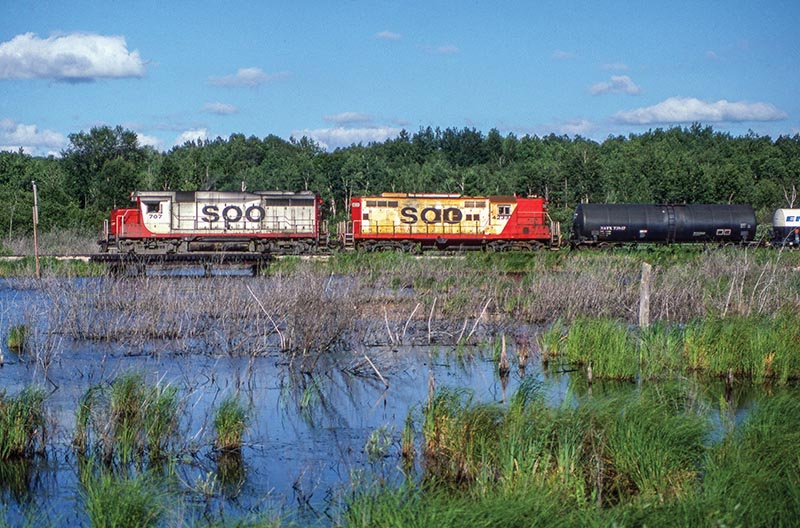
ABOVE: Train 17 crosses Little Hay Meadow Creek north of Otis on July 3, 1987. GP30 707 and GP9 4233 are in charge.
What followed after that phone call from my brother was akin to traveling in a Soo Line time machine that lasted all of a little over seven months.
Now, I need to point out here that I was someone who cut his teeth watching The Milwaukee Road on its Wisconsin Valley Line in hometown Wausau. I was used to the ever-predictable Bensenville–Wausau Train 247 arriving in Wausau in the early morning behind three GP38-2s. A few hours later, the “North End,” the moniker for the Milwaukee’s Wausau–Tomahawk turn, would leave Wausau with one or two GP38-2s. A little later in the morning, one GP38-2 would take the “Rapids Patrol” (“patrol” was the Milwaukee’s term for most way freights) south to as far as Wisconsin Rapids.
Later in the afternoon, both the North End and Rapids Patrol would arrive back in Wausau. By early evening, the three GP38-2s that had brought Train 247 to Wausau that morning were leading Train 246 to Bensenville. The whole operation ran like clockwork, Mondays through Saturdays, orange and black locomotives up front, and an orange bay window caboose in the back. From mid-1985 through early 1987, the former Milwaukee Road in central and northern Wisconsin became much less Milwaukee and much more Soo, and I did not like that one bit.
But, March 1987 changed all of that.
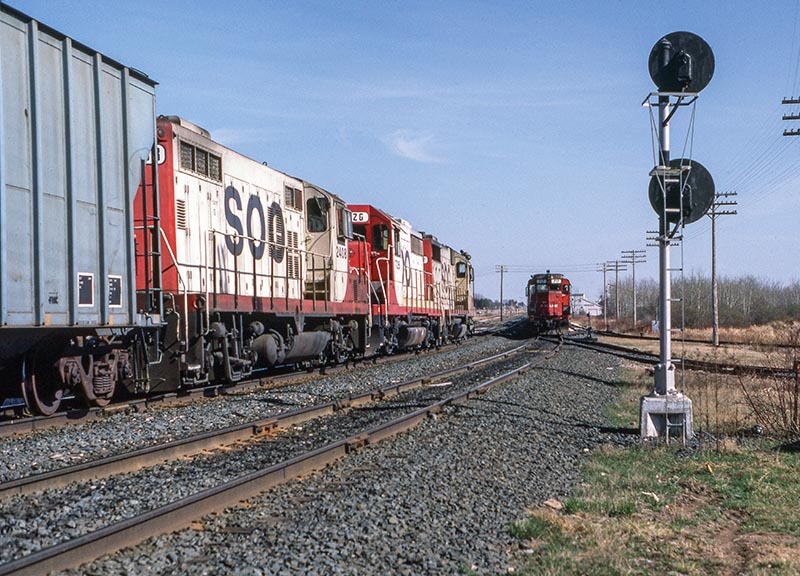
ABOVE: The Stevens Point Dispatcher West set up the meet between Stevens Point–Superior Train 3 and its counterpart Train 4 at Spencer, Wis., on April 17, 1987. Spencer was where the Soo’s route to Ashland split from the Chicago–Twin Cities main line.
This Is 1987?
The transformation in the Stevens Point area happened pretty much overnight. Soo Line transferred 37 GP9s, 19 GP30s, six GP35s, nine SW1200s, and two SD39s (ex-Minneapolis, Northfield & Southern) along with a few “Bandit” ex-MILW GP20s (rebuilt GP9s with chopped noses) and SD10s (rebuilt ex-MILW SD7s and SD9s with chopped noses) to the Lake States. The “Bandit” nickname came from the way former MILW units had their roadnames hastily masked out with black paint and placed back into service. Some units remained this way until the last few were retired in 2019.
This power transfer put Soo’s oldest power on its lightest density lines. The Lake States would not be the land of SD40-2s and SD60/SD60Ms that dominated the former Milwaukee Road main line between the Twin Cities and Chicago. In fact, except for the rust on several of the older Soo locomotives, the look of the Lake States in spring, summer, and fall 1987 was more like a railroad in 1967. The LSTD presented a rare opportunity on a Class I to recreate scenes common two decades earlier.
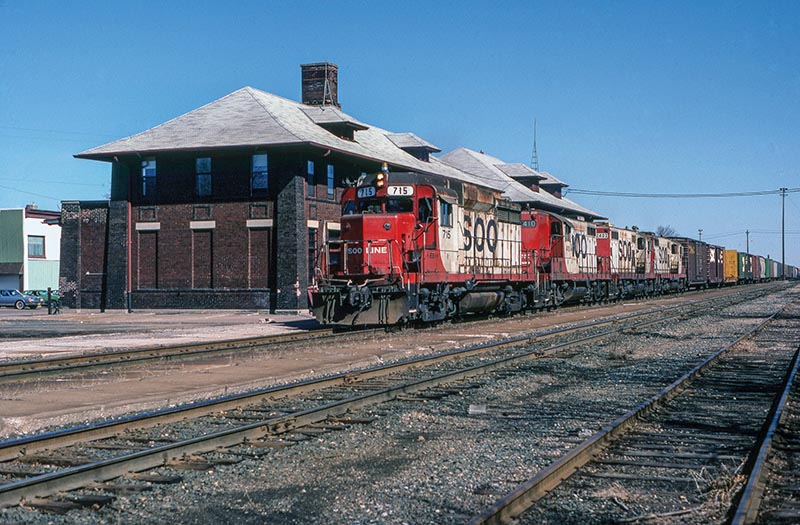
ABOVE: GP30 715, replete with rust, leads three GP9s and Train 3 past the depot at Stevens Point on March 20, 1987.
Suddenly, a drive from Wausau to Stevens Point to “check on the Soo” became a worthwhile venture. My first chance to get to “Point” at the start of the LSTD era was on March 20, and it didn’t take long for me to get hooked. Train 4 was ready to head east to Shops Yard in North Fond du Lac behind GP30s 719 and 703. Skies were bright and sunny, and the two units put on a good audio show as those old turbocharged 567s slugged it up Stockton Hill east of Stevens Point. After the train crested the hill, it was a cross-country chase east to Waupaca.
That afternoon Stevens Point–Shoreham Train 1 left Stevens Point with three GP9s, including two 4200-series “torpedo Geeps” that were originally acquired for Soo passenger train service. After the 1 departed Stevens Point, Train 3 for Stinson Yard in Superior left Point Yard behind a GP30 and three GP9s.
Yep, I was hooked…
