

 by David T. Rohdenburg/photos by the authors
As I pointed my car west toward the CSX Indiana Subdivision before sunrise from our home in suburban Cincinnati on a humid August 2025 morning, the lyrics to John Mellencamp’s 1985 hit “Small Town” rang in my head. To me, the song’s lyrics always bring to mind the rural communities west of Cincinnati in southeast Indiana that dot the former Baltimore & Ohio main line to St. Louis — towns with names like Pierceville, Holton, North Vernon, and Seymour.
Seymour is actually the small town the song was written about — John Mellencamp’s birthplace and boyhood home — and is also a focal point in today’s operations on what is now the Indiana Sub. It is the junction with Louisville & Indiana Railroad, and where CSX trains coming from Louisville, Ky., via L&I turn eastward onto B&O to head toward Cincinnati. It’s not the small towns or rural scenery that have drawn railfans to this line, though, but the classic B&O color position light (CPL) signals that have guided trains for decades but are finally succumbing to modern technology.
Originally constructed by Ohio & Mississippi Railroad, the line was completed as a six-foot broad gauge railroad in 1857 and was converted to standard gauge in 1871. Baltimore & Ohio Southwestern Railroad acquired O&M in 1893, and it was formally merged into the Baltimore & Ohio system in 1900, establishing a continuous rail route from Baltimore to St. Louis. Changes in traffic patterns over the years meant that much of the former B&O main line across southern Ohio, Indiana, and Illinois became less important, and sections were gradually abandoned.
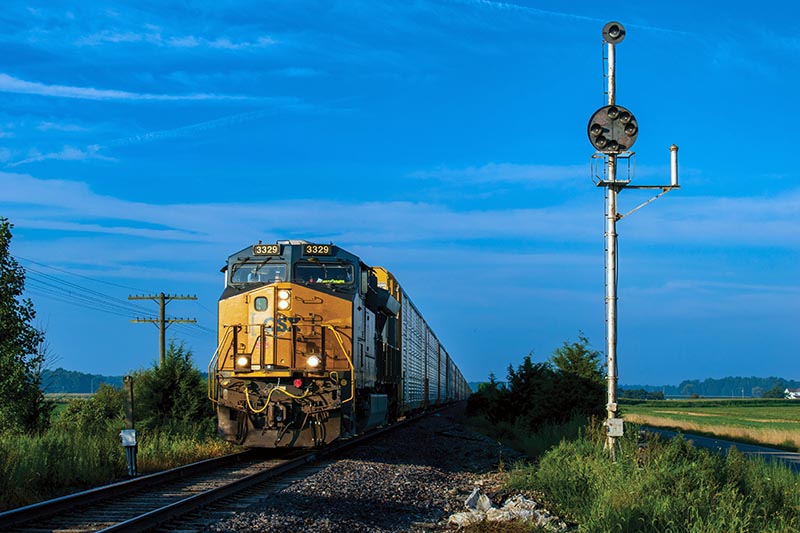
ABOVE: Train M252-08 passes the “Doll Arm” CPL at West Osgood, Ind., on August 8, 2025. A passing siding had once existed here, later cut back to a stub maintenance-of-way track. The spur was finally removed a few months before this photo was taken. The “doll arm” or “dummy mast” confirms the signal is for the far track at left, and not the former siding at right.
In the mid-20th century, a wave of mergers swept the railroad industry. Chesapeake & Ohio had acquired control of B&O in the 1960s, and later of Western Maryland Railway, and folded all three into Chessie System in 1973. This move combined the three railroads under a single corporate marketing identity (though the individual railroads still existed on paper). In 1980, Chessie System merged with Seaboard Coast Line Industries (the holding company of Seaboard Coast Line and Louisville & Nashville and a number of smaller regional roads), forming the holding company CSX. The B&O name and corporate identity officially ceased to exist in 1987. While the Indiana Subdivision maintained some importance as a part of the consolidated system, the same could not be said for other parts of B&O’s historic route.
The decision to abandon B&O’s Ohio Division was a stark example of this new operational reality. In 1985, CSX severed the route east of Greenfield, Ohio, a move that effectively cut the heart out of the main line from Baltimore to St. Louis. Much of the remaining Ohio Division trackage was eventually sold to regional and short line railroads like Indiana & Ohio. With its focus on efficiency and unit trains, CSX consolidated traffic onto its most profitable and best-maintained lines. B&O’s scenic, but less competitive, main line through Ohio was deemed redundant.
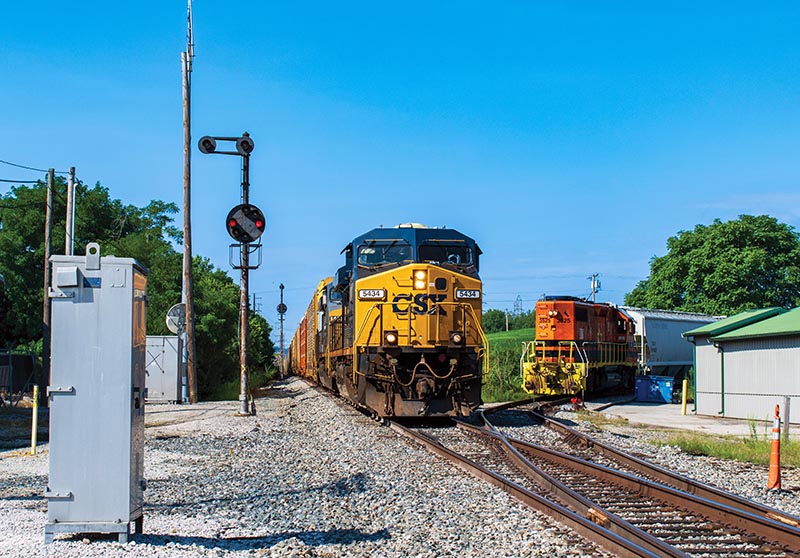
ABOVE: CSX Train M252-06 meets Central Railroad of Indiana’s Z881 job at Lawrenceburg, Ind., on August 6, 2025. A short CIND branch breaks off the Indiana Sub here, accessed via trackage rights on CSX from North Bend, Ohio.
While much of the Ohio Division was lost, the former B&O west of Cincinnati (the Indiana Subdivision from Cincinnati to Washington, Ind., and the Illinois Subdivision from Washington to St. Louis) maintained a reasonable level of traffic into the early 2000s, when much of the remaining traffic to St. Louis was rerouted onto the former Conrail St. Louis Line that CSX acquired in 1999. This left B&O as a secondary route and a connection to other lines.
Up until 2009, some traffic still traveled the Indiana Subdivision from a connection with the former Monon Hoosier Subdivision in Mitchell, Ind., to St. Louis and vice versa, but that traffic was rerouted and the former Monon and its famed semaphore signals were officially abandoned in 2017, leaving little through and local traffic west of Mitchell. In 2015, the Illinois Subdivision was taken out of service between Flora and Caseyville, Ill., severing another segment of the route.
A single local continued to ply the rails of the Indiana Subdivision between Mitchell and Washington until 2017, swapping cars with another local based out of Vincennes, Ind., on the Illinois Subdivision. Once this practice ended, the west end of the Indiana Sub went mostly silent, somewhat ironically, because this had once been the busiest portion of the line, and was equipped with centralized traffic control (CTC). Today, this segment is out of service between milepost BC128 (just west of Mitchell) and milepost BC165 (just east of Washington), its B&O CPLs still intact, but many of the passing sidings removed. A small segment of Indiana Subdivision trackage east of Washington is still in use to serve local industries, and is presently served by the Illinois Sub local L364, based out of Vincennes…
