

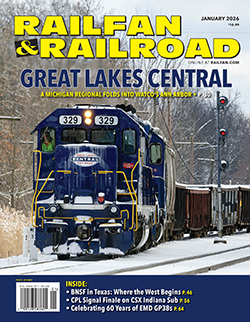
 In this issue, we’ll catch up with the disappearing Color Position Light (CPL) signals on the CSX Indiana Subdivision (see page 56). Predecessor Baltimore & Ohio developed the system in the 1920s as a practical application of high-intensity electric lighting combined with a unique position or arrangement of colored lights. While these specific signal lights are about to be removed in favor of modern hardware, they are an example of a wider culture of communication, much of which relied upon light — something that remains true to this day.
Even as these older signals are replaced, there are new installations across the continent, typically as part of the upgrading or installation of what’s known as Centralized Traffic Control (CTC), where a remote dispatcher dispenses track authority via signal indication — that is to say, through the colors and patterns of lights displayed on a wayside signal. CTC is not the only form of lineside signaling in North America, and not all convey authority to occupy track — the so-called Automatic Block System, for example, only provided advisory information — yet one truth remains: vital information is conveyed to train crews not only through written or spoken instructions, but also through displays of light.
Moreover, wayside signals are not the only example of this, nor my favorite. For that, we must turn to the signals passed by conductors and brakemen using lanterns. Lantern signals grew out of hand signals, yet another richly codified communication system that relied on visual display to convey complex information between members of a train crew. Hand signals, however, were virtually impossible to read after dark or in bad weather, and railroaders quickly developed a parallel, related system of signals using handheld oil and electric lamps.
It is interesting to compare the two systems. Hand signals tended to vary wildly from place to place and company to company, with little standardization; indeed, it is rare to see rule books specify precise hand signals, with the exception, perhaps, that anything “waved violently” by anybody near the tracks — a hand, a book, a flag, whatever — should be understood by an engineer as requesting an emergency stop. Beyond this? Charts and descriptions are rare and, even in the most recent rule books, there’s a considerable amount of leniency. The most recent edition of the General Code of Operating Rules, for example, states “employees may use other hand signals” so long as “all crew members understand the signals.”
Lantern signals are different. Even as early as the 1890s, rule books began to include illustrated guides to a very small number of signals, generally those meaning ahead (a lantern lifted straight up and down), back up (swung in a circle), stop (swung side-to-side), and a signal warning the engineer that the signal giver intended to go between cars (swung in a “C,” ending pointing inward to the car gap). What is more surprising is the consistency of these signals, both geographically and through time. Despite no federal regulation defining them, most lantern signals remain relatively uniform across North America, and relatively unchanged for more than a century.
This is not to say there were no variations thought up by train crews and informally added to the lexicon. Linda Niemann, photographer and former Southern Pacific employee, once quipped that the old-timers she knew in the 1970s could “order an anchovy pizza” using just a lantern to communicate. Certainly, though, some of this variety has been lost, as the introduction of portable radios in the latter half of the last century bit into the richness of this visual language. Still, lantern signals remain a persistent part of railroad culture, one in which it is light, not words, that carry meaning.
—Alexander Benjamin Craghead is a transportation historian, photographer, artist, and author.
