

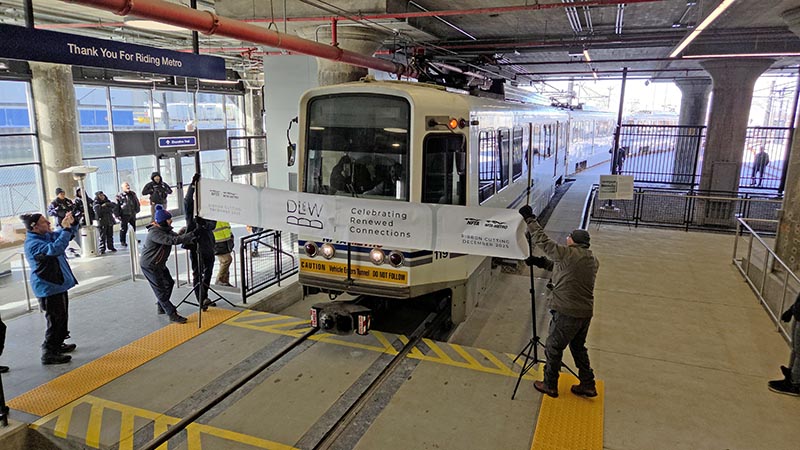
The public was welcomed back inside Buffalo’s former Delaware, Lackawanna & Western terminal for the first time since 1962 when the Niagara Frontier Transportation Authority opened its new DL&W Station on December 8. The $57 million project transforms the lower level of the historic trainshed into a modern two-track station with a center-island platform, giving passengers direct access to the revitalized Canalside and Cobblestone districts, as well as KeyBank Center, home of the NHL’s Buffalo Sabres. Buffalo’s unique light rail line runs in a subway tunnel for the first five miles from the south campus of University at Buffalo, with the final mile-and-a-half surface-running on Main Street (now shared with vehicular traffic) down to DL&W Station. While the system was originally designed with extensions to the suburbs and airport in mind, funding has been difficult to secure.
When Erie Lackawanna shut down its waterfront terminal in October 1962, only a handful trains still called there — including the Phoebe Snow, Owl, and Lake Cities — and service shifted to a minimalist joint facility shared with Nickel Plate Road in the freight yards across town. The grand 1917 terminal designed by Kenneth Murchison was soon abandoned, vandalized, and ultimately conveyed to Conrail in 1976. NFTA purchased the deteriorating property in 1977 to use the trainshed as protected storage for its new light rail fleet. Following some debate over protected historic status, the headhouse was demolished in 1979 to construct new yard leads. Although light rail service began in 1984, the station’s upper level platforms were sealed off and left unused.
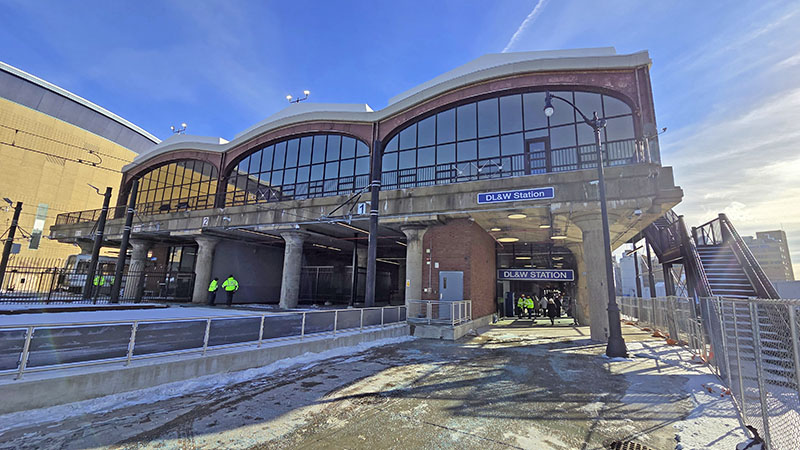
ABOVE: The former two-level trainshed built by Delaware, Lackawanna & Western in 1917, and tranformed into a covered storage yard for NFTA light rail trains. The headhouse was demolished in 1979. —Otto M. Vondrak photo
Over the next four decades, the surrounding industrial district was transformed into an entertainment hub. A small “Special Events” stop served arena crowds but offered little shelter or amenities. Redeveloping the former DL&W trainshed remained a long-discussed idea, but momentum finally came in 2017 when NFTA secured funding for a new station, waterfront access, redevelopment of the upper level, and a direct connection to KeyBank Center. Construction began in 2019, with Savarino Companies selected to design and develop the upper level as a multi-use public space.
Although construction delays pushed the opening back more than a year, the new metro station debuted to press and invited guests on December 8, complete with a ribbon-cutting featuring elected city officials and NFTA directors and staff. The station’s bright, spacious interior is a welcome addition to the 6.4-mile system, but the stairways and enclosed connector to KeyBank Center are not expected to be completed until summer 2026. Until then, riders must exit to South Park Avenue and walk the long way around, prompting some local outlets to advise passengers to continue using the nearby Canalside station. NFTA also cut ties with Savarino in mid-November, citing the developer’s failure to produce a viable business plan for the upper-level project.
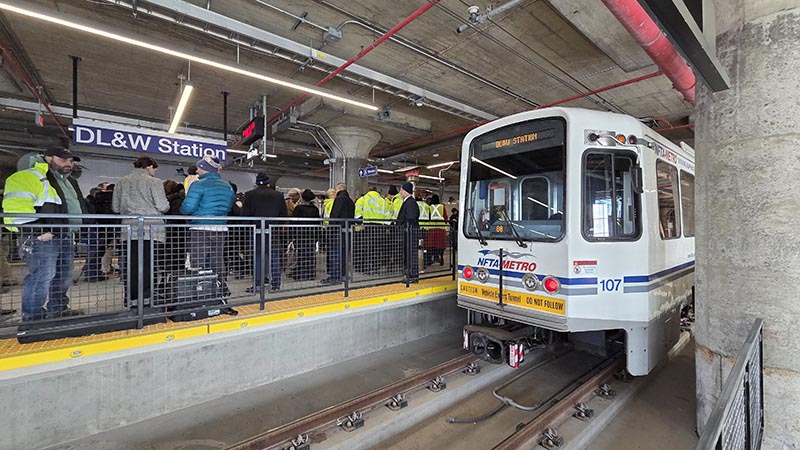
ABOVE: The new DL&W Station will allow future access to the upper level as well as a covered entrance into KeyBank Center. —Otto M. Vondrak photo
Though the DL&W Station extends service only a few blocks, officials emphasized that it represents meaningful progress toward broader future expansion. “This station is far more than a new stop on our system,” NFTA Executive Director Kim Minkel said at the opening. “It’s an investment in the future of our region — expanding access, strengthening economic development, and creating new opportunities for residents and businesses alike. And we’re just getting started.”
—Otto M. Vondrak
