

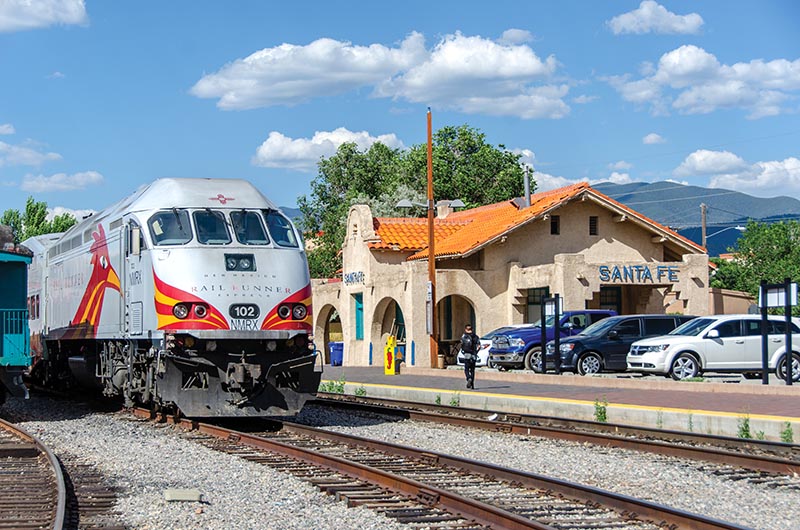
 Where is the American Southwest? One might be tempted to pick up a map and point toward specific states that, within the borders of the U.S., are literally south and west, yet this is a bit fraught — is all of California the “Southwest”? Does Texas belong, or Oklahoma, or Arkansas, or Kansas? To many people, it is not state borders, but rather a certain look, feel, and rhythm that define the Southwest, and much of this was crafted by the passenger department of Atchison, Topeka & Santa Fe Railway.
Its goal was to solve a problem — Santa Fe’s eastern lines, stretching west from Chicago across Illinois, Missouri, and Kansas, had plenty of agricultural traffic and a fair amount of towns and cities. The farther west the main line went, however, the drier the land became, less fertile, less populated. Almost everything from Colorado to Southern California was arid, even bone-dry. The potential for lineside traffic? Equally dry. But Santa Fe posed this question to Americans — what if that same barren landscape was, when viewed through a Pullman car window, distinctive scenery, viewable nowhere else in the world?
Through prose, painting, and photography, all prominently featured in company advertising, Santa Fe heavily marketed the Southwest as a place of scenic wonder. But its efforts went beyond the printed page and into design and architecture. Where eastern depots were often modest frame buildings, those in the Southwest frequently used — or appeared to use — adobe construction and Spanish clay roof tiles. Hotels, restaurants, and other concessions carried Native or Spanish names, while inside of them, gift shops sold baskets, blankets, rugs, and jewelry, the design of which was inspired by (and often made by) Native peoples. Company designers, chief among them architect Mary J. Colter, sometimes adjusted colors and forms to better suit tourist tastes.
Theming extended aboard the trains themselves, from names such as El Capitan, Chief, and Super Chief to decorative patterns on dining car china inspired by thousand-year-old Native pottery from southern Arizona.
This is not to say Santa Fe invented the Southwest alone. Other railroads, eager to claim their share of a growing tourism trade, played a role, as did countless entrepreneurs across the region. Perhaps the most striking example came in 1912, when citizens of Santa Fe, N.M., voted to remake their city, bit by bit, so it would appear older, more Spanish, and more Native — transforming many late 19th-century American buildings into a kind of romanticized Pueblo village. The result, even if rooted partly in fantasy, is undeniably beautiful.
And in the wake of the tourism market that the railway had built came numerous auto tourists, many traveling the two-lane blacktop of Route 66, designated a national highway in 1926. On page 28, Elrond Lawrence celebrates the relationship between the railway and this highway, which marks its centenary.
The occasion is bittersweet. The Super Chief is gone, and much of Route 66 survives only in fragments, bypassed by modern freeways. Some aspects of the past are better left behind, but the sense of wonder Santa Fe created around the Southwest — however carefully constructed — is worth preserving. It encouraged travelers to slow down, look out the window, and see a landscape once regarded as an obstacle as one of the most beautiful places in the world. Yes, it was done to sell tickets, but it was also a remarkable gift.
—Alexander Benjamin Craghead is a transportation historian, photographer, artist, and author.
