

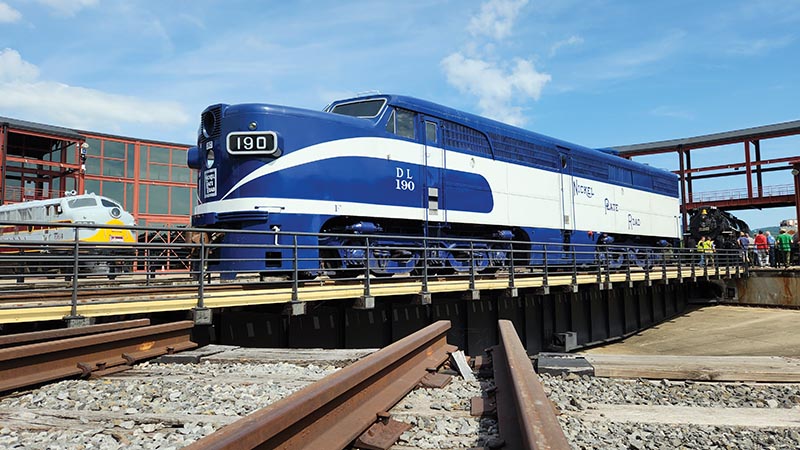
 Why love a locomotive, much less a locomotive builder? For railfans, the answer is often simple. Sometimes it is the sheer look of an engine — its beauty, character, or unmistakable profile. Other times, affection grows from familiarity, when a locomotive seen in childhood becomes wrapped in nostalgia. And perhaps no diesel-electric builder inspires that kind of devotion more than American Locomotive Company.
Yet, to the accountants at railways across the continent, Alco was not a subject of much positive sentiment. After shutting down domestic production in 1969, the cost and availability of spare parts became a serious concern. Burlington Northern attempted to address the challenge by pooling both locomotives and parts to a single maintenance base, the former Spokane, Portland & Seattle terminal in Vancouver, Wash., eking out another decade of service in the process. Other roads were more direct — in the 1970s, Southern Pacific first demoted, then scrapped, its Alcos, while Union Pacific sold its off. In Canada, the Alco legacy was luckier, as affiliate Montreal Locomotive Works remained operating into the early-1980s, but this was only a delay in the familiar pattern of downgrades, storage, then sale or scrap.
Yet something curious happened; as the big railroads disposed of their Alco fleets, short lines and regional railroads began buying them. Certainly, their low purchase price compared with locomotives from builders still in business was attractive. But that advantage had to be weighed against dwindling parts supplies, increasingly specialized maintenance knowledge, and nonexistent factory support. So why keep buying Alcos?
It is often taken for granted that we the railfans are the sentimental ones, while those who work for the railways are likely to view their equipment — along with the rest of their industry — with a clearer head. Yet railroaders are also subject to sentimentality, and this, I think, explains this second and even third life for Alco locomotives.
Consider one example. When Atchison, Topeka & Santa Fe sold off several of its Alco PAs, four went to Delaware & Hudson to bolster its passenger service. When D&H changed course in the late 1970s, the locomotives were sold again, this time to Ferrocarriles Nacionales de México, where they worked former Southern Pacific de México routes.
At least one of them was repainted by FNM crews into Southern Pacific’s red and orange Daylight scheme. There was no strictly practical reason for doing so; it was an act of affection, and ex-D&H 17 became something of a mascot for railroad employees. It survives today, still wearing that employee-applied Daylight scheme, at the Museo Nacional de los Ferrocarriles Mexicanos in Puebla.
A stablemate, former Santa Fe 59L, eventually returned to the U.S. as little more than a shell and was brought back to life by preservationist Doyle McCormack. Today, it operates on Delaware-Lackawanna in Scranton, Pa.
Nobody at D&H was forced to buy those old Alco PAs, much less spend good money modernizing them and giving them a new lease on life. Nor did anyone at FNM have to purchase the locomotives third-hand, paint one in a fanciful Daylight scheme, or help keep them from the scrapper’s torch long enough to reach preservation.
All of this — and, for that matter, nearly every purchase of a used Alco since 1969 — suggests that the accountants do not always get the final word. Sometimes affection for a machine, however irrational it may seem, wins.
—Alexander Benjamin Craghead is a transportation historian, photographer, artist, and author.
