

 by Lucas Leighton/photos as noted
While American Locomotive Company ceased domestic production in 1969, its Canadian counterpart Montreal Locomotive Works kept building new diesels into the 1980s. Even after the last MLWs rolled out of the shop in Montreal, a large fleet of the Alco siblings kept working in Québec, on Class Is and short lines alike; in the 1990s, it was possible to see MLWs on hotshot intermodal trains on Canadian Pacific and Canadian National, as well as short lines like Asbestos & Danville and Romaine River Railway, the province’s most remote railroad. Even after the Class Is retired their MLWs in the mid to late 1990s, many of those CN and CP units found second homes on short lines across Eastern Canada.
Today there are three short lines still using MLWs in regular service in the French-speaking province. Each operator has experienced its own share of trials, tribulations, and accomplishments, and all three differ dramatically from each other. One thing all three have in common is that they are sure to pique the interest of visiting Alco fans.
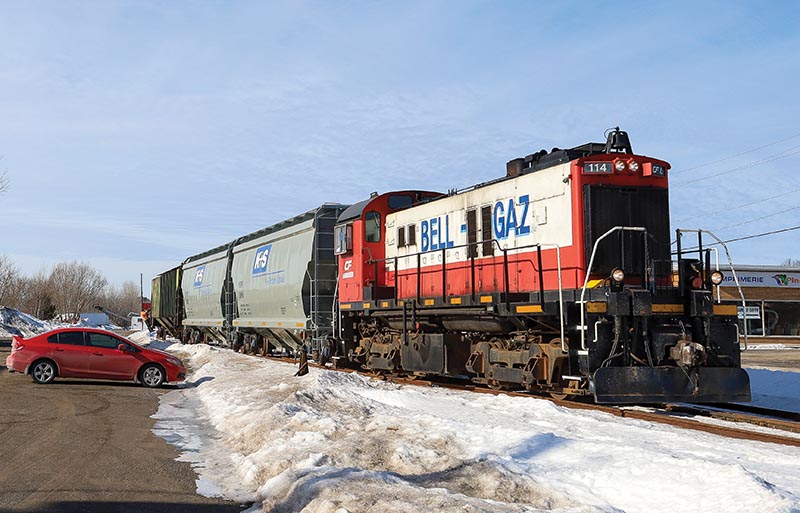
ABOVE: Chemin de fer Lanaudière RS-23 114 pulls empties from an agricultural customer at Saint-Felix-de-Valois, Que., on March 13, 2025. —Lucas Leighton
Chemin de fer Lanaudière
The smell of grease and oil drifts out of the enginehouse in the small Québec town of Saint-Félix-de-Valois, as engineer Luc Charron, a veteran of the MLW era on CN, begins his morning tasks. Among them is checking the oil of S-13u 114 and the original Quebec Rail Corporation RS18u-3 rebuild, number 3000. The 3000 will be started on this day, then placed on a side track due to a damaged gearbox cover on a traction motor that was awaiting replacement. After the prelube cycle is finished, 3000 slowly comes to life and is left to warm up as Luc turns his attention to 114. Dressed in parent company Bell-Gaz’s corporate paint scheme, 114 requires a little more persuasion in the form of a battery boost, but soon it too comes to life.
The Lanaudière, or simply known as CFL, is owned by Québec propane and fuel supplier Bell-Gaz. The 11-mile railroad was formed in 1992 after Bell-Gaz became the final customer on CP’s Saint-Gabriel Subdivision. For motive power, an ex-CN S-13u built in 1959 as CN 8620 was acquired. As traffic grew in the 2000s, CFL began searching for a second unit, eventually settling on the then-recently rebuilt 3000, which started life as CP 8734. It eventually ended up on New Brunswick East Coast, which rebuilt it into an RS18u-3. It was acquired in 2009.
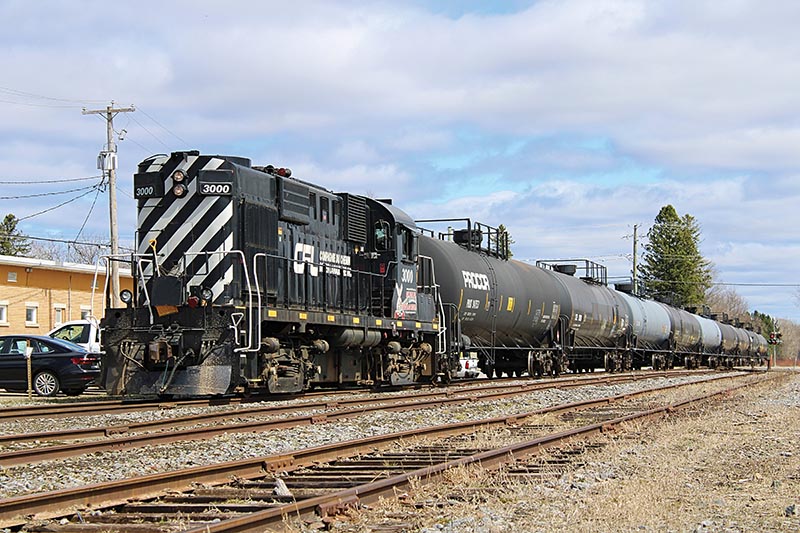
ABOVE: RS-18u 3000 shoves loaded cars north after running around its train in Saint-Felix-de-Valois on April 16, 2024. —Harrison Smith
In 2017, Bell-Gaz was sold to Filgo, a larger fuel and gas station operator based in Québec. In addition to the liquefied petroleum gas traffic for Filgo, LPG for smaller companies is also unloaded at the transload in Saint-Félix-de-Valois. The railroad also moves plastic pellets for Plastiques GPR and loads of potash and fertilizer for Campagnard, both in Saint-Félix-de-Valois. This traffic diversification keeps the railroad busy year-round, with the non-LPG traffic allowing for the purchase of LPG cars for CFL.
After a few hours, the crew has finished switching at the transload and heads south to the Quebec-Gatineau Railway (QGRY) interchange in Joliette. Luc skillfully guides his train toward the QC-345 crossing, which will have to be flagged. After this, the trip south continues as the train cuts between sections of forest and large fields bordered by a high-voltage power line, before entering the neighborhoods of Joliette. Here, the conductor and brakeman disembark while Luc guides 114 into the siding to pick up nine loaded LPG tank cars left by QGRY. In a few moves, the crew will shove the cars out of the siding and onto the main before dropping the empties, normalizing the switches, and then heading back north. The link with QGRY allows for CFL to connect with CN at Joliette or CPKC in Montreal.
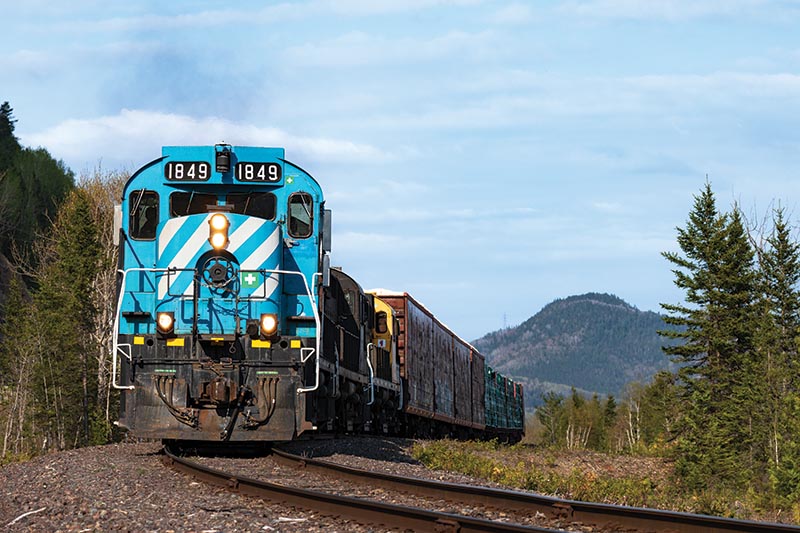
ABOVE: After a long day of switching all the industries alongside the Cascapédia Subdivision, Train 565 makes it to Matapédia just short of its twelfth hour on duty on May 15, 2024. The cars will be set off on the CN interchange tracks on the Mont-Joli Subdivision, and the crew will then tie up the locomotives and call it a day. —Julien Boily
Due to the grades on the line, 114 can only handle nine loads in good weather and even fewer during the fall. The 3000 is able to handle up to 12 loads on this same grade. On this day, just enough leaves kicked up by the wind landed on the railhead for 114 to struggle on the hill. Luckily, with his experience, Luc keeps the train moving, albeit at a slow pace.
Arriving in Saint-Félix-de-Valois, the crew runs around the train at the fertilizer customer before shoving back to the LPG transload, where the cars will be sorted and stored. After finishing the day early in the afternoon, the crew grabs 3000 and pulls it back into the enginehouse, which was expanded for the second unit in the 2000s and has an inspection pit and a little bit of everything needed for maintaining units. Even in 2026, MLWs continue to hold strong on the former CP Saint-Gabriel Subdivision…
