

 by Kevin Gilliam/photos as noted
Southern Railway marked the official end of steam with a ceremonial run of 2-8-2 6630 from Oakdale to Chattanooga, Tenn., on June 17, 1953. Upon the locomotive’s arrival, Southern became the largest railroad in the U.S. to complete dieselization. President Harry DeButts marked the occasion by declaring, “It has taken us 123 years to put out that fire.” For anyone present in Chattanooga that day, it would have been hard to imagine that just 10 years later, another Southern 2-8-2 would roll over that same busy main line and help launch a 28-year program of steam excursions.
To understand the importance of that program, and how it came to be, we need to turn back to the early 1960s. Southern Railway was then a thoroughly modern railroad that neither wanted nor welcomed steam on its tracks. The catalyst for change was Chattanooga businessman Paul Merriman. Seeing the end of steam approaching rapidly, Merriman purchased ex-Southern 2-8-2 4501 from the coal-hauling Kentucky & Tennessee Railway at Stearns, Ky., located near Southern’s busy Cincinnati–Chattanooga main line. Against the odds, Southern agreed to move 4501 to Chattanooga under steam as a one-time exception. Huge crowds lined the route to see the locomotive, resplendent in authentic Southern freight livery, roll down the main line.
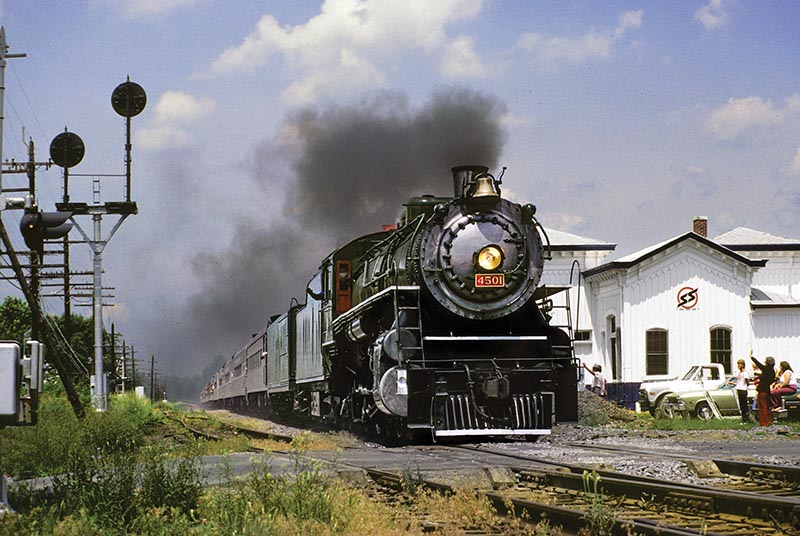
ABOVE: Rolling through Rural Retreat, Va., a location made famous by O. Winston Link’s recordings in the steam era, Southern 4501 is bound for Radford in June 1985 with an excursion from Bristol. —Ron Flanary
Three months later, on August 29, 1964, the first Southern Railway steam excursion departed Atlanta, Ga., when Savannah & Atlanta 4-6-2 750 powered the first of three successful round trips over the Central of Georgia main to Jonesboro. It was a closely guarded secret, but the company’s official policy toward steam had begun to change. A few excursions followed in 1965, and soon the big show was ready to begin.
4501 and Friends
On August 18, 1966, the rebuilt Southern 4501 left Chattanooga for a three-month tour of the Southern system. Now resplendent in Southern’s passenger green livery, it made a pretty sight as it headed north. Its main point of call was in Richmond, Va., for the annual convention of the National Railroad Historical Society. At the banquet, Graham Claytor, the vice president of law for Southern Railway, made the proclamation that steam was “here to stay.” In 1967, Graham Claytor became president of Southern Railway, and the new Steam Program kicked into full swing.
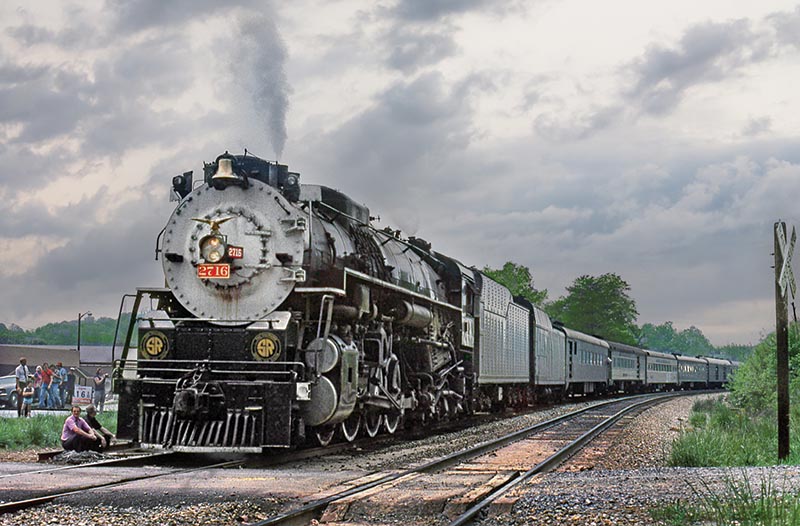
ABOVE: The Southern Berkshire — Southern never purchased a Super Power steam locomotive, so Bill Purdie had work to do making Chesapeake & Ohio 2-8-4 2716 look right. It’s drawing a crowd at Yuma, Va., in May 1982. —Ron Flanary
In June 1967, something unexpected showed up in Roanoke, Va. To celebrate the opening of the Roanoke Transportation Museum, East Tennessee & Western North Carolina Railroad sent one of its engines for several days of trips around the Roanoke Belt Line. No. 207 must have looked awfully familiar to a Southern man like Graham Claytor; before going to ET&WNC, it had been Southern 630.
It did not take long for Southern to offer a pair of Alco RS-3 diesels in exchange for the Tweetsie’s two steam locomotives, and the growing steam program gained two new additions — Southern 630 and 722. The 630 remained in Southern black freight livery, while 722 received green paint to match 4501. With the two 2-8-0s, S&A 750, 4501, and a new steam shop outside Birmingham, Ala., the steam program was becoming a more serious endeavor.
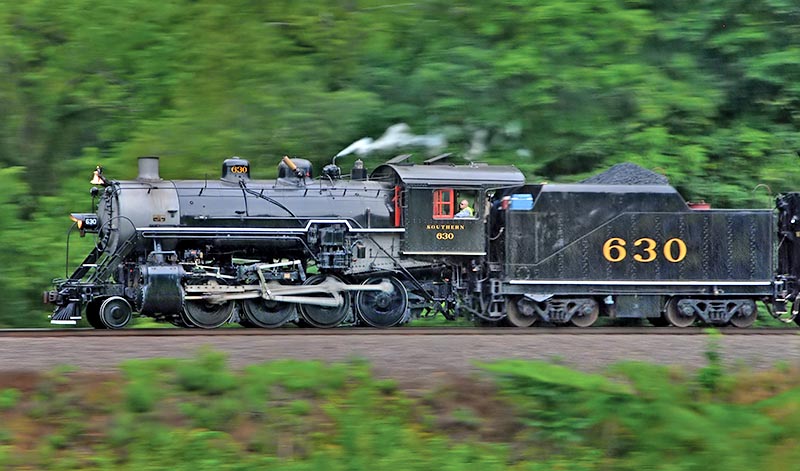
ABOVE: Southern 2-8-0 630 may not have received much notice during the original program, but it was a familiar face in the Norfolk Southern 21st Century Steam program, operating trips from 2011-14. The Consolidation is heading west near Atkins, Va., on July 12, 2012. —Ron Flanary
As the late 1960s gave way to the 1970s, the program found its footing. Mikado 4501 became the primary road engine, operating a season that stretched from April through November, while the other locomotives filled in as needed. A quick look at the schedules shows 4501 racked up plenty of miles during this period, traveling as far as Milwaukee, Wis., to pull the Circus World Museum train in 1973.
The year 1976 was a banner one for the Southern Steam Program. With the country celebrating its 200th birthday, an ambitious slate of trips was announced, including regular excursions from the Washington, D.C., area into northern Virginia. All three Southern locomotives — 630, 722, and 4501 — were scheduled for operation.
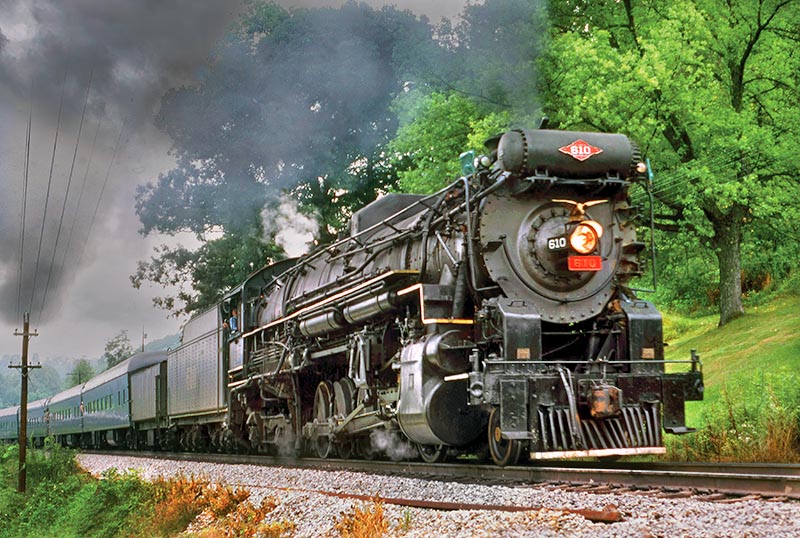
ABOVE: Texas & Pacific 610 rolls east towards Asheville, N.C., in July 1977. —Ron Flanary
It did not take long for problems with the original the plan to become evident. In one particularly rough month, April, all three failed. Southern’s Master Mechanic of Steam Bill Purdie and his crew worked their usual miracles, and soon 630 and 4501 were back on the road as a doubleheader around the system. In the meantime, the program was becoming more popular, and the demands were taxing the aging motive power. Consolidations 630 and 722 were good for 10 or 11 cars. The 4501 was pushed about as far as it could go — 16 cars unassisted was not uncommon. On one trip out of Chattanooga, it had 24 cars behind the drawbar. Southern needed bigger power…
