

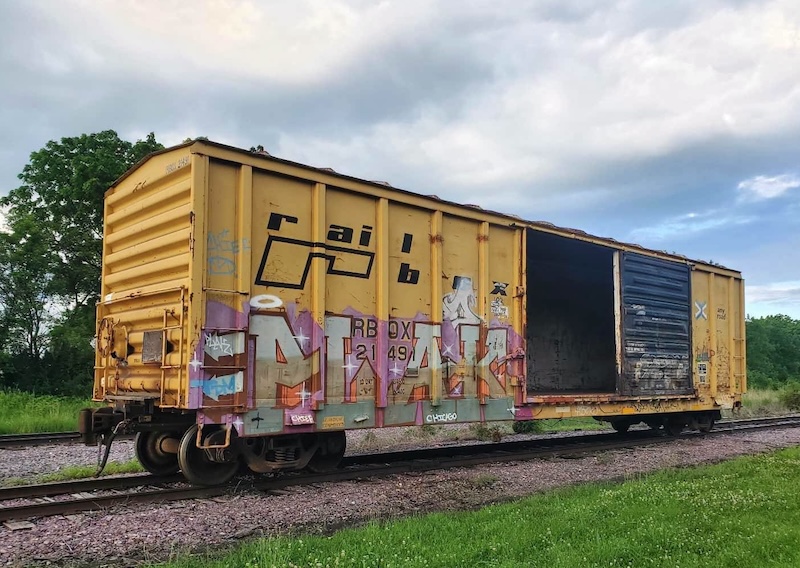
The Illinois Railway Museum has added a 50-foot Railbox boxcar, one of the most ubiquitous and distinctive car types seen on American railroads during the last quarter of the 20th century, to its collection in Union, Ill. RBOX 21491 was built in 1975 by Pullman-Standard and was part of the initial pool of 10,000 boxcars built upon the creation of Railbox in 1974. It arrived at the museum on June 17.
Railbox Company was created in January 1974 to address a critical nationwide shortage of boxcars. Although incorporated as a subsidiary of Trailer Train (TTX), and managed by that company, the construction costs of the initial 10,000 Railbox cars were guaranteed by TTX’s owner railroads. Those 10,000 boxcars were all 50-foot-long, all-steel, “Plate B” cars. These cars were used throughout a “pool” of 258 railroads and helped alleviate the serious shortage of boxcars. Unlike most railroad-owned boxcars at that time, Railbox cars could be loaded in any direction on any railroad without having to move back to the original carrier when unloaded, hence the slogan “Next Load, Any Road.”
In 1982, a recession combined with an oversupply of boxcars — caused in part by the success of Railbox — caused a financial crisis for the boxcar pooling company. The initial 10,000 boxcars were returned to the guarantor railroads, with RBOX 21491 being sent to the Union Pacific, where it was renumbered in the 130400-series. At a later date, RBOX 21491 was repurchased from the Union Pacific by Railbox, and it ended its service days with TTX, which absorbed Railbox Company in 2000.
“IRM wishes to thank TTX Company for donating this historic car,” the museum wrote. “RBOX 21491 is essentially unmodified and represents one of the most visible efforts of American railroads during the 1970s to modernize and to improve their operations and efficiency.”
IRM intends to restore the car to its as-built appearance and operate it occasionally in demonstration service for visitors.
—Railfan & Railroad Staff
