

 by Kevin Meisenhelter/photos as noted
What comes to mind when you think of Florida? For most, it means theme parks, beaches, and the Everglades. But for railfans, Florida East Coast Railway will be one of the first thoughts. This 351-mile regional runs a tight, efficient operation with both freight and passenger trains on its busy main line.
Birth of the Speedway
The railroad was the brainchild of industrialist Henry M. Flagler. After two visits to Florida in the 1880s, Flagler recognized the potential to establish a strong tourism industry in the state and began developing hotels and resorts. Jacksonville, St. Augustine & Halifax River Railway was a three-foot narrow gauge line that opened in 1883 between South Jacksonville and St. Augustine. Flagler acquired this line, rebuilt it to standard gauge, and acquired new equipment so it could adequately serve his properties.
Through a series of acquisitions and new construction, Flagler’s dream of connecting cities and towns along the east coast of Florida became a reality. His railroad built south to Fort Pierce by 1894 and West Palm Beach later that year. In 1895, Flagler’s railroad holdings were reorganized as Florida East Coast Railway, and construction pushed south to Biscayne Bay in 1896. Local residents proposed naming the new settlement “Flagler,” but he declined, encouraging use of the original native name — Miami. Fueled by Florida’s booming economy, FEC soon embarked on one of the most ambitious railroad construction projects in American history.
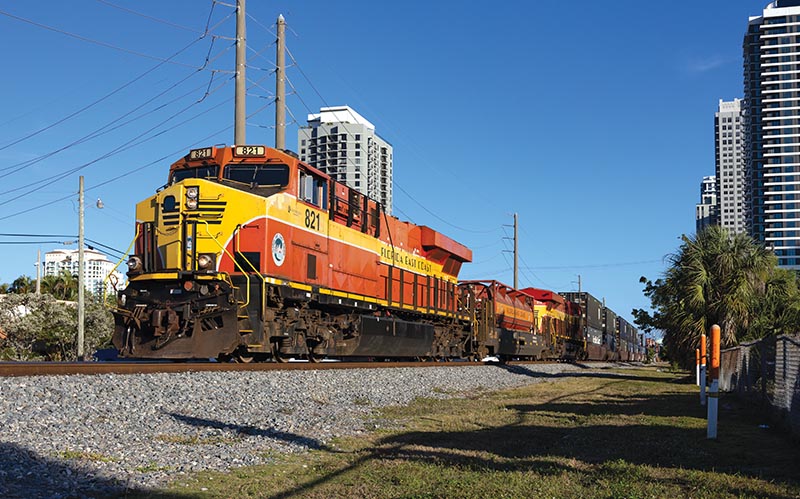
ABOVE: Under clear skies, Train 109 creeps through downtown Fort Lauderdale on January 9, 2026. ES44C4s 821 and 814 are two of three GEs remaining in the “Champion” scheme. —Kevin Meisenhelter
In 1905, FEC began construction of its 156-mile extension from Miami to Key West. The project took seven years to complete and was repeatedly delayed by hurricanes. The first train reached Key West on January 21, 1912; Henry Flagler died the following year. The extension was intended to capitalize on anticipated traffic generated by the opening of the Panama Canal, capturing freight and passengers moving to and from South America and the Caribbean. Much of that business never materialized, however, and the Labor Day Hurricane of 1935 ultimately doomed the line. Forty-two miles of track were washed away, and much of the remainder was heavily damaged. Already in bankruptcy, FEC chose not to rebuild the extension. Today, many of the original bridges stand alongside U.S. Route 1.
As Florida grew into a major vacation destination, FEC became known as the “Speedway to Sunshine,” forming the final link in through routes from New York and Chicago. Streamliners such as the Champion (with Atlantic Coast Line), Dixie Flagler (with Louisville & Nashville and Chicago & Eastern Illinois), and South Wind (with L&N and Pennsylvania Railroad) became synonymous with luxury travel on FEC.
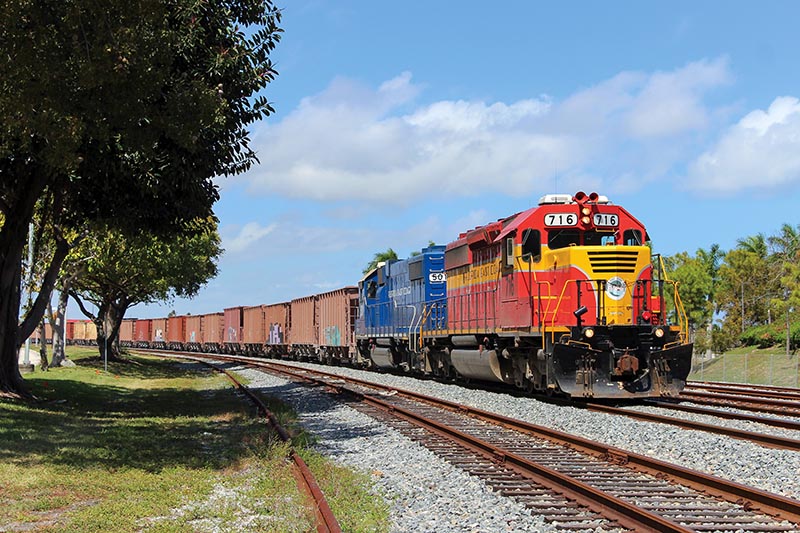
ABOVE: FEC SD40-2 716 leads a late Train 335 through the yard in Fort Lauderdale on March 19, 2020. Aggregate products make up a large portion of FEC’s traffic base. —Kevin Meisenhelter
In 1963, FEC became the center of one of the most contentious labor disputes in American railroad history. After failing to reach agreement on work rules and wages, non-operating unions went on strike against the railroad, and most operating unions initially honored the picket lines. For a brief period, service was largely halted. Within days, however, FEC resumed limited freight operations using supervisory personnel and newly hired replacement workers. (Passenger trains were rerouted over Atlantic Coast Line and Seaboard trackage.) This marked a turning point in the dispute, as the railroad continued to operate, albeit at reduced levels. The conflict grew increasingly bitter, with widespread vandalism, sabotage, and several derailments reported across the system. While some unions reached agreements and returned to work in the late 1960s, others remained on strike for years. The last of the strike activity effectively ended in 1977, bringing to a close one of the longest labor disputes in U.S. railroad history.
The FEC that emerged from the strike was a trimmed-down version of its former self. Except for a brief revival of local service during 1968, passenger trains were eliminated, and most of the railroad’s branch lines had been abandoned. If it didn’t make money, it was cast off. The railroad focused on growing its intermodal and aggregate business. Trains operated on tight schedules and were not held for late cars or length requirements. Quick turnarounds allowed FEC to remain competitive with trucks and achieve a high car utilization rate. Further cost savings came from reducing the main line to single track and instituting two-man crews across the system. The well-engineered right-of-way is the envy of most railroads, it features only minor grades, and most curves allow trains to maintain high speeds. Freight trains can operate at speeds up to 60 mph, and the main line is fully controlled by centralized traffic control.
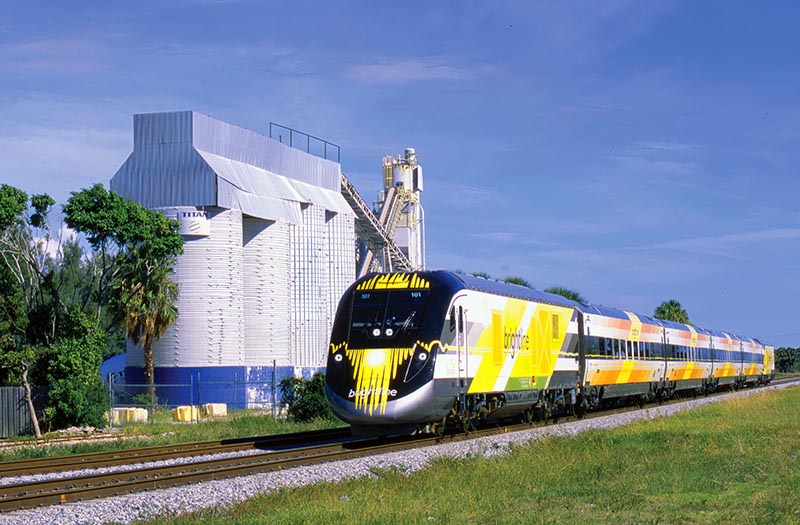
ABOVE: Southbound Brightline “Bright Orange” passes the Titan Cement plant at Linton Road in Delray Beach on September 18, 2018. —Otto M. Vondrak
A Trip Down the Coast
The northern and southern halves of the railroad have quite different operational patterns, with the dividing line being Cocoa. This tour begins at FEC’s northern terminus in Jacksonville and works south down the east coast of Florida. Bowden Yard, a few miles south of downtown Jacksonville, anchors FEC’s northern operations. FEC’s official start is at Milepost 0 at the drawbridge spanning the St. Johns River downtown, but Bowden is the operational start, with all trains originating and terminating there. CP Sunbeam lies at the south end of Bowden Yard and marks where trains enter the main line for their journey south. From there, the tracks parallel U.S. 1 as they head southeast through the Jacksonville suburbs, running straight toward St. Augustine.
Once the site of FEC’s headquarters and a sizable shop complex, St. Augustine offers some of the most recognizable photo locations on the entire railroad. From multiple places along U.S. 1, you can park and photograph trains rolling along the marshlands and across the San Sebastian River. Southbound trains swing directly west for a short stint, allowing you to frame part of Flagler College in the background. The Wilbur Wright Industrial Lead is also located in town. This is a roughly five-mile section of the original line that once ran west to Palatka before returning eastward in Bunnell. In 1925, the Moultrie Cutoff was constructed, eliminating the detour toward Palatka and shaving 20 miles off the main line route…
