

 by Douglas W. Davidson/photos as noted
Chicago’s only electrified main line railroad will celebrate its 100th anniversary during summer 2026. Now operated by Northeast Illinois Regional Commuter Rail Corporation as the Metra Electric District, the former Illinois Central electrified, multi-track line stretches 31.3 miles between Millennium Station (Randolph Street) and University Park, with a double-track branch from 67th Street to South Chicago, and a mostly single-track branch from Blue Island Junction at 120th Street to Blue Island. As a result of a series of projects undertaken by IC between 1893 and 1926, the Metra Electric District between Chicago and University Park is completely grade-separated and free of freight train interference.
Illinois Central inaugurated special suburban service between Chicago and Hyde Park on June 1, 1856, reportedly becoming the first IC train to use the new Great Central Station. Regular suburban operations began on July 21 with the Hyde Park Special, initially offering four daily round trips except Sunday. Ridership proved disappointing, however, and by September service had been reduced to three daily round trips, a level that remained in place for several years amid weak economic conditions.
In 1858, the railroad built a wye at 63rd Street and established Woodlawn station there, extending suburban service beyond Hyde Park while maintaining the same fare. Kenwood station at 47th Street followed in 1859. By 1869, service had reached Oak Woods at 66th Street, site of a new cemetery along the line, and frequencies had increased to five daily round trips except Sunday.
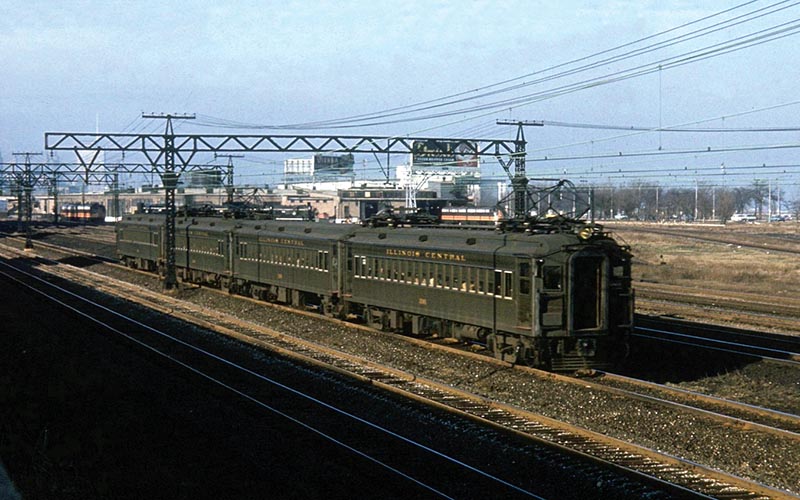
ABOVE: Before McCormick Place changed the landscape along South Lake Shore Drive, a southbound Illinois Central suburban train of Pullman coaches passes the IC roundhouse at 27th Street on November 19, 1960. —James J. Buckley photo, Douglas W. Davidson collection
South of Hyde Park, the railroad initially crossed largely undeveloped territory, but the Great Chicago Fire of 1871 spurred rapid growth along the south side as displaced residents sought new homes outside the crowded city center. One month after the fire, IC increased suburban service to 10 trains each way daily, except on Sundays. In 1872, suburban service was extended as far south as Grand Crossing (75th Street). Because many of the families who moved to the south side after the fire still attended downtown churches, on March 16, 1873, IC launched Sunday service with two round trips between Grand Crossing and Chicago. By 1880, IC was operating 36 daily trains and between 1870 and 1880, suburban ridership had increased from 200,000 passengers per year to 1.5 million passengers per year. By 1883, service was extended to East Roseland (104th Street), Pullman (111th Street), and Kensington (115th Street).
Suburban ridership continued to grow during the 1880s, prompting Illinois Central to expand both its infrastructure and equipment fleet. In 1880, two additional main tracks were added between Chicago and Kensington. Fifth and sixth main tracks were placed in service between Chicago and Grand Crossing in 1883, then extended to Kensington in 1885. The resulting six-track main line provided separate routes for inter-city passenger, freight, and suburban trains. Service on the newly constructed South Chicago Branch began on September 2, 1883.
Until 1880, suburban trains were operated with steam locomotives and coaches drawn from the regular passenger fleet. That year, IC purchased 56 new suburban locomotives capable of operating in either direction, eliminating the need to turn engines after arrival in Chicago. These “double-enders” carried a headlight above the tender for reverse operation. In 1882, the railroad added 55 new suburban coaches with increased seating capacity.
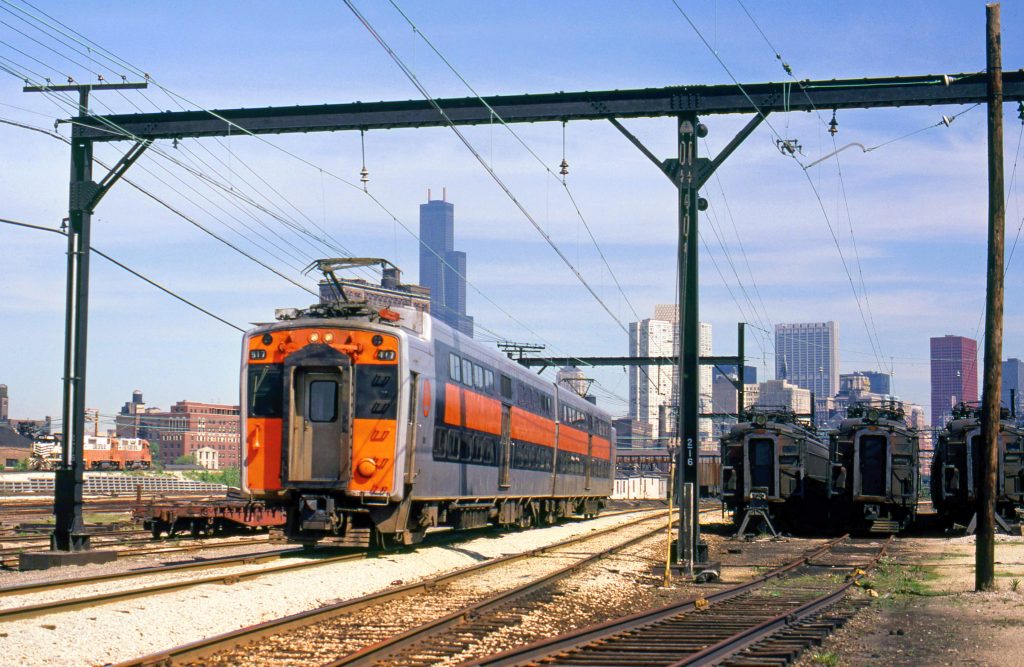
ABOVE: A pair of IC Highliners heads south past 18th Street in June 1974, passing a string of retired heavyweight cars. In the distance, a light power move led by a Gulf, Mobile & Ohio GP35 crosses the St. Charles Air Line. As more Highliners arrived, the last of the heavyweights survived until the harsh winter of 1978–1979 forced their retirement. —Lou Gerard
With construction of the Pullman Palace Car Works and its model industrial town at 111th Street in 1880, Illinois Central established a station at Pullman and erected a depot designed to complement the community’s distinctive architecture. Suburban service to Pullman began that same year, and during construction the railroad even operated excursion trains for Chicago residents interested in viewing the project’s progress.
By 1890, IC was operating 114 daily suburban trains and carrying four million passengers annually. The Blue Island Branch opened on May 1, 1893, and by 1900 supported 16 daily round trips.
The 1893 Columbian Exposition in Jackson Park posed an enormous financial and logistical challenge for Illinois Central, but by all accounts, the railroad met it with remarkable success. In preparation for the World’s Fair, the Chicago City Council passed an ordinance on May 23, 1892, requiring IC to elevate its tracks between 51st and 67th streets. Completed in less than a year, the project eliminated all grade crossings between 47th and 70th streets.
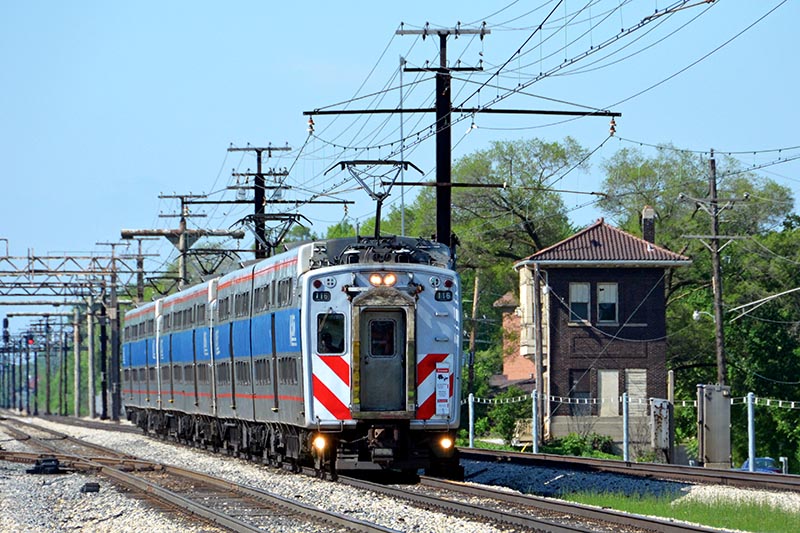
ABOVE: A six-car train of old Highliners is northbound past the old Homewood interlocking tower on June 3, 2015. The tower closed in 1964 when the signal system was upgraded to centralized traffic control. —Lou Gerard
Additional improvements included construction of the new Central Station at Park Row to replace South Water Street Station, installation of two additional tracks between Van Buren Street and the fairgrounds for exclusive World’s Fair service, and a new automatic block signal system between Van Buren Street and Kensington. IC also acquired 41 locomotives and 300 side-door passenger cars for Exposition traffic and built new stations at Van Buren Street and the fairgrounds.
Architect Daniel Burnham of Burnham & Root oversaw the design and construction of the fairgrounds, which became famous as the “White City.” Illinois Central served as the primary rail carrier to the Exposition, with Baltimore & Ohio playing a secondary role. The railroad’s operational statistics during the Fair astonished the industry. During the 182 days the Exposition was open, from May 1 through October 31, IC operated 40,116 special trains carrying 8,780,616 passengers. On October 9, 1893, alone, the railroad handled 263,282 passengers to the fairgrounds and another 241,843 suburban riders, for a one-day total of 505,125 passengers — all without a single serious accident.
Into the 20th Century
Illinois Central’s suburban service continued to expand rapidly in the early 20th century. Annual ridership reached 10.8 million passengers by 1900 and climbed to 13.8 million by 1910.
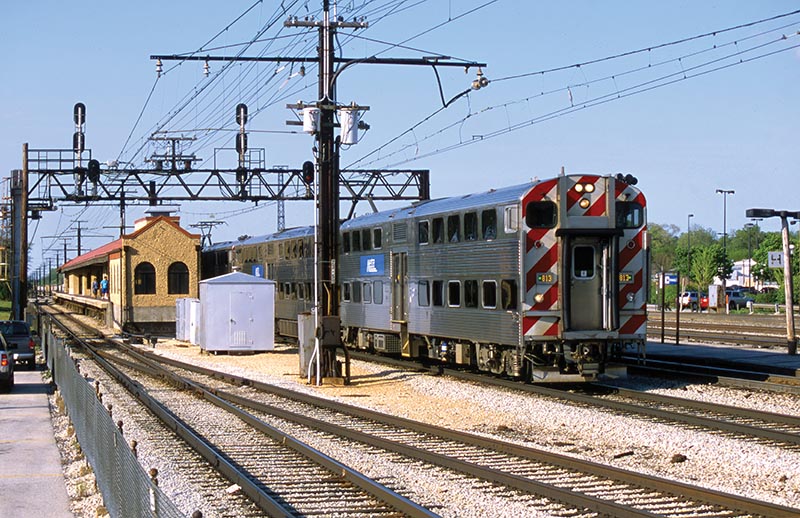
ABOVE: Running against the normal current of traffic, Metra Train 813 departs the classic IC suburban depot at Homewood on May 18, 2014. Low-level platforms to the right serve Amtrak long-distance trains. —Otto M. Vondrak
During this same period, the Chicago City Council passed a series of ordinances requiring nearly every railroad within the city limits to eliminate grade crossings through track elevation or depression. Between 1892 and 1925, Illinois Central complied with eight such ordinances, ultimately creating a fully grade-separated right-of-way within Chicago.
Air pollution caused by steam locomotives — including coal smoke and cinders — also came under increasing public scrutiny. As early as 1897, IC established a special electrification committee made up of railroad officers and engineers, which concluded that suburban electrification was feasible. In a 1909 speech, IC President J.T. Harahan stated that electrification of the terminals was under consideration, though he cautioned that the extensive yard trackage and interchange operations with other railroads posed significant challenges. Federal control of the railroads during World War I delayed further progress for several years…
