

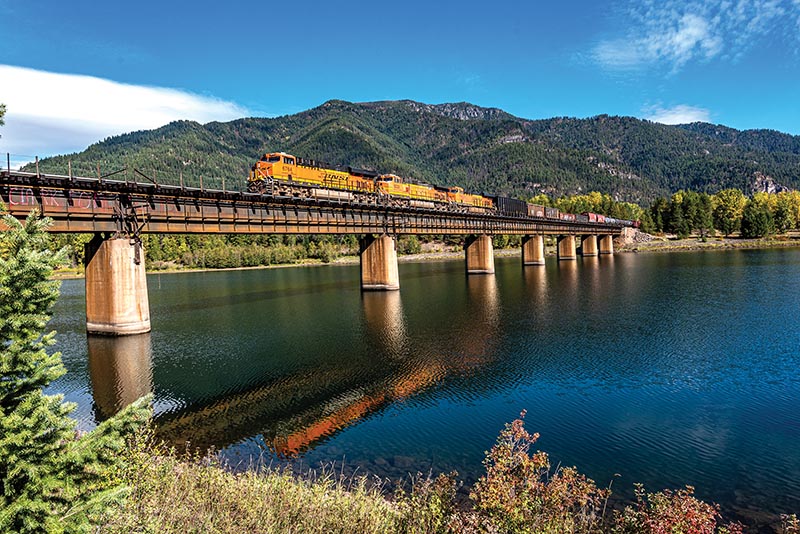
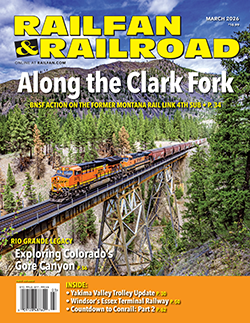
 This month, we bring you a story about a portion of the former Montana Rail Link by Ken Edmier. It seems this stretch of railway is always a “former” something. Today, it is BNSF Railway; in 2023 it was MRL; before 1987 it was Burlington Northern; and before 1970 it was Northern Pacific. This route, which stretches from Missoula, Mont., to Sandpoint, Idaho, has long been known by railfans as one of the most scenic parts of the U.S. rail network, but what few remember is that this was once part of the nation’s second transcontinental railroad.
The words “transcontinental railroad” tend to conjure up a single image of Union Pacific and Central Pacific steam engines sitting nose-to-nose, covered by track crews and corporate gadflies, posed for a ceremony marking the completion of the first coast-to-coast rail link on May 10, 1869. The location of this event was a siding in northern Utah called Promontory Summit, and the photos most people are familiar with were made by one of three photographers present, part of the visual culture of American memory.
Even as this line was nearing completion, however, there were several other, competing transcontinental railway projects, and Northern Pacific was arguably the most important. Founded in 1864 with a charter signed by President Abraham Lincoln, NP was meant to be the second transcontinental railroad, and the first to be finished under the control of a single company. Located farther to the north and exposed to harsher, longer winters, NP struggled to keep up the pace of construction. In 1871, one of the nation’s wealthiest men, Jay Cooke, took control and tried to push the line to completion. But within two years, the cost overruns drove Cooke to bankruptcy, setting off a nationwide depression that became known as the Panic of 1873. It was only after two reorganizations that the last NP rail was laid in September 1883. By this time, the once-hopeful second transcontinental was only the fourth, beaten by Atchison, Topeka & Santa Fe (in 1881) and Southern Pacific (in January 1883).
Still, the company’s president and chief executive, Henry Villard, pulled out all the stops for the finishing ceremonies. Where other celebrations had been rushed together with little pre-planning, NP’s completion was marked by special excursions from New York and Portland, Ore., with international guests that ranged from aristocratic investors from the British Empire and Prussia to former President Ulysses S. Grant, who took a turn at driving the last ceremonial spike. Depending on how you counted matters, NP was the largest corporation in the U.S., and one of the largest in the world.
“The bigger they are…” the old adage goes, and in the case of Northern Pacific, prominence proved difficult to sustain. Much of the railroad was built atop layers of debt, and within months of completion, Henry Villard — who had personally overextended himself to see the project finished — joined the ranks of bankrupt railroad financiers. NP proved again if the harsh territory and brutal winters didn’t defeat you, the crushing financial burden just might.
Yet while rival Great Northern followed a more direct and efficient route to the coast, Northern Pacific threaded its way through established population centers, cementing its role as a vital link between the Great Lakes and Puget Sound and carrying higher overall traffic volumes. Despite its challenges, the line endures. More than 143 years later, Northern Pacific’s route remains a critical artery in the continental rail network — proof that an undertaking fraught with risk and difficulty can still prove sound over the long run.
—Alexander Benjamin Craghead is a transportation historian, photographer, artist, and author.