

 by Adam Horgan/photos by the author
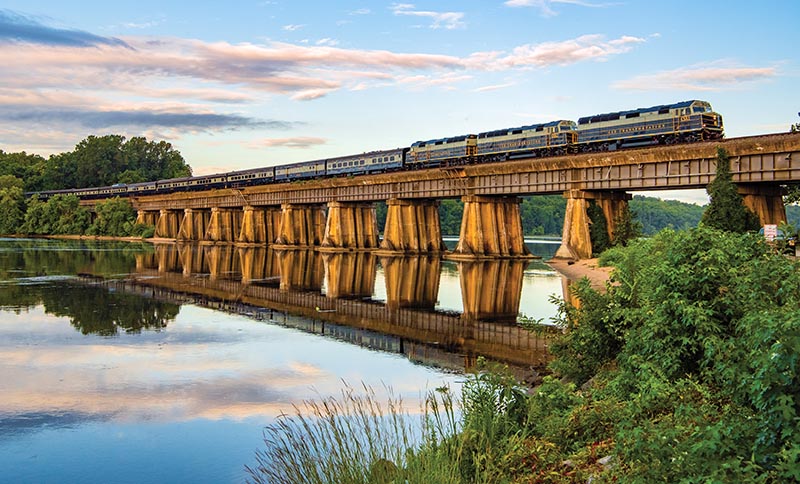
On a summer morning along the banks of Powell’s Creek, a distant horn echoes off the flat water. A northbound parade of trains is marching up CSX Transportation’s Richmond, Fredericksburg, and Potomac (RF&P) Subdivision. The scanner crackles alive with Amtrak P052, the northbound Auto Train to Lorton, Va., calling its last few signals before arriving at the end of its journey from Sanford, Fla. It flies across the bridge, and right on its heels is CSX I032 with priority intermodal traffic from Jacksonville, Fla. Both trains are some of the hottest on the railroad, and the BD dispatcher desk is working hard to keep traffic moving on time. Behind them, an Amtrak regional and another intermodal are on their way north from Richmond, Va. This is just business as usual on one of the most important stretches of main line railroad in America.
RF&P in 2025 is a critical rail corridor for both freight and passenger traffic. As the road’s original slogan says, this subdivision links north and south, connecting the northern portions of CSX’s system in the Northeast, Mid-Atlantic, and Midwest with the southern portions. For more than 190 years, this vital steel rail highway has carried commerce and passengers to and from the nation’s capital. From the Civil War through modern times, RF&P continues to play an important role in the story of America. With changes on the horizon to improve the line and expand capacity, the storied history of RF&P is about to begin a new and important chapter.
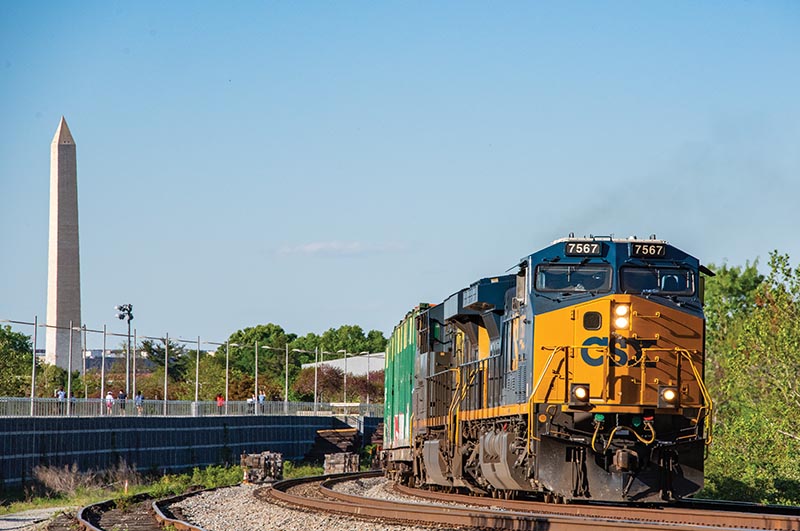
ABOVE: A southbound CSX freight enters Virginia with the Washington Monument in the background. The crew has just called the clear signal at “RO,” the northernmost point in Virginia on RF&P. Due to recent security measures, this spot is no longer accessible.
From Richmond to D.C.
In February 1834, the General Assembly of the Commonwealth of Virginia incorporated Richmond, Fredericksburg & Potomac Railroad. You have to wonder if the lawmakers at the time had any premonitions that Virginia’s sixth chartered railroad would become arguably its most important. Connecting Virginia’s capital city of Richmond to Washington, D.C., it would become a strategically important asset during the Civil War. This is also possibly where the other moniker for RF&P, “Rich Folks and Politicians,” began.
Due to the number of waterways along the route and the bridges required to cross them, the line was not fully connected by rail until 1872. Instead, travelers relied on steamboat connections to Washington for part of the journey. Despite the limitations, the line was burned many times by both armies during the Civil War because it traveled through and near several major battle sites and, like many railroads, later required significant investment.
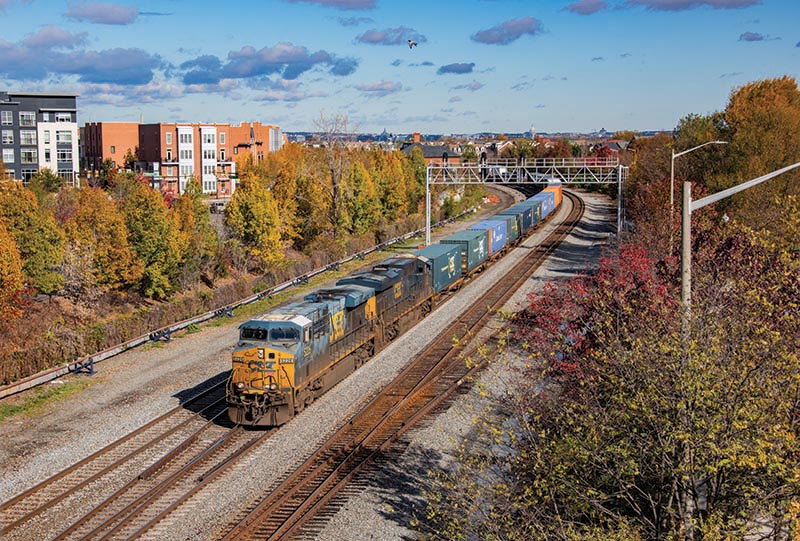
ABOVE: Train I034, a holiday service extra train, crosses under the signals at Slaters Lane in Alexandria on November 23, 2024. In the background is the dome of the U.S Capitol building.
After the war, the railroad grew to meet growing demand. RF&P was a distinctive bridge line connecting northern and southern railroads. The company retained a shared ownership structure, which allowed for the free flow of traffic up and down the I-95 corridor. The railroad served as a not-quite-short line, not-quite-terminal railroad, and not-quite-traditional main line either, moving freight from the massive interchange at Potomac Yard in Alexandria, Va., to Acca Yard in Richmond. The commonwealth of Virginia retained partial ownership of the railroad as well, and the fascinating history of RF&P’s ownership structure could be its own article and has been well-documented by several authors. Over the years, through the evolution of mergers and consolidations, RF&P was a notable missing link in the CSX system. In 1991, CSX officially purchased the line and by the end of the year fully assumed operations.
Today’s RF&P
Since that transition, RF&P has risen to be an increasingly busy and important piece of the CSX system. Running from M Street in Washington to Acca Yard in Richmond, the roughly 114 miles of the RF&P Subdivision are some of the busiest in the eastern U.S. They are also some of the most diverse in terms of traffic, locations, scenery, and options available to railfans.
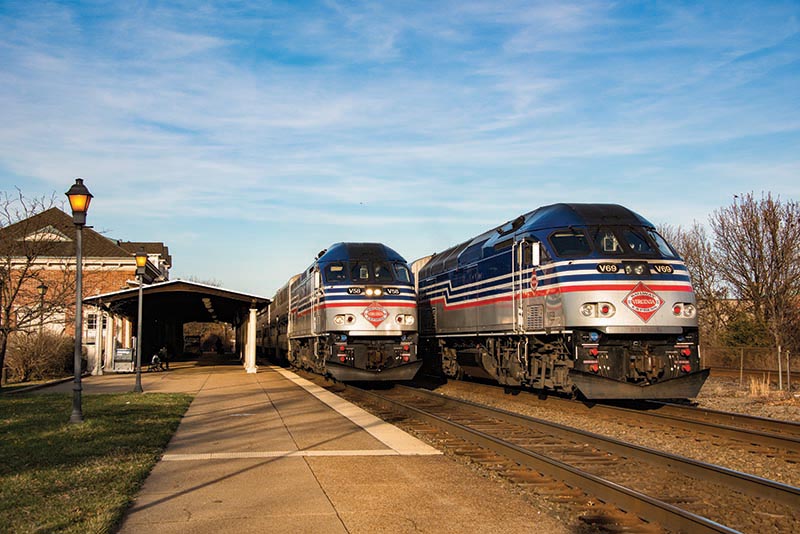
ABOVE: Two Virginia Railway Express commuter trains meet at the Alexandria station during rush hour in March 2022. Launched in 1992, the operation serves 16 stations on two lines serving Manassas and Fredericksburg.
The railroad now has more trains than it has track and capacity to handle them, with the south side by Richmond averaging 40 Amtrak and CSX trains in a 24-hour period. Between 15 and 20 of those trains are CSX freights and the remaining are Amtrak passenger trains. The northern end sees those 40, plus scheduled weekday Virginia Railway Express commuter train movements. Freight traffic is diverse, ranging from hotshot intermodals with containers on flatcars to manifests, coal trains, rock trains, and anything else the railroad needs moved, including military equipment for Uncle Sam. Often featured on priority trains are the iconic Tropicana orange juice cars that travel between Florida and New Jersey. While “the juice” used to be a separate hotshot unit train, it is now generally switched and carried as a block.
RF&P crews traditionally run through to Richmond from their departure terminals, and vice versa, with most freight trains getting new crews before departing Richmond’s Acca Yard. Traditional routing for trains running to northern cities through Baltimore and Philadelphia is to connect with the Capital Subdivision in Washington, D.C., and trains bound for West Virginia and beyond connect with the Metropolitan Subdivision just north of Washington. With the amount of traffic on the railroad, there are plenty of opportunities to see freight in daylight. This line is also home to Auto Train’s northern terminal at Lorton. Auto Train is a unique operation, taking both passengers and their vehicles to Sanford with a scheduled arrival window of early in the morning and a late afternoon departure once the train is loaded and built…
