

 by Rick Malo/photos by the author
Recently, Associate Editor Justin Franz asked me how I approach the difference between black & white photography and color photography — mainly, what determined on any given day how I looked at the world. Did I go out in the field strictly in a “black & white” state of mind? And if so, what determined that? Hmm… Good questions to ponder.
The answer to the first part is “yes.” I frequently go out looking at the subject world strictly with a b&w view. But I’m also flexible in that. While I mainly keep my pair of Nikon D750s set for “Monochrome” in the shooting menu, they will record the color image as well. I love the challenge of the unknown and reacting to situations as they change.
What determines this on any given day is a bit more in-depth.
I have long been captivated by the emotive qualities of b&w imagery and hold that it is far from dead as an effective medium. For this, one can blame the Steinheimers and the Shaughnessys and the Bensons of the world, to name just a few. Not only did they provide ample hours of enjoyment with their coverage of subject matter, but also a master class in creativity. They looked at the subject of trains in new and exciting ways that broke norms.
They dared to be different.
I like “different.” That speaks to me on a heart and soul level. I’m an emotive individual. Always have been.
I think of us in two ways. First, as photographers, we need to be technically proficient with our gear, understanding its capabilities while crafting it to fit our vision of the world, and pushing it to its limits. Take the Tamron SP 15–30mm ƒ/2.8, a beast of an art lens for sure, and my favorite in the bag that rarely is dismounted from its resident D750. One can stand beneath a grand old cottonwood tree on a fine spring morning, point the camera straight up into the tree and still get a train rolling across the horizon in the bottom portion of a portrait-oriented frame. It is an amazing piece of glass that has opened up a whole creative world to exploration.
And that brings me to the second point — we are creators more than anything, artists in our own right, and we seek to create images that are worthy of the time that someone has given to viewing them. We want the photographs to be exciting or thought-provoking. We want them to tell a bigger story, or maybe a smaller story. We want them to mean something to the viewer. And we want them to be different.
But most of all, we want them to mean something to us, and not in a selfish way.
Do we feel the image? Is it a reflection of our soul? Is it simple enough so that the language of the image is not garbled in translation? Are we opening our true soul to the world, or are we just taking a train photograph? Every soul has depth, every soul has shadows, and every soul has points of light. Does it show in the image?
Each soul has its own unique qualities, and so it goes to say that each individual photographer might have his own photographic tendencies, what speaks to his or her heart as they venture out in the field. As we mature as photographers, these things often change, which I think is a natural progression.
I have long felt that Texas, in general, and the High Plains in particular, have been underrepresented in the grand scheme of things. Lack of big scenery, I think, is to blame.
The Llano Estacado is a big place. The full, horizon-to-horizon scope of it can be intimidating to some, and it can be downright frightful, especially when one finds themselves underneath an angry spring thunderstorm as it pounds the land with golf ball-sized hail. Yet it is a place where a soul left alone can wander about, exploring the intimacies of loneliness and coming to terms with one’s own insignificance. Not only is it wide, but it is composed of great depth as well, very much like a soul.
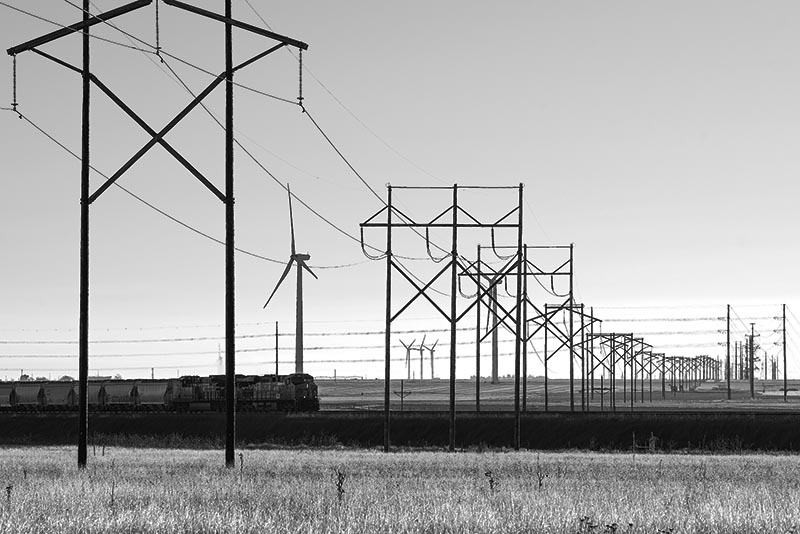
With the pole lines disappearing toward the distant horizon and the train seemingly dwarfed by its surroundings, “Power of the Llano” (above) illustrates that well. Another fine piece of glass, and my second go-to lens, the Nikkor 70–200mm ƒ/2.8 did a wonderful job in capturing it. The lens spends most of its time mounted on a second D750 body, but is switched out occasionally with the monster Nikkor 200–500mm.
I’ve long held that poetry is the voice of the soul written through the heart and arranged by the mind. If we transmute that into photography, the lens becomes a window to the soul. An open mind seeing things — lights, shadows, objects — a scene that triggers something in the heart; a composition of emotion. We feel the scene. It is up to us to capture it, to align the light just right so when we open and close the shutter in 1/60th or 1/400th of a second, our soul is bared through glass elements.
There are certain factors that dictate the image. The fact that the BNSF Transcon angles across the Texas Panhandle in a northeast-southwest direction means that winter light and summer light will be completely different. “Power of the Llano” and “Hotshotting out of Higgins” (page 48) only worked in early morning winter light, whereas “Tumbleweeds and Fast Trains” (page 49) needed late afternoon summer light to be effective.
The orange paint on BNSF locomotives is another factor. In good sunlight, its tone rendered in b&w tends to match that of other colors, mainly the blue of the sky, and so the object loses its definition and blends into the background instead of standing out against it. To counter that, shooting from the shadow side or in good cross-lighting is the way to go.
In our genre of rail photography, there seems to be a great willingness to share knowledge and techniques. Dick Steinheimer’s theory of “layering” has been especially helpful on the High Plains of Texas. With each excursion, whether it be along the Hereford Sub, the Plainview Sub, or along the Panhandle Sub in my own backyard, I find new things and new ways of capturing them.
Yet, some of the most impactful words have come from Jeff Brouws, himself an understudy of Steinheimer: “It is better to photograph the essence of something than it is to photograph the thing itself.”
That theory can be effective whether one is shooting in color or in b&w. On a recent trip to Hereford, Texas, it was put to good use on a dusty, hazy Friday afternoon. A south wind had been blowing briskly all day and had filled the air with fine dust lifted off the South Plains, creating a beautiful soft light that lasted until sundown. It was a color-only outing along the side streets and back alleys of town, looking for something different. The 70–200mm did not disappoint.
While the progress that drones and digital photography have made in color photography is undeniable, I still prefer to have my boots on the ground and have an eye open always for good light, shapes, and shadows that would impart themselves well to b&w. Perhaps I’m treading on ground where everyone has already walked, making up for lost time due to my late start. So, we come back around to Justin’s question — what determines a photographic mindset? I shall let the poet in me speak to that:
What am I
If not for a soul?
A mere shadow upon the ground
To plod sullen in hollow footsteps?
A fine line between the ridiculous
And the sublime?
To sample the sweetness of both
And be lost still?
Yet the heart knows true
And whispers such
When it whispers, I listen to it.
